

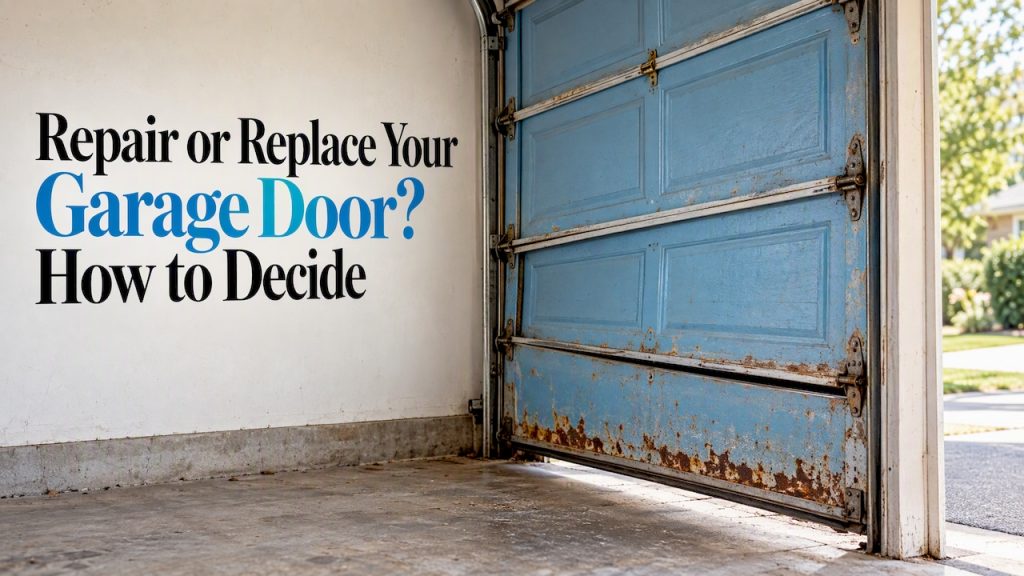
Repair the door if the problem is isolated, such as a broken spring, a worn roller, a bent track or a failing opener, and the door itself is in good shape. Replace it if the door is old, damaged across several panels, poorly insulated, or if repairs keep stacking up. Most doors land clearly on one side once you check four things: age, the kind of damage, what the repair costs against a new door, and safety.
This guide walks through each of those checks with real price ranges, so you can make the call before you phone anyone. If you live in Massachusetts or Connecticut and want a second opinion on your door, we can look at it in person.
TL;DR
- Repair when the damage is isolated (springs, cables, rollers, sensors, one dented section) and the door is roughly under 15 years old.
- Replace when the door is older and not working properly, several sections are damaged, insulation has broken down, or repair bills approach half the price of a new door.
- Common repairs run from about $100 to $350, while a new door typically starts around $969 to $1,573 per door before upgrades.
- Never adjust or remove springs and cables yourself. They hold enough tension to cause serious injury.
- A trained technician should inspect the whole system before you commit to either route.
Table of Contents
- When repair is the right call
- When replacement makes more sense
- Repair or replace: a quick comparison
- What it costs: repair vs. new door
- A worked decision framework
- Safety checks before you decide
- Our perspective: what we see on the job
- How we help you decide
- Special cases worth knowing
- What to ask before you approve any work
- FAQ
- Sources
When repair is the right call
Repair wins when something small has failed and the rest of the door is sound. Manufacturer guidance says minor cosmetic damage such as worn weatherstripping, faded hardware or scratched paint can often be repaired, and that some doors can be fixed by replacing a single section.
In practice, these problems are almost always repair jobs:
- Broken springs. Springs wear out by design, because they are rated for a limited number of open-and-close cycles. A new spring on a healthy door is routine work. See our broken spring repair service.
- Frayed or snapped cables. The door may hang crooked or refuse to lift. Replacing the cable fixes it. Our broken cable repair page covers what that involves.
- Worn rollers, hinges and tracks. Noisy, jerky travel is often just hardware. A bent track or an off-track door can usually be straightened or swapped.
- Opener trouble. Dead remotes, failed sensors, stripped gears and receiver faults rarely mean the door is finished. Our opener repair and installation page lists what we handle.
- One damaged panel. A car bump that dents one section can often be solved with a section replacement, provided a matching section is still available.
The pattern: a single failed part, a door that is otherwise straight, solid and still insulated. That is a repair.
When replacement makes more sense
Replacement is the better move when the problems are about the door itself rather than a part on it. Manufacturer guidance suggests considering a new door once it is over 15 years old and no longer operating properly, because repairs can cost more than a new door and parts may be hard to find. It also points to deteriorated insulation as a reason to replace.
Look for these signs:
- Several damaged panels. If dents, cracks or rot show up on multiple sections, matching and replacing them one by one adds up fast.
- Warping and sagging. A door that has bowed, or panels that are separating at the joints, will keep putting stress on new hardware.
- Rust and rot. Steel doors that are rusting through at the bottom, or wood doors that are soft at the edges, are not worth rebuilding. This matters in New England, where road salt and damp winters are hard on the bottom panel.
- Poor insulation. If the garage is attached to your house, or you use it as a workshop, a cold uninsulated door costs you comfort every winter.
- Repairs every few months. One repair is maintenance. A third in a year is a signal.
- Obsolete parts. Older models can be hard to match, which turns a small job into a guessing game.
- Storm or impact damage. After high-wind damage, industry guidance from the Door & Access Systems Manufacturers Association (DASMA) says a technician should assess whether the system can withstand another such event.
Repair or replace: a quick comparison
| Situation | Usually best | Why |
|---|---|---|
| Broken spring, door under 15 years old | Repair | Springs are a wear part, the door is fine |
| Snapped cable or off-track door | Repair | Hardware fix, quick to complete |
| Opener stops responding, door moves by hand | Repair or replace the opener only | The door is not the problem |
| One dented panel, replacement section available | Repair | Section swap is cheaper than a new door |
| Several dented, cracked or rotted panels | Replace | Piecemeal repair costs more over time |
| Door over 15 years old and failing repeatedly | Replace | Parts and labor keep adding up |
| Cold garage, no insulation, high heating bills | Replace | Insulated doors fix the cause |
| Opener has no working reversing system | Replace the opener | Safety issue (see below) |
What it costs: repair vs. new door
Prices vary by door size, material, hardware and region, so treat these as national ballparks, not quotes. One 2026 cost guide puts most common repairs between $100 and $350: a broken torsion spring is listed at $150 to $350, cable replacement at $100 to $200, an off-track door at $125 to $175, and opener repair at $75 to $300.
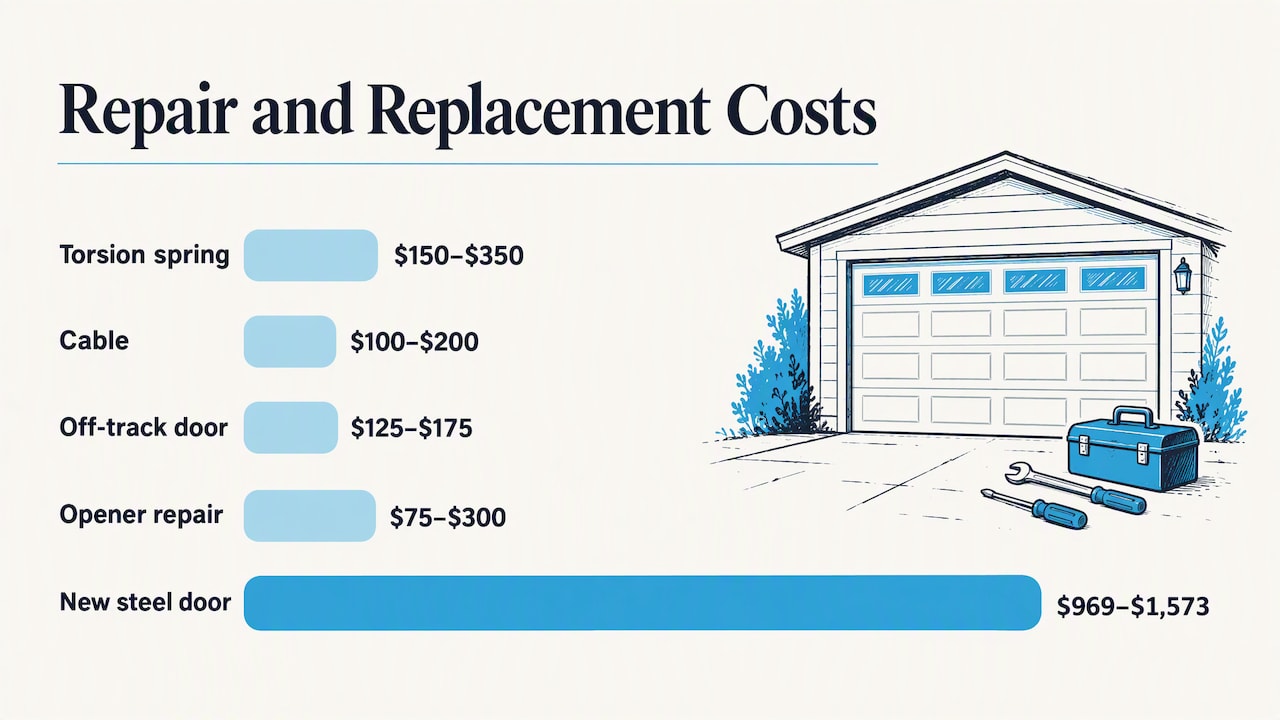
For a new door, one cost estimator gives a national average starting at $969 to $1,573 per door as of May 2026, for a basic steel door with labor. Insulated, wider, carriage-style or smart-opener packages cost more.
We do not publish set prices, because the real number depends on your door, the parts and the condition of everything around the failed piece. We give you a clear price before work starts.
The 50 percent rule of thumb
A simple way to sanity-check the decision: if the repair quote is more than about half the price of a comparable new door, and the door is already old, put that money toward replacement. If the door is young, even a larger repair can make sense, since you are protecting a door with years left.
Example: you have a 20-year-old door with a bent bottom panel and a failing spring. A spring on its own is a modest repair, but the panel damage, the age and a drafty garage tip it toward replacement. Now take a 7-year-old door with the same spring failure: repair it and move on.
A worked decision framework
Run through these questions in order. The first clear answer usually settles it.
- How old is the door? Under 10 years, lean repair. Over 15 and struggling, lean replace.
- Is the damage one part or the door body? One part: repair. Several panels, warping or rust-through: replace.
- Does the repair cost approach half of a new door? If yes and the door is older, replace.
- Does the garage need better insulation or security? If yes, replacement solves a problem repair never will.
- Is the opener safe? An opener that fails safety tests should be repaired or replaced regardless of the door’s condition.
- How long will you stay? Selling soon? A repair may be enough. Staying for years? A new door adds comfort and curb appeal.
Safety checks before you decide
Safety belongs in this decision, because a few failures are not worth patching.
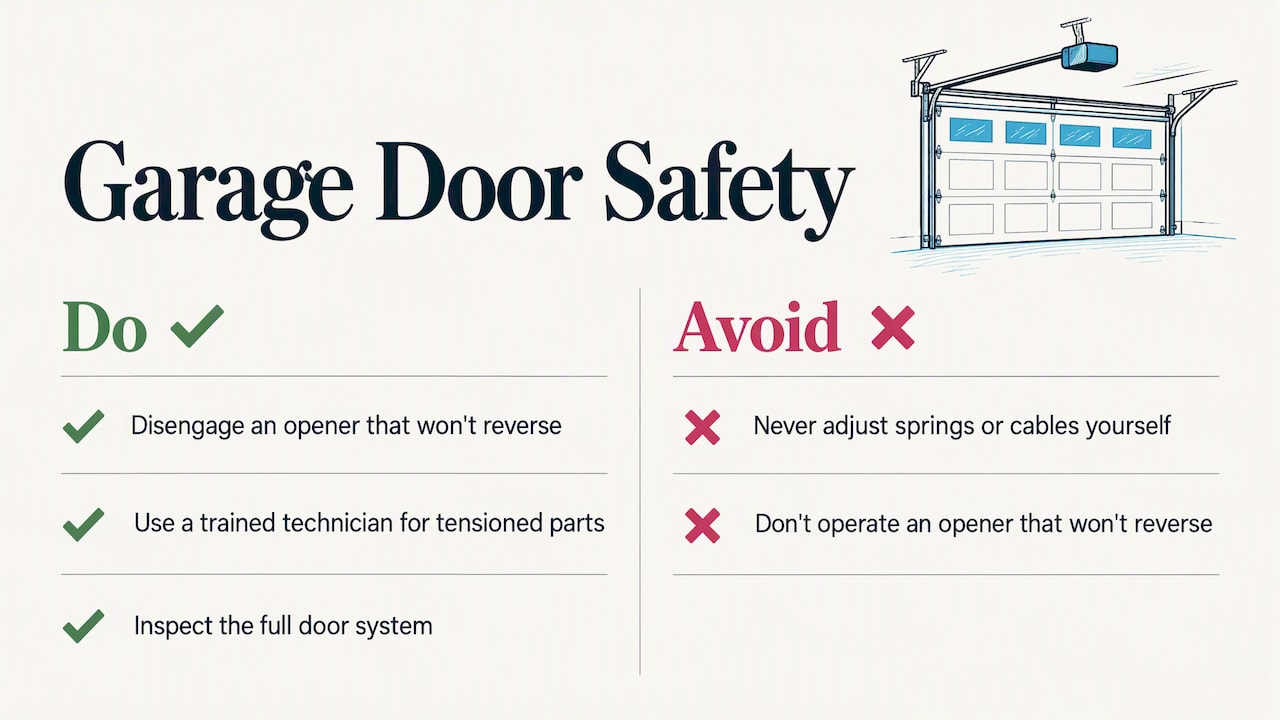
Opener reversing systems. Under federal rules, openers made or imported for sale after January 1, 1991 must have a reversing system, and an external entrapment protection requirement was added in 1993. The U.S. Consumer Product Safety Commission advises that if your opener does not reverse, you should disengage it until it is adjusted, repaired or replaced. If your opener predates those rules, replacing it is the right call.
Springs and cables. DASMA documentation says homeowners should never adjust, repair or remove springs, cables or other high-tension parts themselves, because doing so can cause serious injury or death. That work needs a trained technician with the right tools. So if your question is whether you can repair your own garage door, the answer is yes for things like cleaning tracks, tightening visible hardware and replacing weatherstripping, and no for anything under tension.
The system works together. DASMA notes that the door, operator and entrapment protection all have to function together, so a fault in one area compromises the safety of the whole system. That is why a proper inspection looks at everything, not only the part that failed. The same industry guidance says a trained technician should judge repair versus replacement after checking sections, hinges, rollers, alignment, framing and signs of fatigue.
Our perspective: what we see on the job
We are a family-owned company serving homeowners and businesses in Massachusetts and Connecticut, and the honest truth is that most calls we get are repair calls. A snapped spring, a cable that jumped the drum, a remote that quit: these are the everyday failures, and fixing them is the right answer far more often than selling a new door.
Where we do recommend replacement, it is for reasons you can see for yourself: panels that no longer line up, rust at the bottom edge, a door that has been repaired again and again, or a garage that is cold in January. We would rather show you the problem and explain the options than push you toward the bigger invoice.
Two habits save our customers money. First, maintenance: regular tune-ups catch worn rollers, loose hardware and balance problems before they strain the springs and opener. Our door maintenance service exists for that. Second, deciding with the whole door in front of you. A single quote for a single part can hide the fact that the rest of the door is near the end of its life.
If a spring breaks, stop using the door and call. Trying to open a door with a broken spring by hand, or forcing the opener, is how motors burn out and people get hurt.
— the author
How we help you decide
When you call us, we inspect the door, hardware, tracks, balance and opener, then tell you whether a repair will hold up or whether a new door is the smarter spend. We cover residential and commercial properties, with same-day service and 24/7 emergency repairs when a door fails at the worst time.
- Need a fix? Start with our garage door repair services.
- Ready for a new door? See new door installation.
- Door stuck at night? Our 24/7 garage door repair line is for exactly that.
Not sure which side of the line you are on? Book an inspection and we will give you a straight answer and a clear price. Visit Speedy Garage Door Services to get started.
Special cases worth knowing
Commercial doors. Businesses have different pressures: heavy daily cycling, delivery schedules and downtime costs. For these properties, scheduled maintenance often beats waiting for a failure, and replacement timing is driven by cycle count and how long a shutdown you can tolerate. Our commercial service covers installation and scheduled maintenance.
Springs that keep breaking. If you have an older door with extension springs, a spring system conversion may be worth discussing. It is part of what we do under spring repair.
Opener-only upgrades. If the door is solid but the opener is loud, slow or lacks safety sensors, you can replace just the opener and keep the door. Keypads, remotes, sensors and receivers can also be serviced separately.
Selling your home. A garage door is among the most visible parts of the front of a house. A tired door can undercut curb appeal, but a clean, working door in good order is usually all a buyer expects.
What to ask before you approve any work
- What exactly failed, and can you show me?
- Is this a one-time repair, or a sign other parts are about to follow?
- What is the total price including parts and labor, in writing?
- How old is the opener and does it have working safety reversal and sensors?
- If I replaced the door instead, what would that cost and what would improve?
A good technician answers these without pressure. If you get a vague answer or a quote that changes on arrival, get a second opinion.
FAQ
How do I know if my garage door is too old to repair?
Age alone is not a verdict, but doors over about 15 years old that are no longer operating properly are strong candidates for replacement, since repairs can approach the cost of a new door and parts can be hard to source. If the door is still straight, solid and insulated, a repair can still be worthwhile.
How much does it cost to repair a garage door that is off track?
One 2026 cost guide lists an off-track door at roughly $125 to $175, though bent tracks, damaged rollers or cables can raise the cost. Do not force the door back into place yourself, since the cables and springs may be under tension.
What is the most common garage door problem?
Broken springs are generally the most common repair, because they are a wear part with a limited cycle life. Cables, rollers, tracks and opener faults follow. All of these are normally repairable on a door that is otherwise in good shape.
Can I replace just one panel?
Often yes, if a matching section is still available. It works best on a newer door with one damaged section. On an older door, color or style matches may be hard to find, which can make a full replacement the cleaner choice.
Should I replace my opener along with the door?
Not always. If the opener is relatively new, works smoothly and has working safety reversal and sensors, it can often stay. If it is old, noisy or fails the reversal test, replacing it with the door is sensible, and it should be replaced regardless if it lacks a reversing system.
Sources
- Repair vs Replace, Amarr
- Trained Door Systems Technician: Checking a Garage Door, DASMA
- Residential One-Piece Garage Door and Electric Operator, DASMA
- Non-Reversing Automatic Garage Door Openers Are a Hazard, U.S. CPSC
- Garage Door Repair Cost 2026
- Cost to Install a Garage Door, Homewyse