

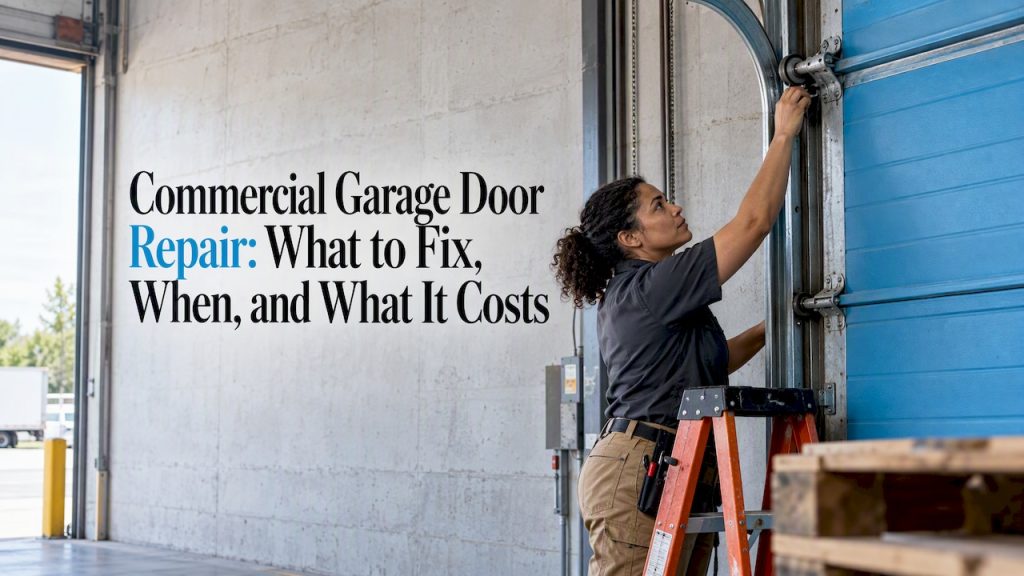
When a commercial overhead door fails, the building stops working: trucks can’t load, the shop can’t lock up, and staff are left guessing whether the door is safe to stand near. The fix is usually a handful of parts (springs, cables, rollers, tracks, an opener or a sensor), but the right move depends on what broke and whether the door is safe to operate. This guide covers the common failures, the signs that come before them, when to call for emergency service, what repairs typically cost, and the maintenance that keeps a door out of the repair queue. We repair and maintain commercial doors for businesses in Massachusetts and Connecticut, so we wrote it the way we would explain it to a facility manager on the phone.
TL;DR
- Most commercial door failures come from a short list: broken torsion springs, frayed cables, worn rollers, bent tracks, failing openers and misaligned safety sensors.
- A door that is off its track, stuck open, moving unevenly or has a broken spring should be taken out of service until a trained technician looks at it.
- National indicative repair ranges run from about $150 for cable and roller work to $1,200 for opener motor work, and the final price depends on access, timing and materials.
- Monthly sensor testing and scheduled maintenance catch most problems before they turn into emergency calls.
- Do not try spring or cable repairs in-house: the parts are under heavy tension and the injury risk is real.
Table of Contents
- What counts as a commercial overhead door
- The most common commercial door problems
- Warning signs worth acting on early
- When it’s an emergency, and what to do while you wait
- Why commercial door repair is not a DIY job
- What commercial garage door repair costs
- Maintenance that prevents breakdowns
- Our perspective: treat doors like equipment, not like walls
- Commercial door service from Speedy Garage Door Services
- How to pick a commercial door service provider
- FAQ
- Sources
What counts as a commercial overhead door
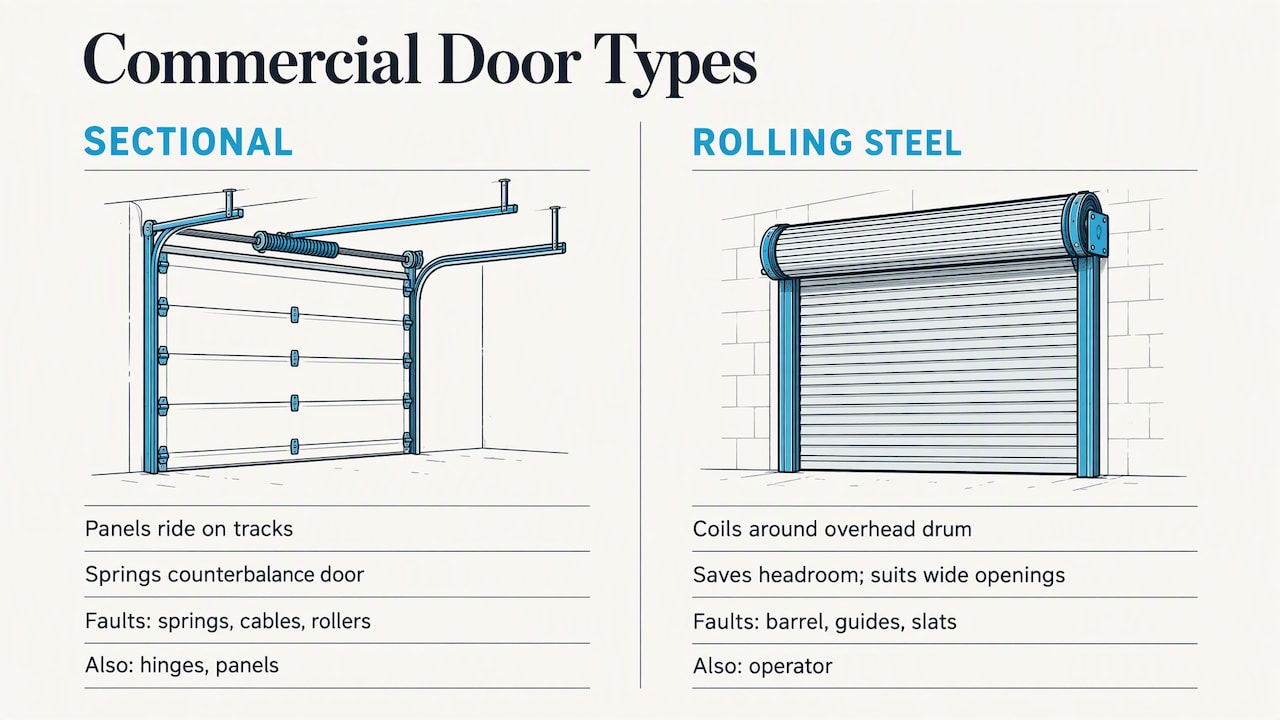
People use “commercial garage door” and “commercial overhead door” interchangeably, and both describe the same family of equipment: large, heavy-duty doors built for loading docks, warehouses, service bays, fire stations, retail back-of-house and industrial openings. The most common type is the sectional overhead door, where hinged panels ride on rollers in vertical and horizontal tracks and are counterbalanced by springs. Rolling steel doors work differently. They coil around a drum above the opening, which saves headroom and suits wide openings and security-focused uses.
Why it matters for repair: the failure points differ. A sectional door usually fails at the springs, cables, rollers, hinges or panels. A rolling door tends to have problems with the barrel, guides, slats and operator. Opener type matters too. Commercial operators come in trolley, jackshaft and hoist styles, and each has its own wear parts. When you call a technician, tell them which type of door you have, its approximate size, and whether it sees a few cycles a day or dozens. Cycle count is the single biggest predictor of how soon springs and rollers wear out.
The most common commercial door problems
A door that gets opened and closed many times a day wears faster than a residential door, and the failures follow a pattern. These are the ones we see most often at businesses.
Broken or weak springs
Torsion springs carry the weight of the door. When one breaks, the door becomes extremely heavy, and an opener or a person trying to lift it can be damaged or hurt. You may hear a loud bang from the door, see a visible gap in the spring coil, or notice the door slamming down or refusing to rise. Springs have a rated cycle life, so a high-traffic door can need new springs far more often than a rarely used one. Our broken spring repair work covers replacement, adjustment and system conversion.
Frayed or snapped cables
Lift cables run from the bottom brackets up to the drums. Fraying, rust or broken strands mean the cable is close to failing. A snapped cable lets one side of the door drop, which often bends the tracks or jams the door crooked in its opening.
Worn rollers and hinges
Rollers wear out quietly. Early signs are grinding, rattling or a jerky ride. Worn rollers put extra stress on hinges and tracks, so a cheap part left too long becomes a more expensive repair. See our garage door roller repair page for what replacement involves.
Bent, loose or misaligned tracks
Forklifts, delivery trucks and carts hit doors. Even a small impact can knock a track out of alignment. Signs include a door that rubs on one side, binds partway up, or leaves a gap at the bottom. Dented panels and damaged sections often come from the same impact.
Opener and control failures
A door that hums but doesn’t move, moves only in one direction, or ignores the wall station could have a worn gear, a failed receiver, a dead remote or keypad, or a limit setting that drifted. Commercial operators work hard, and gears and drive parts wear. Our opener repair and installation page lists what we service, including keypads, remotes, receivers, gears and sensors.
Sensor and safety-edge faults
If a door reverses for no reason or won’t close, a dirty, knocked or misaligned photo-eye is a common cause. Do not bypass a sensor to get the door closed. It’s the device that stops a door from coming down on a person or a vehicle.
Warning signs worth acting on early
Most doors announce a problem before they fail. Train your opening and closing staff to report any of these the same day:
- New noise: grinding, squealing, popping or scraping that wasn’t there last week.
- Uneven movement: one side rising faster, a crooked door, or shaking at the track.
- Slow or strained operation: the opener labors, or the door stops and reverses partway.
- Visible wear: frayed cable strands, a gap in a spring, rust, flattened rollers, loose brackets or cracked hinges.
- Gaps and drafts: light at the bottom or the sides, damaged weatherseal, or a door that doesn’t seat fully on the floor.
- Balance problems: with the opener disconnected by a technician, a properly balanced door stays roughly where you leave it. One that drops or flies up is out of balance.
A short log helps. If staff write the date and the symptom on a card by the door, the technician arrives with a history rather than a guess, and you can see which door is costing you the most.
When it’s an emergency, and what to do while you wait
Some problems can wait for a scheduled visit. These cannot:
- The door is stuck open and the building can’t be secured overnight.
- The door is stuck closed and blocks a loading dock, an exit or emergency vehicle access.
- The door is off its track, hanging crooked, or has a snapped cable or broken spring.
- A vehicle struck it and panels are bent, or it is moving unpredictably.
While you wait for the technician:
- Stop using the door. Cone it off or post a sign at both sides so nobody walks under it or tries the wall button.
- Don’t try to lift or force it. A door with a broken spring can be many hundreds of pounds of dead weight.
- Keep people and vehicles clear of the door’s path, especially a partly open door that could close.
- Secure the opening with temporary measures your site allows, such as a guard at the opening or blocking vehicle access, if the building holds valuables or stock.
- Note what happened: the time, what the door did, any impact, and any noises. Take photos for the technician and for insurance if a vehicle was involved.
- Call your service provider. We offer same-day service and 24/7 emergency repairs, and our 24/7 emergency repair page explains how to reach us.
Federal safety rules reflect the same logic. OSHA’s cargo door rule for marine terminals, for example, requires that partially opened doors be secured against accidental closing and that people be protected from entry during repair work. That rule is written for marine terminals, but the principle applies at any dock: nobody under a door that isn’t secured.
Why commercial door repair is not a DIY job
It’s tempting to have a handy maintenance employee tackle a door problem. For simple things such as cleaning a photo-eye lens, wiping tracks or replacing a remote battery, that’s fine. For springs, cables, drums and operators, it isn’t.
OSHA has no standard written specifically for overhead doors, but its 2002 interpretation says general industry or construction standards can apply depending on the work, and state plans may be stricter. In plain terms, you still carry responsibility for how your employees do this work. One of the standards that commonly comes into play is the control of hazardous energy rule, which covers servicing and maintenance on machines where unexpected startup or release of stored energy could injure someone. A door spring stores a great deal of energy, and a powered operator can start unexpectedly.
The same OSHA cargo door page records an incident in which an employee’s hand was caught between a sprocket and a chain when a door broke free during motor-assembly repair. It’s a marine terminal example, but a door operator and chain hoist at your warehouse have the same pinch points.
There’s a practical cost argument as well. A mistake on a spring or cable can damage the door, the operator and the building, which turns a few hundred dollars into a replacement. A trained technician has the winding bars, the correct springs matched to your door’s weight and cycle rating, and the experience to balance the door afterward.
What commercial garage door repair costs
We don’t publish fixed prices because each commercial door is different: size, weight, type, access and the condition of the surrounding parts all change the job. We quote after we know what’s wrong. For a sense of scale, one national maintenance guide gives indicative ranges like these:
| Repair | Indicative national range |
|---|---|
| Torsion spring replacement | $250 to $600 |
| Cable and roller replacement | $150 to $400 |
| Opener motor repair or replacement | $400 to $1,200 |
| Track realignment or section replacement | $200 to $700 |
| Dock bumper and seal replacement | $150 to $500 |
Treat these as ballpark figures, not a quote for a Massachusetts or Connecticut building. The same guide notes that local labor rates, access, after-hours timing, materials, and whether the call is a one-off or part of a multi-site program all move the price.
What moves the price on your door
- Door size and weight. Larger, heavier doors need heavier springs and more labor.
- Time of the call. Nights, weekends and holidays usually cost more than a scheduled visit.
- Access. A door over a dock, behind racking, or at height may need lifts or extra hands.
- Collateral damage. A cable that snapped and bent a track makes it a two-part repair.
- Parts quality and cycle rating. Higher-cycle springs cost more and last longer on busy doors.
- Repair or replace. When a door has multiple failing systems, a new door may cost less over its life than repeated repairs.
Repair or replace
A useful rule: if a repair brings the door back to reliable service for a reasonable share of what a new door would cost, repair it. Consider replacement when panels are badly damaged or rusted through, parts are no longer available, the door keeps failing in different places, or the building’s needs have changed and you need better insulation, security or speed. We also handle commercial garage door installation, and we’ll tell you honestly if a repair isn’t worth the money.
Maintenance that prevents breakdowns
The cheapest commercial door repair is the one you never need. A simple routine covers most of it.
Monthly, by your staff:
- Test the photoelectric sensors. DASMA’s technical data sheet says commercial sensors should be tested monthly by blocking the beam as the door closes, and the door should reverse or refuse to close.
- Look and listen: watch a full open-and-close cycle for noise, shaking or uneven travel.
- Check that the area around the door is clear of stock, pallets and debris.
- Wipe photo-eye lenses and keep tracks free of dirt.
On a schedule, by a technician:
- Lubricate rollers, hinges, bearings and springs with the right products.
- Inspect cables, drums, brackets and fasteners and tighten what has loosened.
- Check spring tension and door balance.
- Test the operator, limit settings, safety edges and manual release.
- Look at weatherseals and bottom seals.
How often a technician should visit depends on traffic. A door cycling dozens of times a day deserves more frequent attention than a rarely used storage door. Our scheduled maintenance for commercial doors and our door maintenance page outline the options. A good maintenance visit gives you a written list of what’s wearing, so repairs become planned expenses instead of surprises on a loading day.
Our perspective: treat doors like equipment, not like walls
We’re a family-owned company, and the pattern we see in commercial jobs is consistent. Doors get ignored until they fail, and then they fail at the worst possible time: a delivery at the dock, an inspection, a snowstorm. The door was telling someone for weeks. Nobody was listening, or nobody knew who to tell.
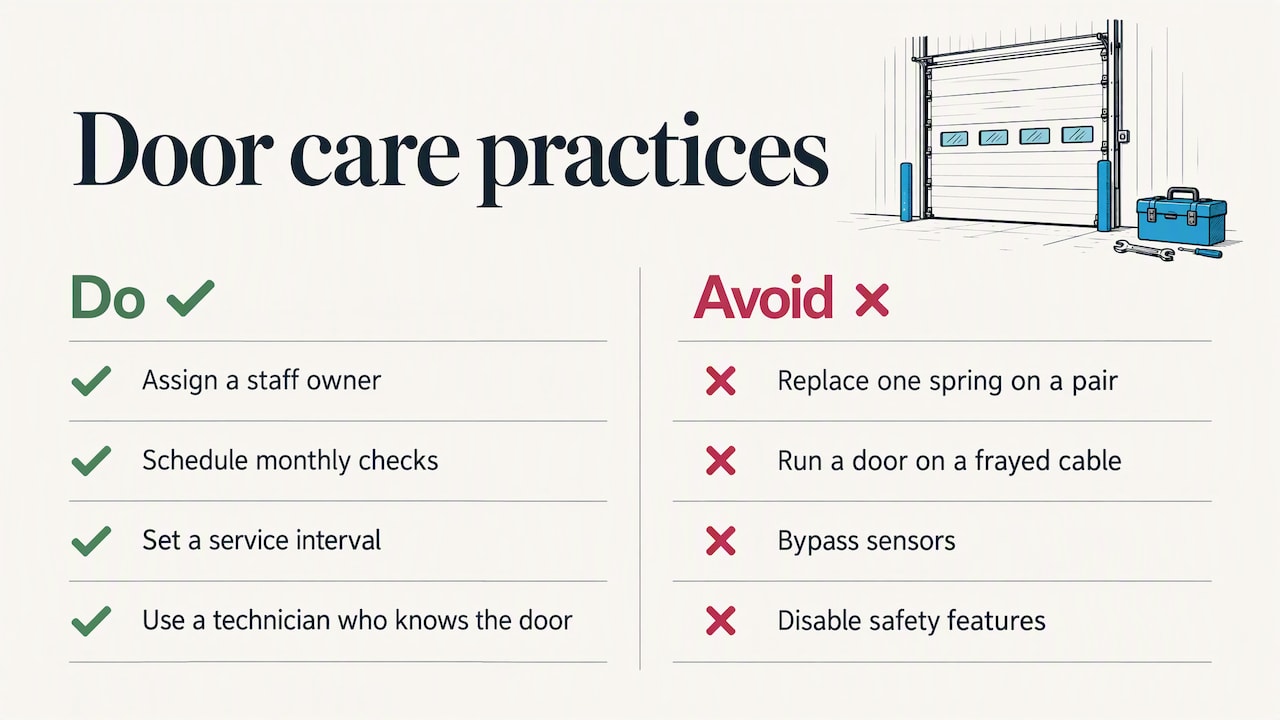
Our advice to business owners is to treat each overhead door like a piece of production equipment. Give it an owner on your staff, a monthly check, a service interval, and a technician who knows it by name. That’s what gets you a short, planned repair rather than a long, urgent one.
We also push back on two habits. The first is patching: replacing one spring on a pair, or running a door on a frayed cable “just until Friday.” Parts of a door age together, and mismatched parts shift stress onto the rest. The second is bypassing sensors or disabling safety features to keep a door moving. We won’t do that, and we’d rather explain why than leave it unsafe. Clear communication matters as much as the repair: you should know what’s broken, what we recommend, what can wait and what can’t, before any work begins.
— the author
Commercial door service from Speedy Garage Door Services
We repair, maintain and install doors for businesses in Massachusetts and Connecticut, from our base in Chicopee. That includes springs, cables, rollers, tracks, section and panel replacement, openers, sensors and receivers, plus scheduled maintenance and 24/7 emergency service.
If a door at your property is down, call us and tell us what you see and hear. If you’d like to prevent the next failure, ask about a maintenance plan. Start on our commercial door services page, or see our full list of services. Prefer to be local? We also serve nearby towns such as Springfield and Agawam.
How to pick a commercial door service provider
Whatever company you hire, judge it on the same few points:
- Response. Do they offer same-day service and a real after-hours line? A door that can’t close doesn’t wait for business hours.
- Experience with your door type. Sectional, rolling and high-use operators all differ.
- Clear estimates. You should get an explanation of the problem and the options before work starts.
- Safety practices. Ask how they secure a door during repair and how they test sensors and balance afterward.
- Maintenance offering. A provider who can keep your doors on a schedule saves you emergency calls.
- Local presence. A technician within driving distance gets to you faster and knows regional conditions, such as New England winters that stress springs and seals.
Get the repair scope in writing, including parts to be replaced and whether the work includes a safety check at the end.
FAQ
How much does commercial garage door repair cost?
It depends on the door, the part and the timing. National indicative ranges run from about $150 to $400 for cable and roller work up to $400 to $1,200 for opener motor work, and spring replacement sits in between. After-hours calls and hard-to-reach doors cost more. We quote each job after seeing what’s wrong.
Can my maintenance staff fix a broken spring or cable?
We advise against it. Springs and cables hold stored energy that can cause serious injury, and OSHA expects employers to protect workers during servicing even though no standard is written for overhead doors alone. Staff can clean sensors, wipe tracks and report problems. Leave tension work to a trained technician.
What should I do if my commercial door is stuck open?
Keep people clear, don’t force it, and secure the opening with a guard or temporary barrier if you must leave the building. Then call for emergency service. We handle 24/7 emergency repairs in Massachusetts and Connecticut.
How often should a commercial overhead door be serviced?
It depends on how many times a day it cycles. High-traffic doors benefit from more frequent technician visits, while lightly used doors can go longer. Between visits, test the photo-eye sensors monthly and report any new noise or uneven movement the same day.
Is a commercial overhead door the same as a rolling steel door?
Not exactly. A sectional overhead door raises hinged panels along tracks to the ceiling, while a rolling steel door coils around a drum above the opening. Both are commercial doors, but their parts and repairs differ, so tell your technician which one you have.
Sources
- OSHA 29 CFR 1917.114, Cargo doors
- OSHA interpretation on overhead door standards, September 10, 2002
- OSHA 29 CFR 1910.147, The control of hazardous energy
- DASMA TDS 382, Photoelectric non-contact sensors on commercial doors
- Facilities Maintenance, Commercial garage, overhead and dock door repair