

If your garage door opener has stopped working, the fix is usually a repair, not a new unit. The cause is most often a remote, a sensor, a gear, a receiver or a worn spring or cable that makes the opener work too hard. A technician can find which one in a single visit. On average, opener repairs cost around $174, while a replacement averages about $329. We repair and install openers across Massachusetts and Connecticut, and this guide shows what to look at, what to leave to a professional, and how to decide.
TL;DR
- Most opener failures trace back to a small part: remote, keypad, safety sensor, receiver, gear, or a door that is out of balance.
- Nationally, repairs average about $174 and replacement about $329. A common rule is to replace when the repair estimate passes 50% of a new unit’s cost.
- Never adjust springs, cables, pulleys or brackets yourself. They are under extreme tension and need a trained technician.
- Pull the manual release to get a stuck door open during a power outage or a failure, then call for service.
- We offer same-day service and 24/7 emergency repairs in Massachusetts and Connecticut.
Table of Contents
- Why a garage door opener stops working
- Safe checks before you call
- The door matters as much as the opener
- Extension springs: signs and replacement
- What opener repair costs
- Repair or replace the opener?
- What happens during an opener repair visit
- What we repair and install
- After a power outage or in a winter emergency
- Keeping the opener running longer
- Our perspective
- Need opener repair in Massachusetts or Connecticut?
- FAQ
- Sources
Why a garage door opener stops working
An opener is a motor, a drive (chain, belt or screw), a set of gears, a receiver, a control board and two safety sensors. When one piece fails, the whole system seems dead. The symptom usually points to the cause.
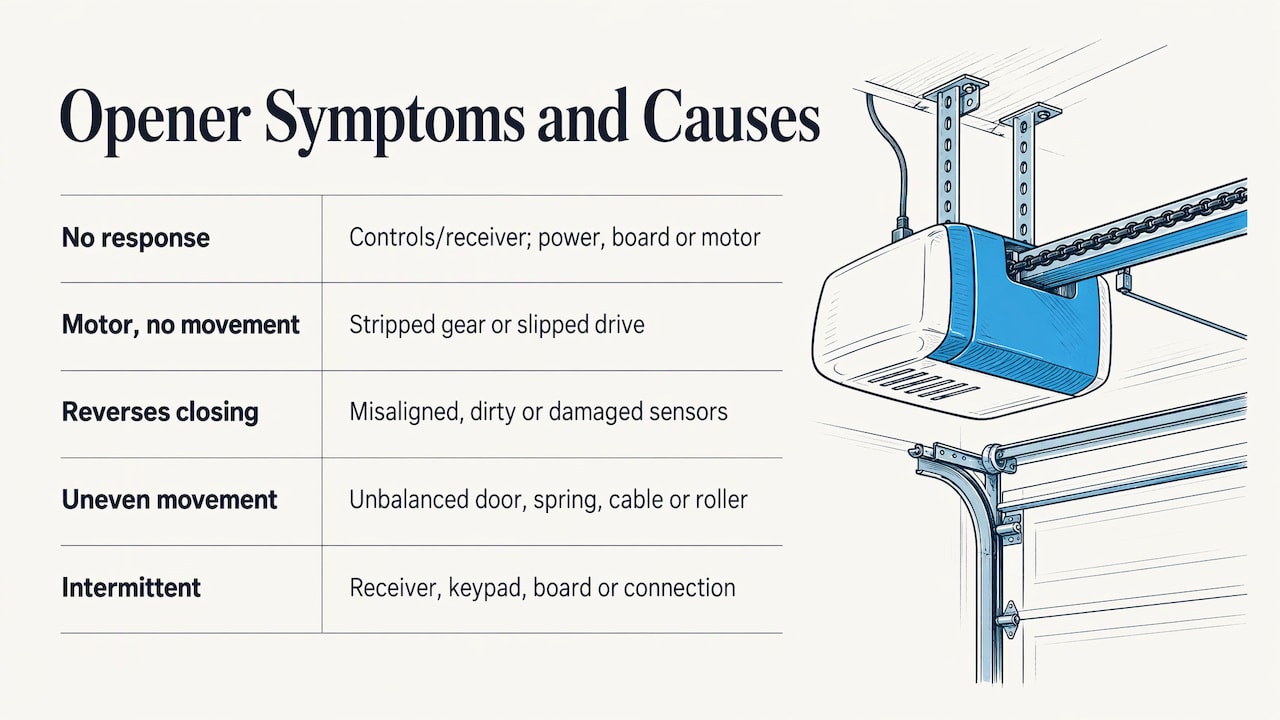
Nothing happens when you press the remote or wall button. The problem may be the remote, the keypad, the wall control or the receiver in the motor head. If the wall button works and the remote does not, the receiver or the remote itself is the likely culprit. If neither works, the power supply, the logic board or the motor is more likely.
You hear the motor run but the door does not move. That often means a stripped gear or a drive that has slipped or disengaged from the trolley. Gear replacement is a common repair and does not mean a new opener is needed.
The door starts to close, then reverses. The safety sensors, called photo eyes, are the usual cause. They sit near the floor on each side of the door. If they are misaligned, dirty, or damaged, the opener assumes something is in the way and reverses. Sensor replacement is a routine part of our opener work.
The door moves unevenly, jerks or sounds strained. The opener may not be the problem. A door that is out of balance, or has a worn spring, cable or roller, forces the opener to work harder. We come back to this below, because it changes what you should fix.
The opener works only sometimes. Intermittent failure points to a weak receiver, worn keypad, failing logic board or a connection problem. It is worth having someone look before it fails fully, usually on the coldest morning of the year.
Safe checks before you call
A few checks cost nothing and need no tools. Stay on the safe side of the line, though: some parts of a garage door should only ever be touched by a trained professional.
- Confirm power. Check that the opener is plugged in and the outlet works, and look at whether the breaker has tripped.
- Look at the photo eyes. Check that nothing blocks them and that each one shows an indicator light. Sensors that sit no higher than 6 inches from the floor are part of the standard monthly safety routine from the Door & Access Systems Manufacturers Association (DASMA).
- Try the wall button, then the remote. The result tells you whether the fault sits in the remote side or the opener itself.
- Pull the manual release. Residential openers made after January 1, 1991 must have a manual way to detach the operator from the door. Use it only when the door is fully closed or you are sure it is balanced and stable, then lift gently. If the door feels very heavy, drops, or will not stay up, stop. Do not force it.
- Look, but do not touch, the springs and cables. Chamberlain’s guidance is to call a trained door system technician if your door binds, sticks or is out of balance, and to never try to loosen, move or adjust springs, cables, pulleys or brackets, all of which are under extreme tension.
If these checks do not solve it, you have still narrowed the problem, and that helps a technician work faster.
The door matters as much as the opener
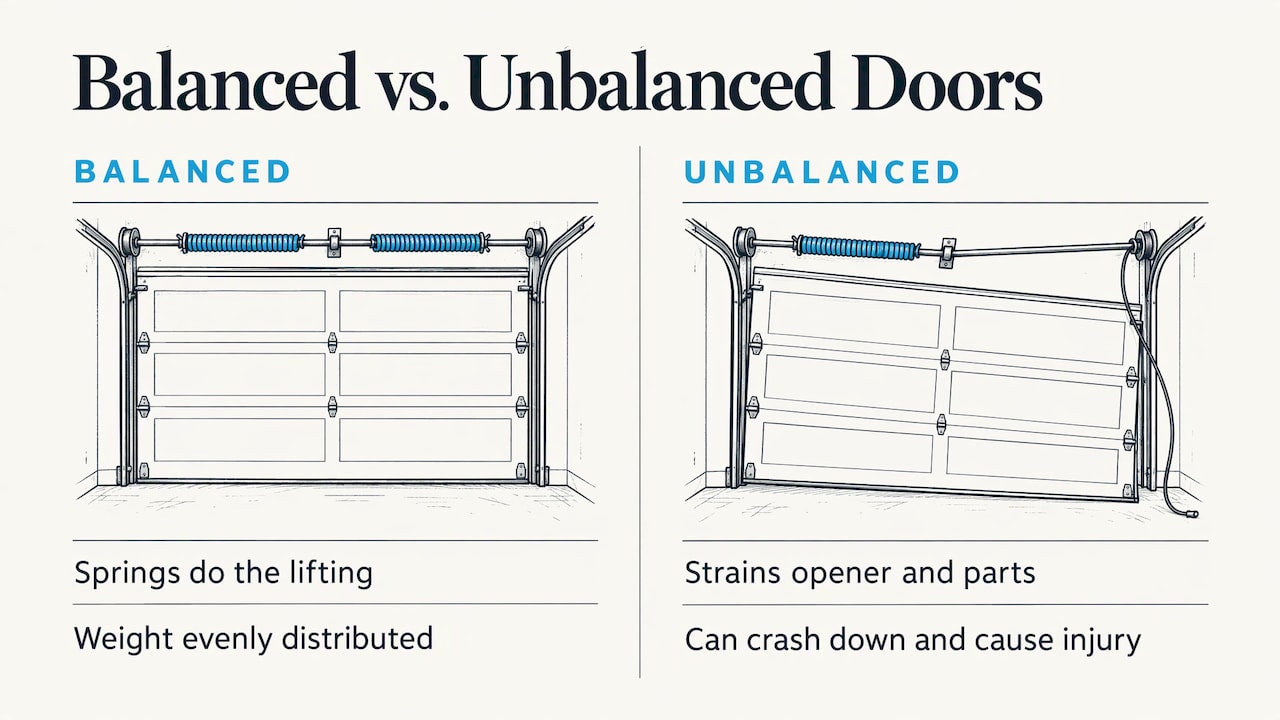
Many calls that start as “my opener is broken” end with a spring or cable. The opener is built to guide a door that is already balanced, not to lift its full weight. Genie explains that when a door is balanced, the springs do the lifting and the weight is evenly distributed. An unbalanced door strains the door, the opener and their parts, and can cause many components to break or fail.
That is why a good opener repair visit includes the whole system: springs, cables, rollers, tracks and the opener together. Replacing a motor on an unbalanced door only sets up the next failure. Genie also notes that an unbalanced door is not safe and could crash down and cause injury, and it recommends checking balance monthly.
If your door is heavy to lift by hand with the opener disconnected, or one side hangs lower than the other, treat it as a spring or cable problem and call. Our broken spring repair and cable work cover exactly this.
Extension springs: signs and replacement
Many readers searching for opener repair also ask about extension springs. These are the long springs that run along both sides of the horizontal tracks, stretching and contracting as the door moves. Torsion springs sit on a bar above the door and twist. Which type you have depends on the door, and a technician identifies it right away.
Signs that an extension spring has failed or is wearing out:
- The door will not lift, or lifts only with great effort, with the opener straining or humming.
- A loud bang came from the garage, and one spring now hangs loose or has separated.
- The door rises crooked, with one side higher than the other.
- A visible gap or stretched coil in a spring that used to look tight.
- The door slams down faster than it used to.
What replacement involves: a technician removes the failed spring, matches the replacement to your door’s weight and size, checks the safety cables that run through the springs, and tests balance afterward. Matching matters. A spring that is wrong for the door’s weight leaves it unbalanced and leaves the opener working too hard.
One piece of guidance applies to every spring job. DASMA advises that if your door has two springs, replace both even if only one is broken. It prevents damage from the second spring failing and helps the door work efficiently. DASMA also says frayed or worn cables should only be replaced by a trained technician because of the dangers of high spring tension.
We do not publish a flat price for spring replacement, because the right spring depends on your door’s weight, size and setup. We quote after looking at the door.
What opener repair costs
Opener repair prices vary with the part, the opener model and the labor. These are national figures for context, not our prices.
| Item | Typical US figure | Source |
|---|---|---|
| Average opener repair | About $174 | ConsumerAffairs, 2026 |
| Average opener replacement | About $329 | Same |
| Replacement range | $159 to $499 | Same |
According to the same source, replacement cost varies with garage door size, opener type and local labor costs. We do not publish set prices for our services, so the number you get from us comes from looking at your actual door and opener. We explain the work and the cost before we start.
For wider context on replacement spending, see our guide to garage door replacement cost.
Repair or replace the opener?
A widely used rule of thumb: replace the opener if the repair estimate runs above 50% of the cost of a new unit. Beyond price, these questions help you decide.
Repair makes sense when:
- The fault is a single part, such as a remote, keypad, sensor, receiver or gear.
- The motor and drive are otherwise running smoothly.
- The opener still has the features you want.
Replacement makes sense when:
- The motor has failed, or several parts are failing at once.
- Repairs keep recurring.
- You want newer features, or a quieter or stronger drive.
- The existing unit is too weak for your door.
There is also a safety angle. Openers sold in the US must meet federal entrapment protection rules. The Consumer Product Safety Commission (CPSC) required residential operators to include a reversing system that reverses a downward-moving door within two seconds after contacting a two-inch test block. The CPSC later reported that only two child deaths of this kind were reported in a decade after its mandatory standard took effect, compared with 46 from 1982 to 1990. If your opener is old, a technician can test its reversing function and tell you whether it still performs as it should.
If the question is bigger than the opener, our guide on whether to repair or replace your garage door walks through the decision.
What happens during an opener repair visit
Here is what you can expect when we come to your home or business.
- Listen and diagnose. We ask what you saw and heard, then test the remote, wall control, sensors, receiver and drive.
- Check the door. We look at balance, springs, cables, rollers and tracks, since they decide how hard the opener has to work.
- Explain the options. You hear what failed, what it takes to fix, and whether repair or replacement fits better.
- Do the work. That may be sensor replacement, gear replacement, receiver service, new keypads and remotes, or a new opener installation.
- Test safe operation. We confirm the door opens and closes smoothly, that the sensors work, and that the door reverses when it should.
The last step matches what industry guidance describes for monthly testing. DASMA recommends testing door balance and opener safety features with a 2×4 board and a photoelectric sensor block test, plus a visual check of hinges, rollers, springs and panels.
What we repair and install
Our opener work covers the parts that most often fail:
- Opener repair and installation
- Keypads and remotes
- Sensor replacement
- Receiver service
- Gear replacement
- Related door work: springs, cables, rollers, tracks, sections and panels
The details are on our opener repair and installation page. For the door itself, see our repair services. We serve homes and businesses, including residential customers and commercial properties.
After a power outage or in a winter emergency
When the power goes out, most openers stop. The manual release lets you move the door by hand, as long as the door is balanced and the springs and cables are intact. Federal rules for residential openers include the ability to detach the opener from the door, which is what that release does.
If the door is stuck, crooked or heavy even with the opener detached, do not force it. That points to a spring, cable or track problem. In New England, cold weather puts extra demand on a door, and we cover that in our guide to preparing your garage door for a New England winter.
Power returning does not always restore function. If the opener will not respond after the outage, a technician can check the receiver, logic board and sensors.
Keeping the opener running longer
Regular attention prevents many of the failures above. Our approach is simple:
- Run a monthly visual and balance check, as DASMA and Genie recommend.
- Keep photo eyes clean and aligned.
- Listen for new noises, jerks or slowdowns, and act on them early.
- Schedule professional maintenance for springs, cables, rollers and opener settings.
Our door maintenance service and our local guide to garage door maintenance in Chicopee explain what a tune-up covers.
Our perspective
We treat an opener call as a door system call. Over the years the pattern is clear: when an opener struggles, the cause is often the sensors, a gear or the remote side, and sometimes the springs and cables that the opener depends on. Fixing only the symptom brings the customer back.
That is why our technicians check balance, hardware and safety reversal on every visit, and explain what they find in plain language before any work begins. We are a family-owned company, and we would rather you understand the repair than simply approve it.
Our view is that professional repair is the right answer for anything involving tension, balance or safety. A trained technician with the right tools and replacement parts turns a worrying breakdown into a tested, working door, often the same day. For emergencies, we are available 24/7.
the author
Need opener repair in Massachusetts or Connecticut?
Speedy Garage Door Services repairs and installs garage door openers for homes and businesses across Massachusetts and Connecticut. We offer same-day service and 24/7 emergency repairs, with clear communication from the first call.
Tell us what the opener is doing, and we will tell you what we think it needs. Start with our opener repair and installation page, or see our Chicopee garage door service page if you are in the Pioneer Valley. You can also reach us from the Speedy Garage Door Services homepage.
FAQ
What does it cost to fix a garage door opener?
Nationally, the average opener repair costs about $174, and the average replacement about $329. The final cost depends on the failed part, your opener model and labor. We quote after inspecting your door and opener.
Why did my garage door opener stop working?
Common causes include a dead remote or keypad, misaligned or blocked safety sensors, a stripped gear, a failing receiver or a power problem. A door that is out of balance can also overload the opener. A technician can test each one and tell you which applies.
Can I fix a broken extension spring myself?
We do not recommend it. Springs, cables and their hardware are under extreme tension, and manufacturers advise leaving them to a trained technician. If your door has two springs, DASMA advises replacing both even if only one has broken.
Should I repair or replace my opener?
A common rule is to replace it when the repair estimate is more than 50% of the price of a new unit. Single failed parts such as sensors, remotes or gears are usually worth repairing. A technician can compare both options for your door.
How do I open the door after a power outage?
Use the manual release to detach the opener, then lift the door gently if it is balanced and moves freely. If it is heavy, crooked or stuck, stop and call a technician, since that points to a spring or cable problem.
Sources
- Cost to Replace Garage Door Opener (2026), ConsumerAffairs
- How to test the balance of a garage door, Chamberlain
- How to Check If Your Garage Door Is Balanced, Genie
- Automatic Garage Door Opener Safety & Maintenance Guide, DASMA
- Safety Tips, DASMA
- CPSC Safety Standard Targets Garage Door Deaths, CPSC
- CPSC Celebrates 50 Years of Making Consumer Safety our Mission, CPSC