

Most garage doors that won’t close have a simple cause: dirty or misaligned safety sensors, an obstruction in the path, a dead remote battery, or opener settings that no longer match the door. Work through those first. If the door is heavy, crooked, noisy or hanging off one side, stop: that points to a spring, cable or track problem, and it needs a technician, not a screwdriver.
Below is the order we use when we diagnose a door that refuses to shut, plus the closely related problem of a door that won’t open. Each step says what to look for, what is safe to do yourself, and where to stop.
TL;DR
- Check the sensors first. Wipe both lenses, make sure nothing blocks the beam, and confirm both units point at each other.
- If the door closes a little and then reverses, the cause is usually opener force or travel settings, or a door that has gone out of balance.
- A dead remote battery, a locked wall control or a tripped outlet can look like a broken opener. Rule them out in two minutes.
- Never touch springs, cables or the bracket at the bottom corners. A door that feels very heavy needs a professional.
- After any adjustment, test that the door reverses when it meets a 2×4 laid flat on the floor.
Table of Contents
- Start with the two-minute checks
- Safety sensors: the most common reason a door won’t close
- The door closes partway, then reverses or stops
- Remote, keypad and wall control problems
- When the door is out of balance, off track or has a spring or cable problem
- How to close the door manually when it won’t cooperate
- Test the safety reversal after every adjustment
- Quick reference: symptom, likely cause, next step
- When the door won’t open instead
- Need a hand? Here is how we help
- Our perspective
- FAQ
- Sources
Start with the two-minute checks
Before you open a toolbox, rule out the things that fail most often and cost nothing to check.
- Look at the door’s path. Check the floor under the door and both tracks for a stray toy, a garden tool, a pile of leaves or a bag of salt that has slumped into the opening. Anything in the way will stop the door.
- Try the wall button, not just the remote. If the wall control works and the remote doesn’t, the problem is the remote or its battery. If neither works, the opener or its power is the issue.
- Check the lock setting. Many wall controls have a lock or vacation mode that disables the remotes. If the control’s light is off or flashing, someone may have pressed it by accident.
- Confirm the opener has power. Look at the opener head. If it is completely dark, check the outlet it plugs into, the breaker, and any GFCI outlet that may have tripped.
- Watch what the door does. Does it not move at all, move a little and stop, or close and bounce back up? Each behavior points to a different cause, which the sections below cover.
If you hear the opener motor run but the door doesn’t move, the opener may have disengaged from the door, or a gear or a spring has failed. Don’t keep pressing the button. Repeated attempts can put extra strain on parts that may already be damaged.
Safety sensors: the most common reason a door won’t close
Every residential opener sold in the U.S. has to stop and reverse a closing door when something is in its way. Under federal rule 16 CFR 1211, summarized by DASMA, openers made on or after January 1, 1993 need built-in entrapment protection that reverses the door within two seconds of touching an obstruction, plus a second protection system, which can be external, such as the photo eyes near the floor.
Those photo eyes are the small units mounted a few inches above the floor on each side of the door. They send an invisible beam across the opening. If the beam is broken or the sensors can’t see each other, the opener refuses to close the door from a remote or wall button. Clopay’s guide names the safety sensor system as the most common culprit when a door reverses after closing, with force and travel settings the next most frequent.
What to check on the sensors
- Dirt and cobwebs. Wipe each lens with a soft, dry cloth. Spider webs and a film of road salt, common in a Massachusetts or Connecticut winter, are enough to interrupt the beam.
- Alignment. A sensor bumped by a bicycle or a lawn mower can tilt a few degrees. Look at the indicator light on each unit and make sure both are steady, not blinking or dark. Gently nudge the tilted unit until the lights go steady.
- Sunlight. Strong low sun shining directly into a receiving lens can confuse it. If the door fails only at certain times of day, that is a clue.
- Wires. Follow the thin wire from each sensor to the opener. Look for a staple that has pinched the wire, a cut, or a loose connection at the terminal.
- Mounting brackets. Loose brackets let the sensors drift out of line. Tighten them by hand or with a small screwdriver.
When the door is blocked by an obstruction or a sensor fault, Chamberlain’s support article explains that the opener beeps and the lights flash five times as the door reverses. If you see that pattern, the sensors are the first place to look. Our related post on a blinking opener light and a door that won’t open walks through what the different flash patterns mean.
Sensors look fine but the door still won’t close
This is the question readers raise most: the sensors are lit, nothing is in the way, and the door still won’t close. At that point, move on from the sensors to three other suspects: the opener’s force and travel settings, the balance of the door, and the opener’s own electronics. If you have unplugged the opener for about 30 seconds and plugged it back in to clear a glitch, and the door still won’t respond, one of those three is the likely cause. Sometimes a sensor has simply failed internally even though it appears to be working, and it needs replacing. That is a small job for a technician.
The door closes partway, then reverses or stops
A door that travels some distance and then goes back up is telling you the opener believes it has hit something. Chamberlain lists the usual reasons a door fails to travel fully: the door is out of balance, the force settings are no longer correct, the opener thinks it has met resistance, or the opener cannot tell how far the door has moved.
The force setting tells the opener how much resistance to accept. According to Chamberlain, if the opener detects more resistance than allowed, the door reverses. Seasonal change matters here. Cold weather stiffens grease and weatherstripping, and a door that closed fine in August can start reversing in November.
Travel limits
The travel limit tells the opener where “fully closed” is. If the limit is set too short, the door stops above the floor and the opener may reverse or flash. If it is set too far, the door presses on the floor and reverses. On the LiftMaster 2220 manual, for example, a door that does not close completely needs its down limit increased by turning the adjustment screw counterclockwise, where one turn equals 2 inches of travel. A door that reverses in the fully closed position needs the down travel decreased by turning the screw clockwise. Other brands use different controls, so check your own opener’s manual before adjusting anything.
Don’t fix a force problem by cranking up the force
This is the one shortcut that creates real danger. The LiftMaster manual warns that too much force interferes with the safety reverse system, and that the door might not reverse when required, which could seriously injure someone under it. The same document says not to raise force beyond the minimum needed to close the door.
If a door needs a lot more force than it used to, the opener is not the problem. Something has changed in the door, and the most common change is a worn spring.
Remote, keypad and wall control problems
When the opener works from the wall button but not from the remote, the fix is usually one of these:
- Dead battery. Replace the battery in the remote or keypad. If your vehicle has a built-in transmitter, the opener may need to be re-paired after a battery swap.
- Lost programming. After a power outage or an opener reset, a remote may need to be re-learned using the opener’s learn button.
- Lock mode. The wall control may have disabled remote signals.
- Weak range. If the remote works only close to the door, a failing battery or a damaged receiver in the opener may be the cause.
If you have replaced the batteries and re-programmed the remote and the door still ignores it, the receiver in the opener may need service. We handle keypad, remote and receiver work as part of opener repair.
When the door is out of balance, off track or has a spring or cable problem
An opener is built to move a door that is already balanced and easy to lift. Chamberlain notes that when something changes, the opener may stop or reverse to prevent damage or injury. If the door has become heavy, the opener senses that as resistance and refuses to finish the job.
A simple balance check
Genie’s safety guidance describes the standard balance test. With the door closed, pull the emergency release cord to disconnect the opener from the door, then lift the door by hand to about 36 inches (three feet) off the ground. A balanced door stays put. If it drifts more than a few inches up or down, it is out of balance, and Genie advises contacting a professional dealer right away.
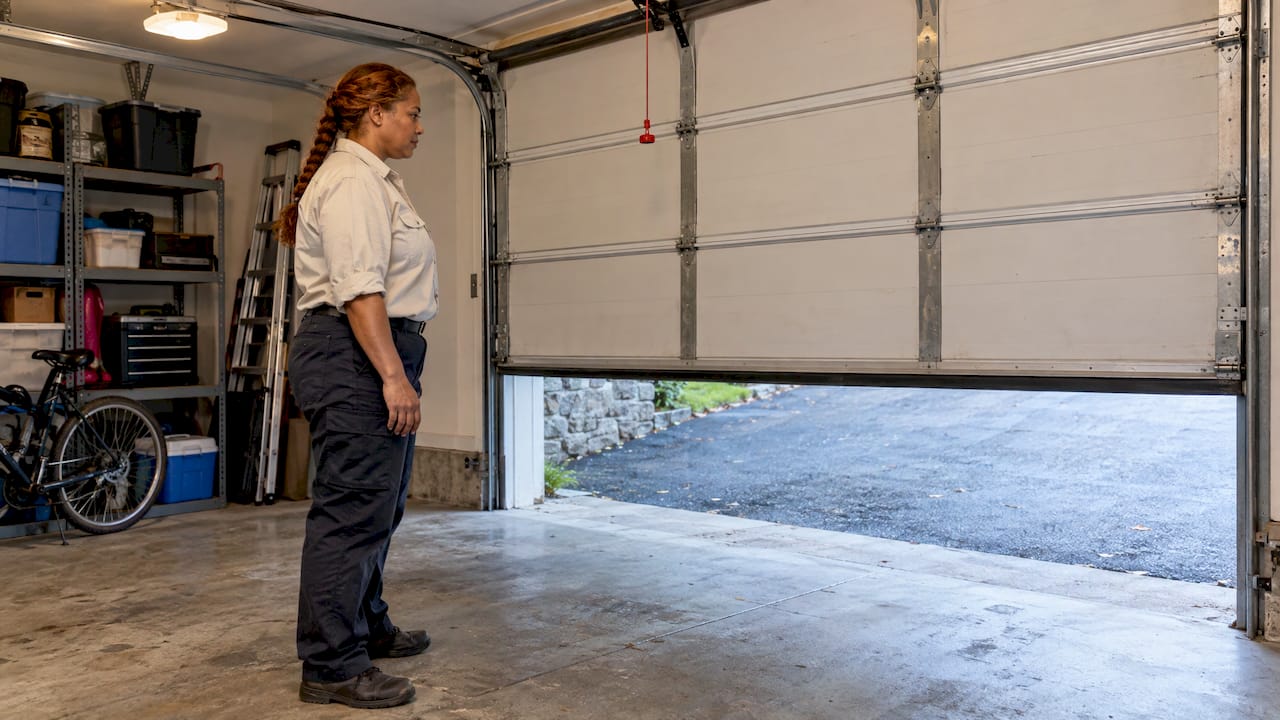
Do this only if the door moves freely and you are confident the springs and cables look intact. Keep your hands clear of the track and the joints between panels, and never do it if the door is crooked or a cable hangs loose.
Signs you should stop and call
- A loud bang from the garage followed by a door that won’t lift.
- A visible gap in the coil of the torsion spring above the door.
- A cable that is frayed, slack or off its drum.
- The door sits crooked, one side higher than the other.
- A roller out of the track, or a bent or dented track.
- A panel that is cracked or buckled.
Springs and cables are under extreme tension, and the brackets that hold them can cause severe injuries if loosened. These are not parts to adjust at home. If you recognize the pattern, read our guide to the warning signs a garage door spring is about to break, or go straight to our broken spring repair page.
How to close the door manually when it won’t cooperate
If you need the door shut tonight and the opener won’t respond normally, there are two safe options, depending on the cause.
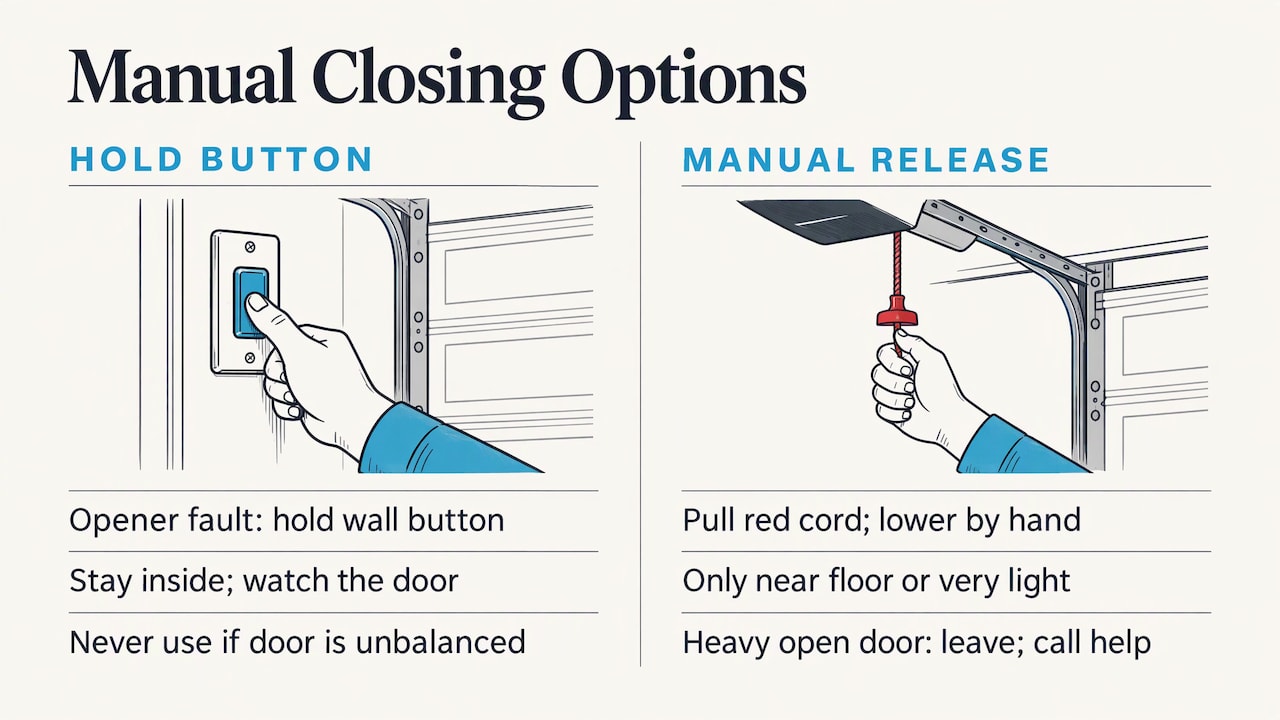
Hold the button. Genie’s troubleshooting page says that when an operating problem prevents the opener from closing, you can press and hold the wall console button until the door is completely closed. This overrides the sensor logic on many openers, so you must stand inside the garage with a clear view of the door and make sure no person, pet or object is under it. Don’t use this method to keep closing a door that is out of balance.
Use the manual release. Pull the red emergency release cord to disconnect the door from the opener, then lower the door by hand. Only do this if the door is already near the floor or moves with very little effort. If the door is open and feels heavy, a spring or cable has probably failed, and lowering it could drop it fast. In that case, leave it and call for help. If it is open and you need the home secured, we offer 24/7 garage door repair for exactly that situation.
Test the safety reversal after every adjustment
Any time you touch a force setting, a travel limit or a sensor, test the reverse function before you trust the door again. Chamberlain states the system must be tested every month, and after any adjustment the door must reverse on contact with a 1-1/2 inch (3.8 cm) object or a 2×4 laid flat on the floor.
The steps, as Genie describes them:
- Lay a single 2×4, wide side down, on the floor in the center of the door opening.
- Close the door with the wall control or the remote.
- The door should begin to reverse when it touches the board, within two seconds.
- If it doesn’t reverse, the close-force setting must be lowered, and the test repeated.
If you can’t get the door to pass, don’t use it with the opener. Put the opener in manual mode and call a technician. The same applies to the photo eye test: wave an object through the beam while the door is closing, and the door should stop and reverse.
For homeowners who like routine, our door maintenance service covers this kind of check as part of a regular tune-up.
Quick reference: symptom, likely cause, next step
| What you see | Likely cause | Safe next step |
|---|---|---|
| Nothing happens when you press the remote | Dead battery, lock mode, no power | Replace battery, check the wall control and the outlet |
| Opener hums or clicks, door doesn’t move | Disengaged trolley, broken spring, stripped gear | Stop pressing the button and call a technician |
| Door won’t close from the remote, lights flash | Blocked or misaligned sensors | Clean and realign the photo eyes |
| Door closes a few inches and reverses | Force setting, balance or obstruction | Check the track, then the balance, then the force |
| Door touches the floor and bounces up | Travel limit set too far | Adjust the down limit per your manual, then retest |
| Door looks crooked or heavy | Spring, cable or track problem | Don’t touch the parts; call for repair |
| Door won’t stay closed unless you hold the button | Sensor fault or limit problem | Check sensors, then the limits |
When the door won’t open instead
A door that is stuck closed or jammed shut often shares causes with one that won’t close: a dead remote, lock mode, a power loss, or a broken spring. Here is how the checks differ.
- Opener runs but the door stays down. If the door is disengaged from the trolley, re-attach it by pulling the release cord toward the opener, and run the opener again. If the door is locked by a manual slide lock on the inside, unlock it.
- Nothing runs at all. Check power, the wall control and the remote battery. After a storm, a tripped GFCI is a common cause.
- Opener strains and stops. A broken spring is the main suspect. The opener motor alone can’t lift a door that the springs no longer support.
- Door open and stuck. Check for an obstruction in the track, and make sure the cable is still on its drum. If it won’t move up or down, don’t force it.
For a flashing light on the opener, see our post on why the light blinks and the door won’t open.
Need a hand? Here is how we help
If your checks point to a sensor that needs replacing, an opener that has lost its settings, or a spring, cable or track problem, we can take over. Speedy Garage Door Services is family-owned and serves homeowners and businesses in Massachusetts and Connecticut, with same-day service and 24/7 emergency repairs for the moments a door is stuck and the car is inside.
We handle opener repair and installation, including sensors, keypads, receivers and gears, and broader door repairs such as cables, rollers and tracks. Local to Chicopee, we also cover Springfield, Agawam and Longmeadow. You can also start from our Chicopee page or the Speedy Garage Door Services homepage to request service.
Our perspective
When a door won’t close, owners often think the opener has died. In our experience, the opener is usually doing its job: it is protecting your family and your property from a door that no longer behaves the way it did.
That is why we start with the door, not the opener. We look at balance, springs, cables, rollers and tracks first, then the sensors and settings. If we fix a symptom and leave the cause, the door will be back at your driveway door next month, and nobody wants that.
Safety is where we won’t compromise. Springs and cables carry serious tension, and the reverse system exists to protect people. We would rather you call us for a door that feels heavy than risk a tool slipping on a spring bracket. Clear communication matters to us as well: we tell you what we found, what it needs and what the options are, in plain words.
As a family-owned business, we know a stuck door at 6 a.m. or after dark is more than an inconvenience. That is why we offer same-day service and 24/7 emergency repairs across Massachusetts and Connecticut.
the author
FAQ
Why won’t my garage door close when nothing is in the way?
The usual suspects are dirty or misaligned sensors, a travel or force setting that has drifted, or a door that has fallen out of balance. Clean both sensor lenses and check that their lights are steady. If they are, test the balance by lifting the door by hand to waist height with the opener disconnected.
Why does my garage door close and then go back up?
The opener thinks it met an obstruction or too much resistance. Clopay points to the sensors and the force and travel settings as the main causes. Check for a blocked track, then the sensors, then the settings in your opener’s manual.
Can I close the garage door manually?
Yes, in two ways. You can hold the wall button until the door finishes closing, as long as you can see the whole opening. Or you can pull the emergency release cord and lower the door by hand, but only if it moves easily. A heavy door means a spring or cable problem, and it should be left for a technician.
Is it safe to adjust the opener force myself?
Only in small steps, using your opener’s manual, and always followed by the 2×4 reversal test. Never raise the force to push a stiff door shut, because that can defeat the safety reverse. If the door needs more force than before, the door itself should be inspected.
When should I call a garage door company?
Call when you see a broken or gapped spring, a frayed or loose cable, a crooked door, a bent track, or if the door fails the reversal test. Call also when a door is stuck open overnight or you can’t secure the garage. We offer same-day service and 24/7 emergency repairs in Massachusetts and Connecticut.
Sources
- DASMA: Federal and State Residential Garage Door Operator requirements
- Clopay: Why does my garage door open again after closing
- Chamberlain: My Garage Door Will Not Fully Close
- Chamberlain: Garage Door Won’t Fully Open or Close
- Chamberlain: Garage Door Only Travels a Little Way and Then Reverses
- LiftMaster 2220 manual
- LiftMaster opener manual safety warning
- Genie: Garage Door Opener Safety
- Genie: Garage Door Opener Troubleshooting