

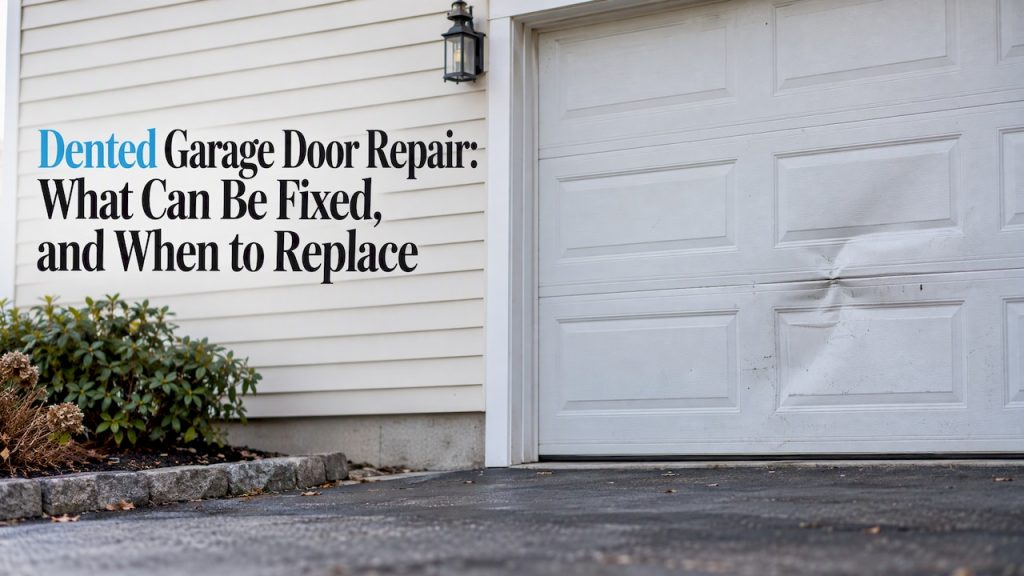
Most dents in a garage door can be dealt with, but the right fix depends on how deep the dent is, whether the panel has creased or buckled, and what the door is made of. A shallow ding in a steel panel is a cosmetic repair. A crease that runs across a section, or a panel that no longer sits flush with its neighbors, is a different problem. It can affect how the door moves, and it should be looked at before anyone pulls, pries or pushes on it.
This guide helps you sort your dent into one of those groups, explains what a technician actually does, and shows where the line sits between repairing a panel, replacing one section, and replacing the whole door. If you are in western Massachusetts or Connecticut, we explain how to get it looked at the same day.
TL;DR
- Small, shallow dents in a steel or aluminum door are often repairable. Creased, buckled or cracked panels usually need a technician’s judgment, and sometimes a new section.
- Industry guidance says occupants should not try to straighten a bent panel. A trained technician should inspect it and decide between repair and replacement.
- If the door has started to stick, shake, scrape or run unevenly after the impact, stop using it and call a pro. The damage may reach the tracks, cables or springs.
- Replacing one or two panels is often practical on a door in good shape. Widespread damage, a damaged frame or an old door with no matching panels points toward a new door.
- We inspect dented doors across Massachusetts and Connecticut, and we can handle same-day visits and 24/7 emergencies.
Table of Contents
- First, work out what kind of dent you have
- Can you pop the dent out yourself?
- How a technician approaches a dented panel
- When a panel should be replaced rather than repaired
- Repair, replace one section, or replace the door?
- Signs that mean stop using the door
- What to do right after an impact
- Perspective: why we look at the whole door
- Get your dented door looked at
- Keeping the next dent from happening
- FAQ
- Sources
First, work out what kind of dent you have
Not all dents are equal. Before you think about repair methods, look at the door in daylight, from outside and from inside the garage, and note four things: how deep the dent is, whether the paint or surface is cracked, whether the metal has creased, and whether the door still closes evenly.
A broad, shallow dent with smooth edges means the metal has stretched very little. A sharp dent with a crease in the middle means the metal has folded and work-hardened. A dent near the edge of a section, close to a hinge or a roller bracket, matters more than the same dent in the middle of a panel, because that is where the section takes load every time the door moves.
| What you see | What it usually means | Typical next step |
|---|---|---|
| Shallow, rounded dent, paint intact, door runs normally | Surface damage, often from a ball, a bike handle or a light bumper tap | Cosmetic repair is often possible |
| Sharp dent with a crease through the panel | Metal has folded, and the section may have lost stiffness | Technician inspection; repair or section replacement |
| Dent plus cracked or split panel | Structural damage to the section | Section replacement is more likely |
| Dent near a hinge, roller or the bottom edge | Hardware mounting may be affected | Inspection before the door is used again |
| Panel visibly bowed or out of line with the neighbors | Section is bent, and door may bind in the tracks | Stop using the door and call a technician |
| Dents across several sections | Impact was large, or the whole door was racked | Compare replacing sections with replacing the door |
This table is a starting point, not a diagnosis. Two dents that look alike in a photo can need different fixes once someone sees how the section sits in the door.
Can you pop the dent out yourself?
You will find plenty of videos showing suction cups, glue pullers, plungers and body filler. Some of those techniques can work on a light dent in a thin steel panel on a bumper or a car door. A garage door is a different object. It is a hinged, spring-balanced assembly, and each section carries part of that balance.
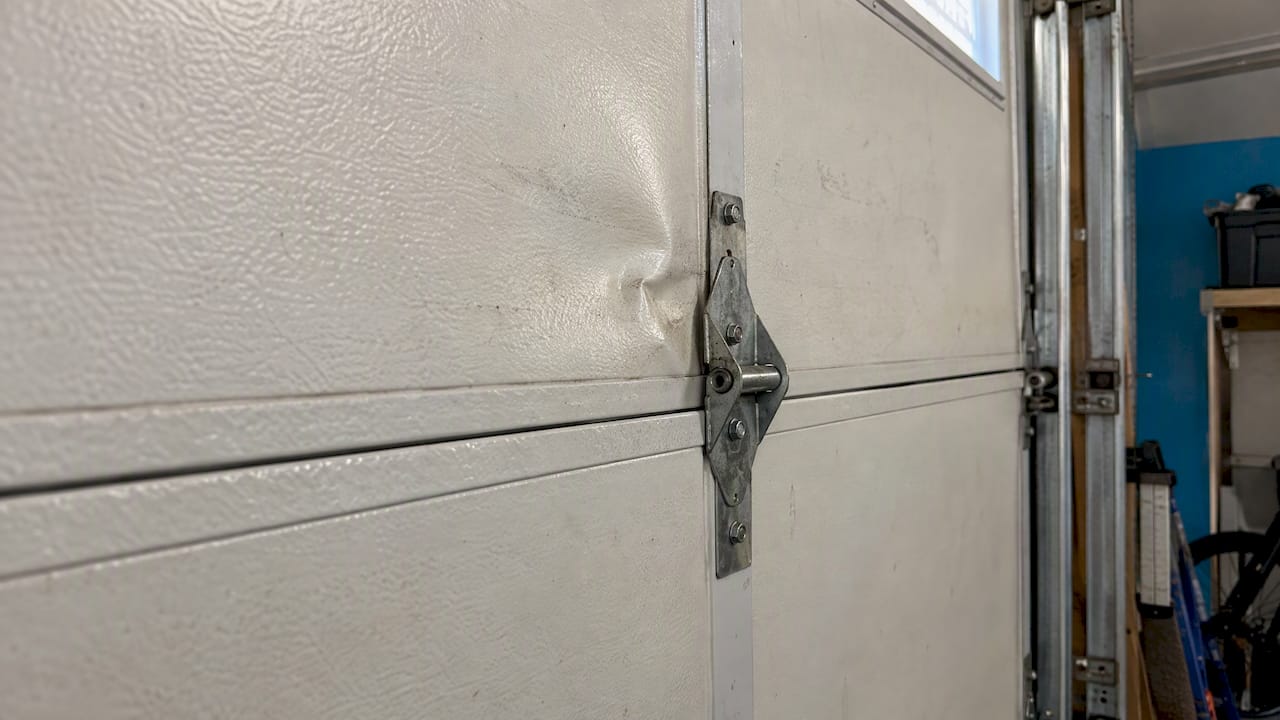
The Door and Access Systems Manufacturers Association (DASMA), the industry’s trade body, is direct about this. In its technical guidance on checking a garage door, it says that occupants should not attempt to straighten or repair a bent panel, and that a trained door systems technician should inspect it and judge whether it should be repaired or replaced. The same sheet tells technicians to inspect sections from inside and outside for cracks, dents or buckling that could reduce performance.
Here is what we would say to a homeowner in practice:
- Looking is fine. Photograph the dent, run a gloved hand along the panel, and check whether the paint is cracked.
- Cleaning is fine. Dirt hides the real size of a dent, and a clean panel is easier to assess.
- Forcing is where doors get hurt. Pulling or pushing hard on a panel can crease a dent that was only a dimple, tear the skin, or knock a hinge or roller bracket out of line.
- Anything near the springs, cables or bottom brackets is off limits. DASMA’s 2024 opener safety and maintenance guide recommends a monthly visual check of panels, hinges, rollers and springs. It also says to contact a trained technician when damage is evident, and not to adjust springs, cables, bottom brackets or supports yourself.
If you do want to try something on a very light dent in a plain, uninsulated steel or aluminum panel, keep it to gentle pressure from inside, stop at the first sign of a crease, and accept that you may be paying for a section later if it goes wrong. For an insulated door, a door with a wood-composite skin, or any dent with a crease, leave it to a technician.
How a technician approaches a dented panel
A good visit starts with the whole door, not just the dent. Impacts that dent a panel often push the door slightly out of square. The technician will look for the following:
- The panel itself: depth, creasing, cracking, and whether the skin has separated from any insulation behind it.
- The hardware around it: hinges, roller brackets and end caps on the damaged section.
- The tracks: bends, gaps or marks where a roller has jumped.
- The cables and springs: fraying, slack cable or an uneven door are signs the impact reached the balance system.
- The opener: if a car or a bin hit the door while it was closing, the opener’s force and sensor settings are worth checking.
From there, the options are usually one of three:
- Repair the section. On a steel door with a shallow dent and no crease, the metal can sometimes be worked back close to its original profile from the inside, and insulation, if there is any, is restored afterward. How good the cosmetic result is depends on the panel’s embossing, the finish and the age of the paint.
- Reinforce or adjust. If the dent is mostly a symptom of a door that is out of alignment, fixing the alignment, hinges or rollers may address the cause.
- Replace the section. When the panel is creased, cracked or too stretched to recover, a replacement section is the cleaner fix.
We will tell you which of those we recommend, and why, before any work starts. If the dent is purely cosmetic and the door works normally, we will say that too, so you can decide how much the look matters to you.
When a panel should be replaced rather than repaired
Repair makes the most sense when the damage is shallow, the surface is intact and the section still holds its shape. Replacement makes sense when one or more of these is true:
- The panel is creased, cracked or split.
- The dent sits on a hinge or roller mounting point.
- The section is visibly bowed and the door no longer closes flush.
- Repair would leave an uneven finish that you would notice every day from the driveway.
A replacement section has to match the rest of the door: the same model, panel design, thickness, color and finish. That is the practical limit. On a door that is only a few years old, the match is usually easy to find. On an older door, the manufacturer may have discontinued the design, or the color may have faded enough that a new section stands out. We check availability before we recommend a single-section swap, so you do not end up with a mismatched stripe across the door.
Section replacement also involves heavy panels and a door that is under spring tension. That is one reason we do it as a service job and do not recommend it as a weekend project. If you want to see what we do on the panel side, our new door installation and panel replacement page covers it.
Repair, replace one section, or replace the door?
This is the decision that matters most for your budget. We have a full walkthrough in how to decide whether to repair or replace your garage door, but the short version is a set of questions:
| Question | Points to repair or a single section | Points to a new door |
|---|---|---|
| How many panels are damaged? | One or two | Several, or damage that runs across the door |
| How old is the door? | Newer, or in good working order | Old, worn, with discontinued parts |
| Is the frame or track damaged? | No | Yes, or the opening itself is out of square |
| Can you get a matching section? | Yes | No, or only at a cost close to a new door |
| Does the door have other problems? | No | Worn rollers, rusted hardware, an outdated opener, poor insulation |
If you already have two or three other things going wrong with the door, putting money into a cosmetic fix is rarely the best use of it. If the door is otherwise solid, matching a single section keeps what is good and fixes what is not.
Cost is the next thing people ask about. We do not publish flat prices for dent work because it depends on the door, the damage and whether a section is available, so we quote after seeing the door or a clear set of photos. For broader budgeting, it helps to understand home renovation cost factors such as materials, labor and project scope, because the same things that move the price of any home project move the price of a door: size, material, insulation, finish and installation complexity. Ask for a written quote in each case, and ask what is included, so you can compare a section replacement with a full door on equal terms.
Signs that mean stop using the door
A dent is sometimes the least of it. Call a qualified technician, and avoid running the door in the meantime, if you notice any of these after an impact:
- The door jerks, scrapes, or sticks as it travels. DASMA’s garage door safety guidance says a door that does not move smoothly may be unsafe.
- A cable looks frayed, loose or has come off the drum. DASMA says worn or frayed cables should be replaced only by a trained technician. Our page on what to do when a garage door cable is off explains the next steps.
- The door is lopsided, one side sits higher than the other when it opens, or it will not stay open.
- A track is bent, or rollers have left the track.
- You hear a loud bang, or the door suddenly feels very heavy. That can mean a broken spring, and the same guidance puts spring-system repairs in the hands of trained professionals. See our broken spring repair page.
When in doubt, leave the opener unplugged or disconnected from the wall button, keep people and cars clear of the door, and call. A dented panel on a door that still moves smoothly can wait for a scheduled visit. A door that is binding cannot.
What to do right after an impact
- Keep everyone clear and stop operating the door if it looks or sounds wrong.
- Photograph the damage from several angles, inside and out, with something in the frame for scale. If a vehicle or a neighbor caused it, the photos help with any claim.
- Check the basics by eye: tracks, cables, the bottom seal, and where the dent sits compared with hinges and rollers.
- Do not force the panel. A dent you can live with for a week is better than a crease you cannot undo.
- Call for an inspection and send the photos along. If the door is stuck open or shut and your home is not secure, say so, because that changes the priority.
- Ask about insurance. Whether damage from a vehicle, storm or accident is covered depends on your policy, so read it or call your insurer before you commit to a repair.
Perspective: why we look at the whole door
We see dented doors every week, and the most common mistake is treating the dent as the whole problem. A panel is part of a balanced system. When something hits it, the force has to go somewhere, and it often ends up in a hinge, a roller or a track.
That is why we inspect before we quote. If the damage is shallow and the door runs smoothly, we say so and keep the job simple. If the section is creased, we explain why replacing it will serve you better than a patch that shows every time the sun hits it. We would rather tell you the truth about the door in front of us than sell you more than it needs.
We are a family-owned team, and we know that a garage door is the biggest moving part of your home, used several times a day. Our technicians give you clear communication, practical options and a safe result, and when something goes wrong outside business hours, our 24/7 emergency service is there for it.
the author
Get your dented door looked at
We repair and replace garage door panels and the hardware around them for homes and businesses in Massachusetts and Connecticut. A visit covers the dent, the sections, the tracks, the cables, the springs and the opener, so you leave knowing what is cosmetic and what is not. If the door is damaged and stuck, we offer same-day service and 24/7 emergency repairs.
To start, send photos or book a repair visit through our repairs page. If you are near us, you can also reach the local team in Chicopee, Agawam or Longmeadow, and for after-hours problems see our 24/7 garage door repair page. Business owners with commercial doors can go to our commercial garage door page.
Keeping the next dent from happening
Most dents come from a short list of causes: a car backing out, a bike or mower against the door, basketballs, hail, and a door striking something while it travels. A few habits cut the risk:
- Park with a clear margin, and consider a bumper guard or painted line on the garage floor.
- Keep bikes, ladders and tools away from the panels, especially along the bottom section.
- Check that the opener’s sensors and force settings are working, so the door does not push on an obstacle. Our openers and sensors service covers this.
- Look over the door once a month: panels, hinges, rollers and springs, as DASMA recommends. Spotting a loose hinge early costs less than a damaged section.
- Book regular upkeep. A maintenance visit is a chance to catch alignment problems that make a door more likely to hit something.
FAQ
How do you get a dent out of a metal garage door?
The safest answer is to have a technician do it. Light dents in a plain steel panel can sometimes be worked out from the inside, but creases, insulated sections and dents near hardware are easy to make worse. Trade guidance says a bent panel should be inspected by a trained technician, who decides whether to repair or replace it.
Can you straighten a bent garage door panel?
Sometimes a technician can, but homeowners should not try. A bent panel can mean the section has lost stiffness or the door is out of line, which affects how it runs. We inspect the panel, the tracks and the hardware, and then tell you whether repair or a replacement section is the better call.
Can I replace just one panel on my garage door?
Often yes, when the damage is limited to one or two sections and a matching panel is available. On older doors the design or color may no longer be made, which can make a full replacement more sensible. We check availability first and tell you before you commit.
How much does it cost to fix a dented garage door?
It depends on the door’s material, size, finish, how deep the damage is and whether a section must be replaced. We do not publish a flat price for dent work, so we quote after an inspection or a set of clear photos. Ask for the quote in writing so you can compare a repair, a section and a new door.
Is a dented door dangerous?
A cosmetic dent on a door that runs smoothly is usually not urgent. A dent with a crease, a bowed panel, scraping, a lopsided door or a frayed cable is a different story, and the door should not be used until a technician has looked at it.
Sources
- Trained Door Systems Technician: Checking a Garage Door (DASMA)
- Garage Doors safety tips (DASMA)
- Automatic Garage Door Opener Safety & Maintenance Guide, 2024 (DASMA)
- Home Renovation Cost Factors: Your 2026 Budget Guide