

An insulated garage door is a sandwich: two layers of steel (or another material) with a foam core between them, built to slow the heat moving through the door. For an attached garage, a garage you use as a workshop or gym, or any garage in a New England winter, it is usually the right door. The right R-value, a tight fit around the edges and a spring system balanced for the door’s weight decide how well it performs. We install and service garage doors for homeowners and businesses in Massachusetts and Connecticut, so this guide is written for that kind of climate.
TL;DR
- An insulated door has a foam core between layers. An uninsulated door is a single layer with almost no thermal resistance.
- R-6 to R-13 covers most home garages. Higher ratings have diminishing returns if gaps around the door let air through.
- Installed prices in 2026 run roughly $1,400 to $3,500 for a double door, depending on the core. Single doors cost about 55 to 65% of that.
- The door is only one part of the garage envelope. Weatherstripping, the walls and the ceiling decide how much of the benefit you feel.
- A heavier insulated door needs a spring system that matches its weight, so have it balanced when it is installed.
Table of Contents
- What makes a garage door insulated
- How to read R-value and other ratings
- Does an insulated door make a difference?
- How much an insulated garage door costs
- Choosing the right R-value for your garage
- Can you insulate the door you already have?
- Insulated versus non-insulated: the short comparison
- What to expect when a new insulated door goes in
- Getting an insulated door installed in Massachusetts or Connecticut
- FAQ
- Sources
What makes a garage door insulated
A standard steel garage door is one thin skin. Heat passes straight through it, which is why an uninsulated garage bakes in July and freezes in January. An insulated door adds a core between two skins. Two core types dominate:
- Polystyrene: rigid foam panels fitted between the layers. It is the budget option, and the door usually lands in the R-6 to R-9 range.
- Polyurethane: foam injected between the layers that expands to fill the cavity. It bonds to the steel, which makes the door stiffer and quieter, and ratings typically run R-12 to R-18.
Both ranges are shown in Tallyard’s 2026 US cost table, which also lists uninsulated steel at R-0. Wood and aluminum-and-glass doors sit low on the scale unless they are built with an insulated core.
How to read R-value and other ratings
R-value measures thermal resistance: the higher the number, the slower heat moves through the door. DASMA, the garage door industry’s trade association, explains that a door section’s R-value is built from the resistance of the air film, the outside surface, the insulation and the inside surface.
Two cautions when you compare doors:
- R-value and U-factor are different scales. U-factor measures heat transmitted, so lower is better. DASMA notes that a tested U-factor for a whole door and a calculated R-value for a door section cannot be compared with each other. Compare R to R, or U to U.
- The panel rating is not the installed rating. Gaps at the edges, the top and between sections let air through. The Garage Guide notes that these gaps pull the effective R-value below the panel rating, which is why very high numbers give diminishing returns.
Some manufacturers also publish an STC (Sound Transmission Class) rating for noise. A foam-filled door is generally quieter than a hollow one, which matters if the garage sits under a bedroom or faces a busy street.
Does an insulated door make a difference?
Yes, in the right garage. Insulation slows the heat flowing through the door. It does not heat or cool anything on its own, so an unconditioned garage will still drift toward the outdoor temperature over time. What you notice is a smaller swing: less frost on the car in winter, a cooler garage on a sunny afternoon, and less cold air pushed into the rooms next to it.
The benefit is largest when:
- the garage is attached to the house or sits under a room;
- you use the space for a workshop, gym, laundry or storage of paint, tools or anything sensitive to temperature;
- you live where winters are cold, as in western Massachusetts and Connecticut.
If the garage is detached and only holds a car in a mild climate, a lower R-value does the job, and the budget may go further on a better opener or a new set of springs.
How much an insulated garage door costs
Prices vary with size, core, style and labor. These published 2026 figures give a realistic frame:
| Door (16×7 double, installed) | Typical range | R-value |
|---|---|---|
| Steel, no insulation | $1,000 to $1,800 | R-0 |
| Steel, polystyrene core | $1,400 to $2,600 | R-6 to R-9 |
| Steel, polyurethane core | $1,800 to $3,500 | R-12 to R-18 |
| Aluminum and glass | $2,500 to $6,000 | R-0 to R-6 |
| Solid wood | $4,000 to $10,000+ | R-2 to R-5 |
Source: Tallyard, 2026 US data. Single doors run roughly 55 to 65% of the double-door figures.
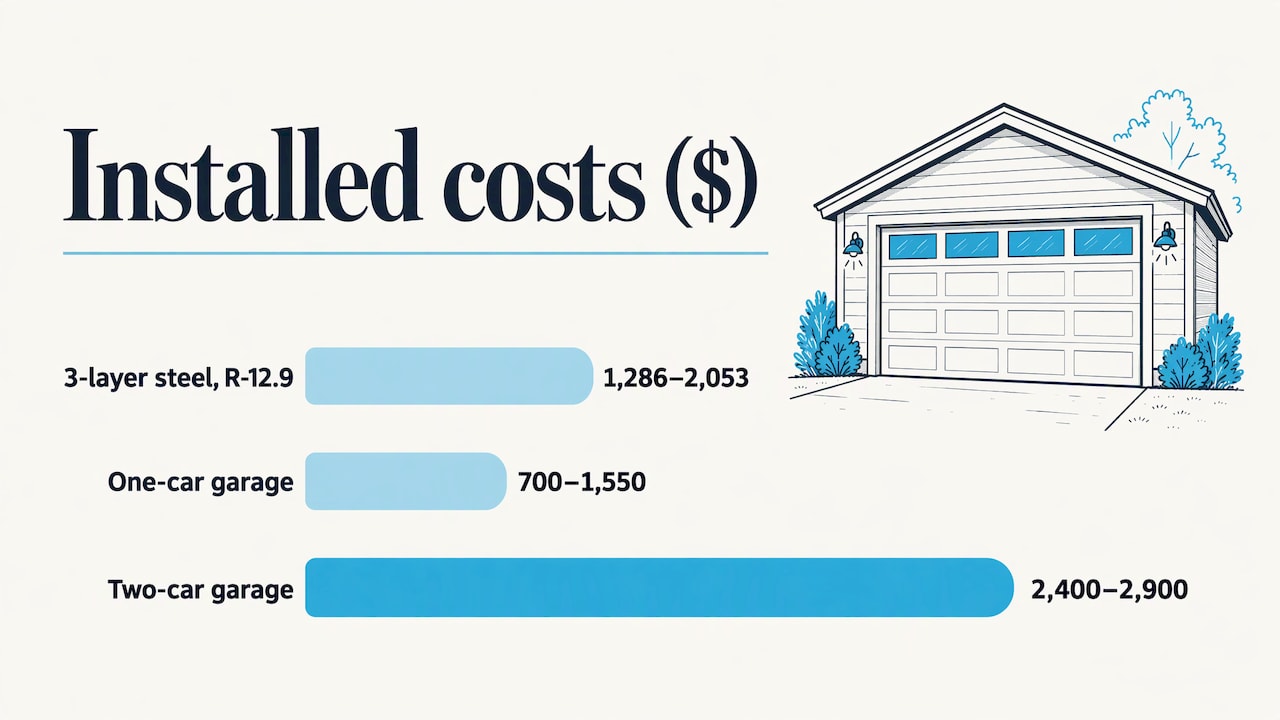
For a second reference, Homewyse’s May 2026 estimate for a three-layer steel door with an R-12.9 core is $1,286 to $2,053 installed on a national average, split about evenly between the door and basic labor. Family Handyman (updated November 2023) reports installed ranges of $700 to $1,550 for a one-car garage and $2,400 to $2,900 for a two-car garage, plus about $100 to remove the old door.
These are national averages, so treat them as a way to check a quote’s realism. A written quote for your exact opening is the only number that counts.
What pushes the price up
- Core and R-value: polyurethane costs more than polystyrene.
- Width and height: a two-car door is far more than twice the cost of a few extra feet of panel.
- Windows, custom colors and wood-look finishes.
- Hardware: springs, tracks and rollers matched to the door’s weight.
- Old-door removal and any electrical work for the opener.
Is the extra cost worth it?
Family Handyman’s garage door expert points out that an insulated door costs more upfront, and that energy savings can offset part of that over time. How much depends on your climate, how your garage is built and your utility rates, so be wary of anyone quoting a precise payback figure. A practical way to decide: ask for the same door priced with and without insulation, in writing, and weigh the difference against how you use the space.
Choosing the right R-value for your garage
Most residential garage doors fall between R-6 and R-13, according to The Garage Guide. Use your situation to pick within that range:
| Your garage | Sensible target |
|---|---|
| Detached, parking only | Lower end, around R-6 to R-9 |
| Attached, unheated | Mid-range, R-9 to R-13 |
| Heated, or used as a workshop or gym | R-12 and up |
| Room or living space above | Highest practical rating in the polyurethane range |
These are our working guidelines, not code requirements. Two more things matter as much as the number:
- Weatherstripping. A bottom seal, side stops and a top seal limit air leakage. A high-R door with large gaps will underperform a modest door that seals well.
- The rest of the garage. The garage door is the largest single opening in the building envelope, and an insulated door on an uninsulated garage delivers limited savings. If you want a comfortable space, look at the walls and ceiling too.
Can you insulate the door you already have?
Yes. The U.S. Department of Energy’s Building America Solution Center describes retrofitting a door with rigid foam panels glued into the sections, canned spray foam in the gaps, and weatherstripping around the edges. That adds some R-value to a flat steel door.
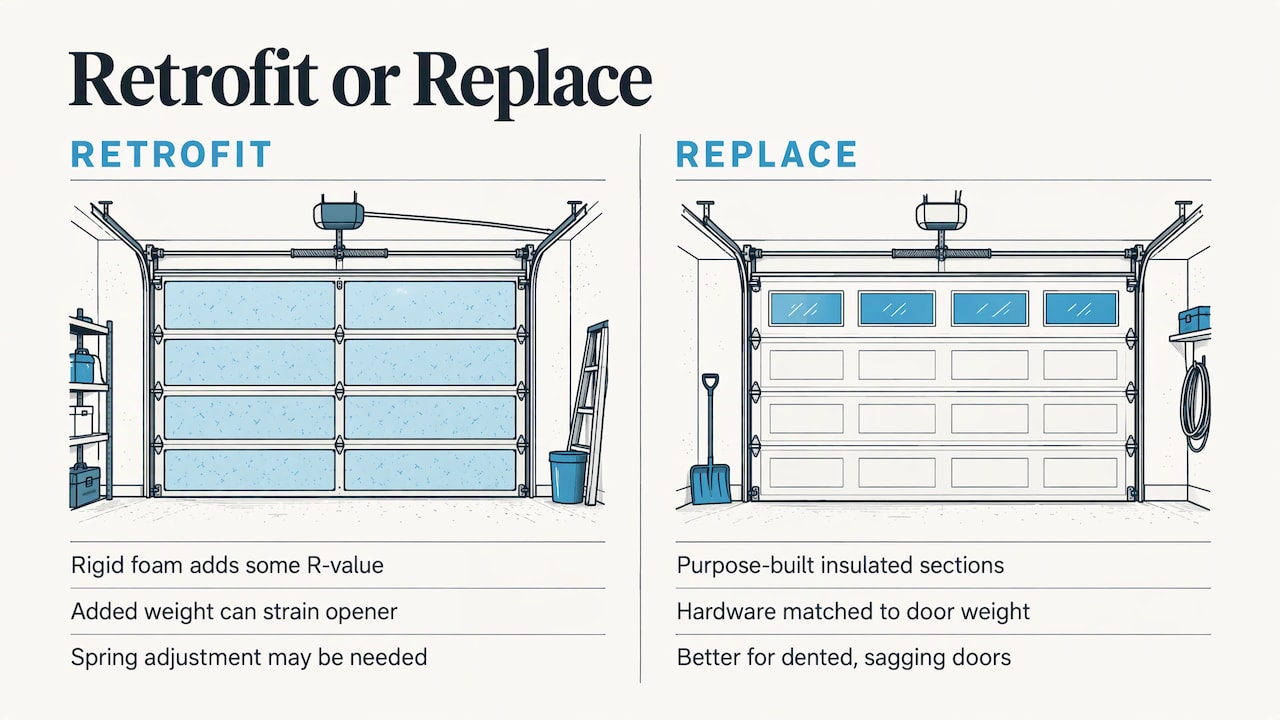
There is a catch that applies to any retrofit. Added panels add weight, and a garage door is balanced by its springs. If the springs were set for a lighter door, it can feel heavy, drift open or closed when you let go, and strain the opener. Springs hold a lot of tension and are not a casual DIY adjustment. That is why a spring adjustment after any weight change is worth booking. Replacing an old, dented or sagging door is often the better route than layering foam onto it: a purpose-built insulated door comes with sections, seals and hardware matched to its weight.
Insulated versus non-insulated: the short comparison
| Insulated | Non-insulated | |
|---|---|---|
| Construction | Two or more layers with a foam core | Single layer |
| Temperature swing | Reduced | Close to outdoor |
| Sound | Quieter, stiffer panels | Louder, flexes more |
| Upfront cost | Higher | Lower |
| Best for | Attached garages, workspaces, cold or hot climates | Detached parking-only garages in mild climates |
What to expect when a new insulated door goes in
A good installation does more than hang panels. The steps that decide performance are:
- Measure the opening and headroom. Width, height, side room and the space above the opening determine which door and track fit.
- Choose the door by core, R-value and finish. Match it to how you use the garage, using the targets above.
- Remove the old door safely. The springs and cables of the old door are under load, so this is the riskiest step to do yourself.
- Assemble sections, set the tracks and hang the door. Rollers, hinges and brackets must line up or the seals will not close evenly.
- Balance the springs for the new weight. A balanced door stays put when released halfway.
- Fit the weatherstripping and check the opener. Safety sensors, travel limits and force settings should be checked with the heavier door.
Our team handles new door installation for residential and commercial properties, and the residential installation guide walks through what the visit looks like.
How we look at insulated doors
Homeowners usually ask us about the panel and the R-number. In our experience the questions that decide whether a new door feels right are about the whole system: is the door balanced, are the seals tight, and does the opener match the new weight? A door that looks perfect but is out of balance wears the opener and the cables quickly.
That is why we treat installation, spring adjustment, tracks, rollers and openers as one job instead of separate parts. Our approach is built on safety and durability, and on telling you plainly what the work involves.
As a family-owned company serving Massachusetts and Connecticut, we answer to neighbors. We offer same-day service and 24/7 emergency repairs, so if your door fails in the middle of a January storm, you can reach us.
the author
Getting an insulated door installed in Massachusetts or Connecticut
If you are replacing a door, a panel or a section, or you want the opener, springs and tracks checked when the new door goes in, we can handle it in one visit plan. We serve homeowners and businesses across Massachusetts and Connecticut, including Chicopee, Agawam, Longmeadow, Ludlow and Springfield. See our new door installation page, or contact us through our main site for a written quote.

Business owners can find our commercial garage door installation and scheduled maintenance on a dedicated page. After installation, regular door maintenance keeps seals, rollers and springs working as the door ages.
FAQ
Is an insulated garage door worth it?
For an attached garage, a workshop or any garage in a cold climate, usually yes. The door costs more up front, and the savings depend on your climate, garage construction and utility rates. A written quote for the same door with and without insulation shows exactly what the upgrade costs for you.
Do insulated garage doors keep the garage cool in summer?
They slow the heat coming through the door, which helps when the sun hits it directly. The garage is not air conditioned, so it will still follow the outdoor temperature over time, but the peak is lower. Tight weatherstripping adds to the effect.
What R-value should I choose?
Most home garages are served by R-6 to R-13. Pick the lower end for a detached garage used only for parking, and the higher end for an attached or heated garage. Compare R-value to R-value across doors, not to U-factor.
Can I add insulation to my existing door?
Yes, with foam panels and weatherstripping, as the Department of Energy’s guide describes. The extra weight changes how the door balances, so have the springs checked afterward. If the door is old or damaged, replacing it is often the cleaner fix.
Sources
- Tallyard: garage door cost and R-value data, 2026
- DASMA: U-factor and R-value for residential and commercial garage doors
- The Garage Guide: garage insulation cost 2026
- Homewyse: cost to install an insulated garage door
- Family Handyman: how much an insulated garage door costs
- U.S. DOE Building America Solution Center: insulate and weatherstrip a garage door