

A squeaky garage door is usually asking for one of two things: a quick, correct lubrication of the metal moving parts, or a repair on a part that is worn out. The trick is telling the two apart before you spray anything. A squeal from dry hinges is a ten-minute fix. A grinding or popping sound from the springs, cables or opener gears is a sign to stop and book a technician. If you are in Massachusetts or Connecticut, we at Speedy Garage Door Services handle both the tune-up and the repair, same day when you need it.
This guide shows you how to find where the noise comes from, what to lubricate, what never to use, and how to recognize the sounds that mean the door is no longer a DIY job.
TL;DR
- Most squeaks come from dry metal hinges, rollers and bearings. Lubricate those, not everything in sight.
- Skip standard WD-40. Bob Vila’s lubrication guide points to white lithium grease or silicone spray instead.
- Disconnect the opener and move the door by hand to learn whether the noise comes from the door or the opener.
- Grinding, popping, a door that feels heavy or a door that drifts when raised halfway points to springs or cables. Do not adjust those yourself.
- A yearly check keeps small noises from becoming expensive failures.
Table of Contents
- What your garage door is trying to tell you
- Step 1: Find out whether it is the door or the opener
- Step 2: Clean and lubricate the right parts
- Step 3: Quiet a noisy opener
- When the noise is a repair, not a tune-up
- A worked example: the Saturday-morning squeal
- We think a noisy door is a maintenance signal
- Keep it quiet: a simple yearly routine
- Get the door quiet and safe with a professional tune-up
- FAQ
- Sources
What your garage door is trying to tell you
A garage door is a counterbalanced machine. Springs carry most of the weight, cables transfer that force, rollers ride in steel tracks, and hinges let the panels fold as the door goes up. The opener only pulls a door that is already balanced. When any of those parts gets dry, loose or worn, it makes a noise, and the type of noise is a useful clue.
| Sound | Most likely source | What to do |
|---|---|---|
| High-pitched squeal or chirp | Dry hinges, rollers or bearings | Clean and lubricate the metal moving parts |
| Scraping or rubbing along the sides | Track out of alignment, bent track, or a loose bracket | Check the track and bracket bolts; call us for bent tracks |
| Rattling or banging | Loose hardware, loose opener mounting | Tighten fasteners; isolate the opener |
| Groaning or slapping from the opener | Slack in the chain or belt | Check the drive tension per the opener manual |
| Grinding when opening | Worn rollers, worn opener gear, or a track problem | Find whether it happens by hand; if the opener, book a repair |
| Loud pop or bang, door suddenly heavy | Broken spring or cable | Stop using the door and call a technician |
Use the table as a first sort, not a diagnosis. The same sound can come from more than one part, which is why the next step matters.
Step 1: Find out whether it is the door or the opener
This is the single most useful test, and it takes about five minutes. The approach below follows the same logic as the troubleshooting routines opener makers publish: listen to the door alone, then to the opener alone.
- Close the door and unplug the opener. This Old House recommends unplugging the opener before you work on it. Treat that as a rule for every check below.
- Pull the red emergency release cord. This disconnects the door from the opener trolley so the door can move freely by hand. Do it with the door fully closed, so the door cannot fall.
- Lift the door by hand, slowly, and listen. A squeal that follows the hinges as they pass the rollers is a door-hardware noise. A scrape in one spot on the track is a track or roller noise.
- Notice how it feels. A well-balanced door lifts with moderate effort and stays where you leave it. If it feels very heavy, or slams down, that is a spring problem, and the rest of this guide does not apply to it. Skip ahead to the repair section.
- Reconnect and run the opener. If the door was quiet by hand but loud under power, the opener is the likelier source.
Write down what you hear and where. It will save time whether you carry on yourself or call us.
The balance check
With the opener disconnected and the door closed, lift it by hand about halfway and let go carefully, keeping your hands clear of the panel joints. A balanced door stays roughly in place. If it drops or shoots upward, the spring tension is off. That is not something to correct with a wrench and a bar. Spring tension adjustment is one of the most dangerous jobs on a home, and it is the point where we step in. Our broken spring repair and spring adjustment service covers exactly this.
Step 2: Clean and lubricate the right parts
If the noise is a squeal from the door itself, lubrication is the right answer. Doing it correctly matters more than doing it often.
Prepare the door
Before you start, unplug the opener. If you need the door raised to reach something, the This Old House guidance on safe opener work is a good reminder that the door should never be left to hold itself up on the opener alone. Keep the door closed whenever you can and work from a stable stepladder for the upper hardware.
Wipe old, gummy grease and dirt off the hinges and roller stems with a rag. Spraying fresh lubricant on top of grit just makes a paste.
Pick the right product
The popular answer to this question is the blue-and-yellow can in the garage, and it is the wrong one. Bob Vila’s guide to lubricating a garage door says to avoid standard WD-40 and use white lithium grease or silicone spray instead. The reason is practical: a thin, solvent-style spray cleans well but does not stay in place, so the squeak comes back within days and you have also washed away whatever grease was left.
Read the product label for what it is safe on. As a rule, keep lubricant on metal moving parts and keep it off anything plastic or nylon.
What to lubricate
- Hinge pivots. Put a small amount where the hinge moves, not across the whole panel.
- Roller stems and bearings. Treat the metal stem where the roller turns. Do not oil the track itself. Oil in the track collects dust and the rollers slide instead of rolling.
- Spring coils. A light wipe or spray along a torsion spring can quiet a creak. Do not overdo it, and never put hands near the spring or its winding cones while the door moves.
- Center and end bearings. Metal bearing plates on the torsion shaft take a drop of lubricant.
- Opener chain or screw. More on this below.
What to leave alone
- Plastic or nylon parts, including nylon roller wheels.
- The door’s rubber weatherstripping and bottom seal.
- The track surface.
- Cables. Do not lubricate or handle them. They are under load.
Operate the door two or three times after lubricating so the grease works in, then wipe off any drips so they do not mark the floor or your car.
If you are giving the door a once-over and the panels also need a refresh, these garage door painting ideas are a good place to start on colors.
Step 3: Quiet a noisy opener
If the door was silent by hand and noisy under power, the opener is working too hard, shaking itself, or wearing out.
Check what you can safely check
- Mounting and vibration. An opener bolted rigidly to the ceiling joists passes every vibration into the framing of the house, which is especially noticeable when there is a bedroom above the garage. This Old House describes rubber pads or isolation mounts at the opener and the wall bracket as a way to cut that transmission. Tighten every bolt while you are there.
- Chain or screw lubrication. Family Handyman recommends lubricating the opener chain or screw once a year with white lithium grease, and notes that some screw-drive openers do not need it, so your owner’s manual decides.
- Chain sag. A chain that slaps or groans as it runs may have too much slack. The adjustment procedure differs by model, so follow the manual and unplug the opener first.
- Mismatch between the door and opener. A door that is out of balance makes the opener strain, and a straining opener is a loud opener. Fixing the balance often quiets the motor.
Signs the opener needs repair
Grinding from inside the motor housing, a whine that rises and falls, a door that hesitates, or plastic shavings under the unit usually mean worn drive gears. Replacing gears, sensors, receivers or the whole opener is work we do every day: see our opener repair and installation page, or read our guide to garage door opener repair causes and next steps to understand what a repair involves.
When the noise is a repair, not a tune-up
Some sounds should end the DIY session. Others are early warnings you can act on before a part fails.
Springs
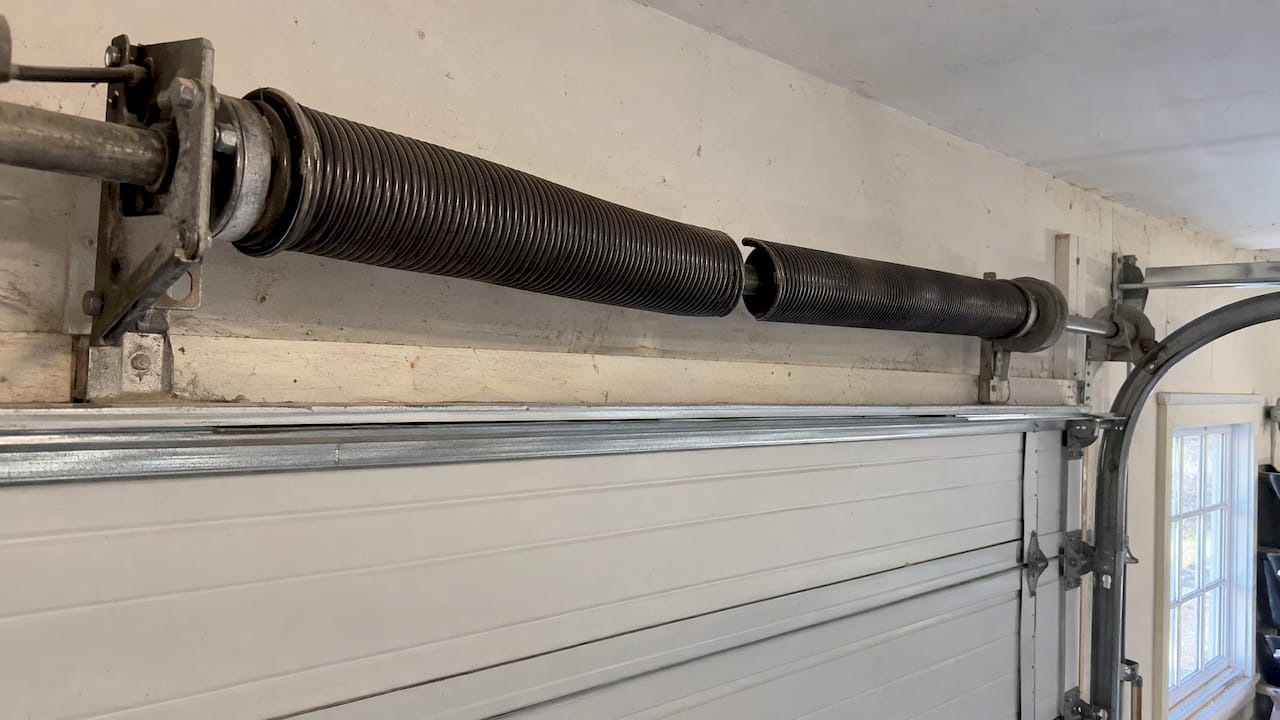
A garage door spring stores enough energy to lift a door weighing a couple hundred pounds, and it releases that energy violently if it breaks or is handled wrongly. Bob Vila’s lubrication guide says damaged or bent springs should be handled by a qualified professional because spring replacement can cause serious injury. Signs of trouble include a visible gap in the coil, a loud bang from the garage, a door that suddenly feels heavy, and a door that will not stay halfway up. Our article on the warning signs a spring is about to break lists what to look for.
Cables
A fraying or loose cable can make a snapping or scraping noise, and a door can hang crooked when one side lets go. Cables are under the same extreme tension as springs. Do not touch them. Our cable repair service is built around this.
Rollers and tracks
Worn rollers rattle, wobble or grind, and a door can feel rough in its path. Tracks can bend from an impact or work loose at the brackets, producing scraping and jerky motion. If your door lurches while closing, our guide on why a garage door jerks when closing walks through the safe checks. Replacing rollers and straightening or replacing track sections is done on our repairs page list of services.
Door that will not close or lock
Noise that comes with a door that stops partway, reverses or will not lock is often a sensor, alignment or track fault. Our guides on a garage door that won’t close and one that won’t lock explain the checks you can do safely.
A worked example: the Saturday-morning squeal
Imagine a two-car door in a Chicopee home that has started to squeal every time it rises. You unplug the opener, pull the release cord with the door closed, and lift it by hand. The squeal is still there, right as the hinges pass the rollers. That tells you it is the door, not the opener. The door lifts easily and stays halfway, so the springs are in balance. You wipe the hinges and roller stems, apply white lithium grease to the metal pivots only, run the door a few times and the noise is gone.
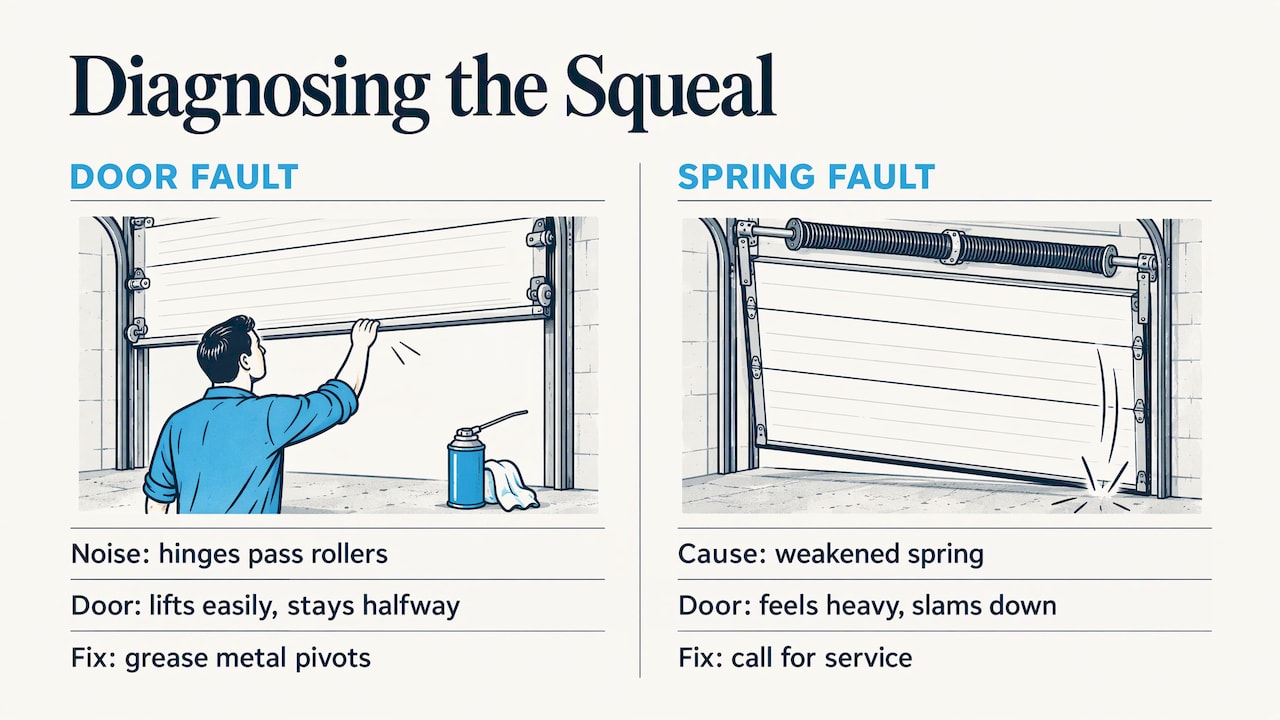
Now imagine the same squeal, but when you lift by hand the door feels heavy and slams down. The noise is a symptom of a spring that has lost its strength. Lubricating will not help and the next step is a call. The same sound, two very different answers, which is why the manual test comes first.
We think a noisy door is a maintenance signal
A squeak is the cheapest warning a garage door will ever give you. Our technicians have a simple view on this: the door is a system, and a noise is rarely a problem in only one part. A dry hinge is a hinge that has been working without care, and the rollers, springs and cables beside it have usually been working without care too.
That is why we prefer to look at the whole door when we visit, not just the part that squeals. Our family-owned team works across Massachusetts and Connecticut, repairing broken springs, cables, rollers, tracks and openers, and we focus on safety and on parts that last. We explain what we find in plain language, so you know what is wearing and what is fine.
If you want the quiet back and want the door to keep working for years, a regular maintenance visit does more than a can of spray. We would rather tune a door that is still healthy than rescue one that has failed at 6 a.m. on a workday. And when something does fail, we offer same-day service and 24/7 emergency repairs.
the author
Keep it quiet: a simple yearly routine
Small noises grow when nothing is done about them. A yearly routine takes about half an hour:
- Look. Check hinges, roller wheels, bracket bolts and the track for looseness, rust or bending. Look at the springs and cables from the floor without touching them.
- Tighten. Snug up the bolts on brackets and hinges. Vibration loosens them over time.
- Clean and lubricate. Wipe the metal moving parts and apply white lithium grease or silicone spray as above.
- Test the balance. Use the halfway lift test with the opener disconnected.
- Check the opener. Lubricate the chain or screw if your manual says to, and look at the mounting.
- Listen. Run the door a few times and note any change from last year.
In New England, cold snaps stiffen grease and make metal contract, so noise often shows up in the first hard freeze. Our guide to preparing your garage door for a New England winter gives a seasonal checklist.
Heavily used doors deserve more attention. If your garage is your family’s main entrance, you open the door several times a day, or you run a business with a commercial door, an annual check is the minimum. Commercial properties can use our scheduled maintenance service so that doors are inspected before they interrupt the working day.
Get the door quiet and safe with a professional tune-up
If you have lubricated the metal parts and the door is still loud, or if the test showed a spring, cable or opener problem, the right next step is a technician. Our door maintenance service covers a full tune-up of the moving parts, and our repair services cover broken springs, cables, rollers and tracks. We serve homeowners and businesses in Massachusetts and Connecticut, including Chicopee, Springfield, Westfield, Longmeadow and Belchertown.

If the door has stopped working, will not close or has a snapped spring, our 24/7 garage door repair line is for exactly that. Tell us what you heard and what you found in the manual test, and we will arrive ready for the job.
FAQ
Why does my garage door squeak when I open and close it?
The most common cause is dry metal hinges, rollers or bearings rubbing without enough lubricant. Worn rollers and loose hardware can add to it. If the squeak comes with a heavy-feeling door, a door that is uneven, or a grinding sound, a spring or cable may be involved and a technician should look at it.
Can I use WD-40 on a squeaky garage door?
It is better not to. Bob Vila advises against standard WD-40 for this job and recommends white lithium grease or silicone spray. Apply either one to the metal hinge pivots and roller stems, not to the track.
Why is my garage door opener so loud?
The cause is usually vibration through the mounting, slack in the chain or belt, a door that is out of balance, or worn gears in the motor unit. Disconnect the door and move it by hand first. If the door is quiet that way, the opener is the source. This Old House describes rubber isolation mounts as one way to reduce the noise passing into the house. Grinding inside the unit calls for a repair.
How often should I lubricate my garage door?
Once a year is a sensible baseline for a door in normal use, as part of a general inspection. Family Handyman recommends yearly lubrication of an opener chain or screw, subject to what your manual says. Doors used many times a day or exposed to harsh winters benefit from a check more often.
When should I stop and call a professional?
Stop if you see a gap in a spring, a frayed or loose cable, a door that drifts when lifted halfway, a loud bang followed by a heavy door, or grinding from inside the opener. Springs and cables carry dangerous tension and should only be handled by trained technicians.
Sources
- Lubricating a Garage Door: Steps and Top Tips, Bob Vila
- How To Muffle a Noisy Garage-Door Opener, This Old House
- Garage Door Tune-Up (DIY), Family Handyman