

A garage door that jerks when it closes is almost always telling you that something in the system is binding, worn or out of balance. The usual suspects are worn rollers, dirty or misaligned tracks, loose hinges and hardware, dry moving parts, and springs or cables that no longer carry the door’s weight evenly. The opener can be involved too, but it is often the messenger rather than the cause. A few safe checks will narrow it down. Anything involving springs, cables or the brackets that hold them calls for a trained technician. If you are in Massachusetts or Connecticut, our team handles garage door repair with same-day service and 24/7 emergency calls.
TL;DR
- Jerking, shaking or bouncing during travel usually means friction or imbalance: worn rollers, dirty tracks, loose hardware or a spring and cable problem.
- You can safely look, listen and clean, and you can run the balance and reversing checks the industry recommends. You should not touch springs, cables or bottom brackets.
- Never raise the opener’s force setting to push through a sticking door. It can defeat the safety reverse.
- If the door fails the balance test, jerks in the same spot every cycle, or reverses on its own, stop using it and call a technician.
- Jerking that also shows up when opening is the same family of problems, so the same checks apply.
Table of Contents
- What “jerking” really tells you
- The most common causes
- Is it the door, the track or the opener?
- Safe checks you can run in 15 minutes
- What not to touch
- What a repair visit looks like
- Our point of view
- Get the jerk looked at
- FAQ
- Sources
What “jerking” really tells you
A smooth door is one where force, weight and friction stay roughly constant from top to bottom. When the door hesitates, lurches or shudders, one of those three has changed at a particular point in its travel. That is useful, because the spot where it happens points to the part.
The door’s weight is carried by springs, not by the opener. The opener mostly guides the door and supplies a small push. So when a door moves in fits and starts, the question is whether the door itself is resisting, or whether the opener is delivering force unevenly.
The manufacturer Amarr notes in its FAQ that a door moving with a jerky motion may come down to a lack of maintenance on the door or the opener. That matches what we see as the most common story: a door that has gone years without attention.
The most common causes
Worn or damaged rollers
Rollers are the small wheels on each side of the door that ride inside the track. When a roller’s bearings wear out, it stops spinning freely and drags, then slips forward. You feel that as a hitch or shudder. A cracked or flat-spotted roller does the same thing. If the jerk happens as one section passes a particular point, a bad roller is a strong candidate.
Rollers are a routine repair. Our roller and track repair covers replacing them and checking the track they run in.
Dirty, dented or misaligned tracks
Tracks are the metal rails that guide the door. Grit, hardened grease or a small dent can make a roller catch and release. Tracks that have drifted out of alignment can pinch rollers at one point and leave them loose at another. A door that bounces in its lowest panel as it reaches the floor often has a track or roller issue near the bottom of the vertical section.
A wiped-clean track tells you something. Clopay’s lubrication guidance says to wipe the tracks with a damp cloth, not to add lubricant to them, because lubricant on the tracks makes it harder for rollers to move and forces the opener to work harder.
Loose hinges and hardware
A door is a stack of panels joined by hinges and fastened with bolts and brackets. Vibration loosens them over time. Loose hinges let panels flex against each other, which shows up as shaking, rattling or a wobble. A bent hinge can also hold a roller at the wrong angle.
Tightening hinge and track-bracket bolts is a normal maintenance step. The exception is the bottom bracket and anything attached to a spring or cable, which are under high tension.
Dry hinges, bearings and springs
Dry metal-on-metal contact creates friction that grabs and lets go. Clopay recommends a silicone-based or garage-door-specific lubricant, or white lithium grease on weight-bearing metal parts, applied to hinge pins, roller bearings (not nylon rollers), springs and the bearing plates at the top of the door, with excess wiped away. The same company explains that WD-40 attracts dirt and dust and can harm rubber, plastic and nylon parts, and suggests relubricating every three to six months.
If lubrication calms the jerk for a week and it returns, the part is likely worn, not just dry.
Springs and cables out of balance
The springs carry nearly all of the door’s weight. When one weakens, stretches or loses tension, or a cable frays or slips off its drum, the door becomes heavy on one side or heavy overall. That can show up as a lurch, a door that drops faster than it should, or a door that crooked-tilts as it moves. If your door sits slightly off level, our guide to a crooked garage door covers the checks.
The industry body DASMA calls springs the most important and most dangerous part of a door. Its advice is to have older springs inspected by a professional, and where a door has two springs, to replace both even if only one has broken. Frayed or worn cables should be replaced only by a trained technician because of the spring tension behind them. If you want to know what failing springs look like before they snap, read 7 warning signs your garage door spring is about to break.
The opener
An opener’s trolley, chain or belt, gears and drive can all wear, and a worn opener can deliver pulses of force instead of steady pull. That tends to be most noticeable at the start of opening or the last few inches of closing. Worn gears, loose chains and failing sensors are all repair jobs we do; see our opener repair and installation page.
A useful warning from the opener side: Chamberlain’s LiftMaster manual says not to use force adjustments to compensate for a binding or sticking door, because excessive force interferes with the safety reverse system or damages the door. If a door sticks, the fix belongs to the door, not to a higher force dial.
Is it the door, the track or the opener?
The easiest way to separate these is to take the opener out of the picture and watch what the door does by itself. This is the logic behind the service routine in the DASMA technician sheet TDS175: disconnect the operator, lift the door slowly, and stop and lower it if it is hard to move.
| What you notice | Likely area | What to do |
|---|---|---|
| Jerk at the same spot every cycle, with or without the opener | Roller, track or hinge at that point | Clean the track, check hardware by eye, book roller or track service |
| Door is smooth by hand but jerks under power | Opener, trolley, chain or belt | Book opener service |
| Door is heavy, slams down or shoots up when released by hand | Springs or cables | Stop. Call a technician |
| Door tilts or one side lags | Cable, spring or track on one side | Stop. Call a technician |
| Bounce in the bottom panel as it lands | Bottom roller, track curve or seal | Look for visible wear, then service |
| Shaking mostly when opening, steady when closing | Often the same causes plus opener startup | Run the same checks |
The other searches people make, such as a garage door shaking when opening or a jerking garage door, are describing the same set of problems. Opening loads the springs and cables differently from closing, so a worn part sometimes only complains in one direction.
Safe checks you can run in 15 minutes
The International Door Association recommends monthly homeowner safety checks. Run them with the door closed, nobody underneath it, and children and pets kept clear.
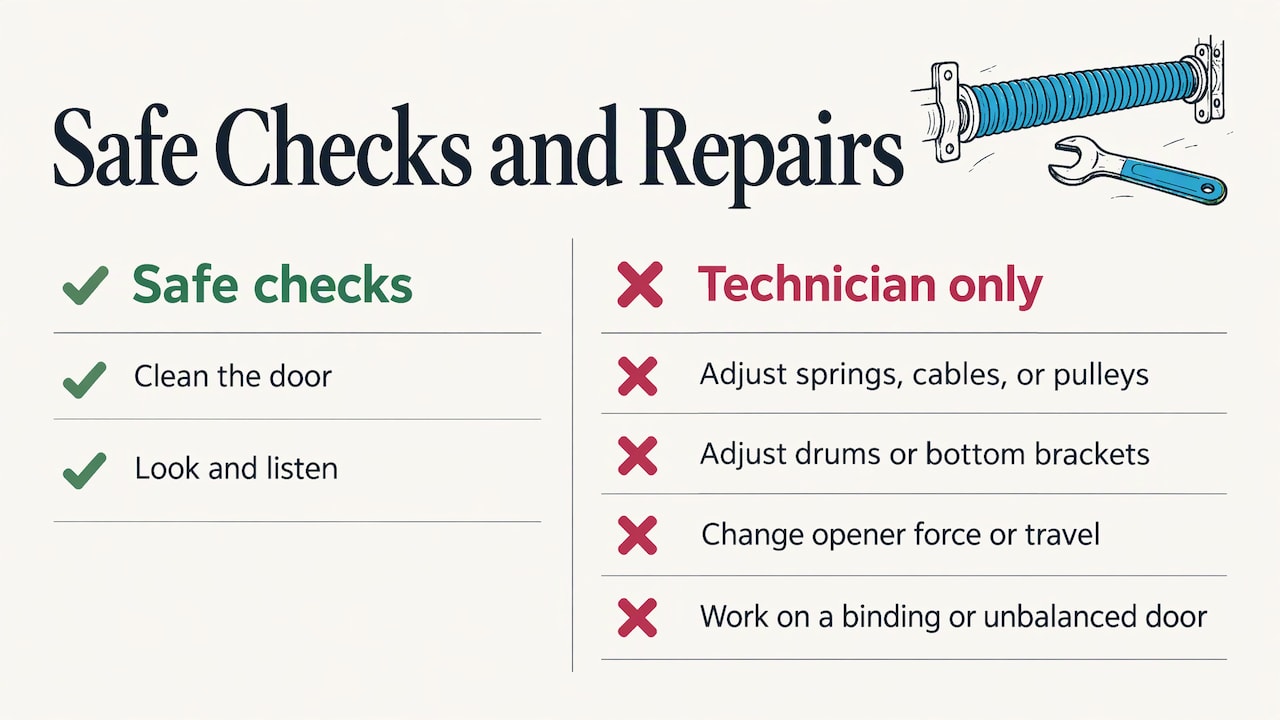
- Look and listen. Run the door with the opener and watch the rollers, hinges and track. Note where the jerk happens, and whether you hear grinding, squeaking or a pop.
- Clean the tracks. Wipe them with a damp cloth. Do not lubricate them.
- Check the balance. With the door closed, pull the red release cord to disconnect it from the opener. Chamberlain’s support page says to lift the door three to four feet off the ground and let go. A balanced door stays put, held by its springs. A door that slams shut or shoots upward is out of balance and needs a professional.
- Feel the manual travel. Lift the door slowly through its whole range. If it binds or is hard to move, lower it and stop there.
- Test the reversing mechanism. After reconnecting the opener, lay a 2×4 flat in the center of the opening. The door should reverse when it touches it. The manufacturer’s manual adds that after any adjustment the door must reverse on a 1-1/2 inch board laid flat on the floor.
- Test the photo eyes. Wave a broomstick in front of a sensor while the door closes. The door should reverse. Clean the lenses with a soft dry cloth.
If any of these tests fails, the IDA’s advice is to have the door serviced by a trained technician. That includes a door that reverses and rises again for no clear reason. We cover that situation in garage door won’t close.
What not to touch
The jerk may tempt you to reach for a wrench. Resist it for anything under tension. Chamberlain’s support page says to call a trained technician if a door binds, sticks or is out of balance, and never to loosen or adjust springs, cables or pulleys. DASMA’s technician sheet goes further: doors are large, heavy objects moving with the help of springs under extreme tension that can cause serious injury or death, and only trained door systems technicians should remove, repair or adjust them.
The practical line is this. Cleaning, looking, listening and the checks above are yours. Springs, cables, drums, bottom brackets and the opener’s force and travel settings are for a technician.
What a repair visit looks like
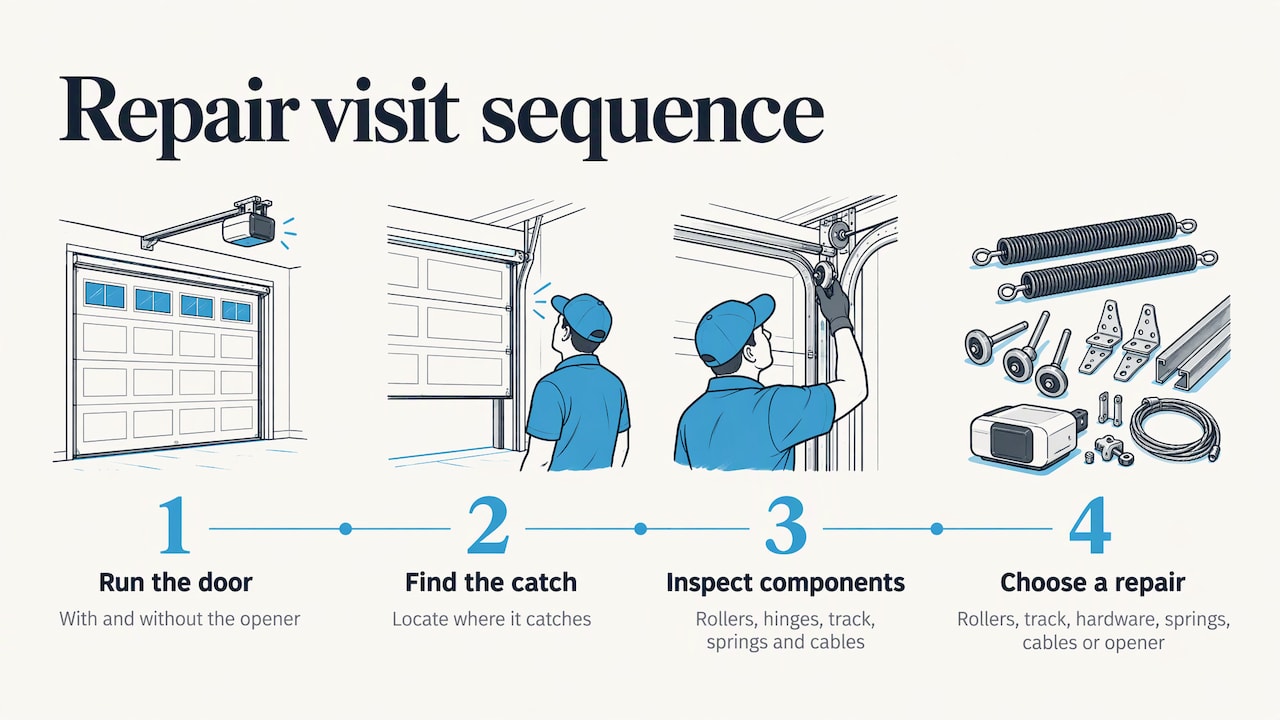
When we are called for a jerking door, the work follows the clues above. A technician runs the door with and without the opener, finds the point where it catches, and checks the rollers, hinges, track alignment, springs and cables. Depending on what turns up, the fix may be new rollers, track adjustment or replacement, tightened or replaced hardware, spring adjustment or replacement, a cable repair, or an opener repair such as gears or sensors. Where it is useful, we can also service the door as part of scheduled maintenance, so wear gets caught before it becomes a jerk.
We do not publish prices for these services, because the cost depends on what the door needs. If a spring turns out to be the cause, broken spring repair is where that work lives.
Our point of view
Most jerking doors we are asked about have been jerking for a while. The owner got used to it, then one day it got worse, or the door stopped altogether. By then a cheap roller has often worn a track, or a weak spring has let a cable fray.
Our view is simple: a door that moves in fits and starts is cheaper to fix early than late, and it is far safer to have a trained technician do anything that involves tension. We are a family-owned team serving Massachusetts and Connecticut, and we offer same-day service and 24/7 emergency repairs because a door that will not move properly rarely waits for a convenient time.
The best result is a door that runs smoothly by hand and under power, passes its safety reverse tests, and has had its rollers, hinges, tracks, springs and cables looked at together instead of one at a time. That is how we approach every call.
the author
Get the jerk looked at
If the checks above point to worn parts, an unbalanced door or a tricky opener, our technicians handle residential and commercial doors across Massachusetts and Connecticut, including emergency calls at any hour. Tell us where it jerks and whether it happens on the way up, down or both, and we will arrive knowing what to look for. See our residential garage door services, or contact us through Speedy Garage Door Services.

Business owners with commercial doors can find the relevant service on our commercial page.
FAQ
Why does my garage door jerk only when closing?
Closing is when gravity helps the door, so a weak spring or a sticking roller can show up as a sudden drop or a hitch. Worn rollers, dirty tracks and loose hinges are common causes. Run the balance test and watch where in the travel it happens before deciding whether it is a door or opener issue.
Why does my garage door shake when opening?
The same family of problems applies: worn rollers, loose hardware, track misalignment, dry parts or a spring and cable imbalance. Opening also loads the opener, so a worn trolley, chain or gear can add shake at the start. If the door is smooth when lifted by hand but shakes under power, the opener is the likelier culprit.
Can I use WD-40 on a jerky garage door?
It is not the right product. Clopay says WD-40 attracts dirt and can harm rubber, plastic and nylon parts. Use a silicone-based or garage-door-specific lubricant on hinges, roller bearings and springs, and leave the tracks to a damp cloth.
Should I raise the opener’s force setting to stop the jerking?
No. Opener manuals warn against using force adjustments to compensate for a binding or sticking door, because it can interfere with the safety reverse. The jerk comes from the door, so it needs a repair, not more force.
When should I stop and call a technician?
Call when the door fails the balance test, slams down or shoots up when released by hand, tilts to one side, shows frayed cables, or reverses without cause. The same goes for anything involving springs, cables or their brackets, which are under high tension.
Sources
- Amarr: Answers to Common Garage Door Questions
- International Door Association: Safety & Maintenance
- Chamberlain Group: How to test the balance of a garage door
- LiftMaster garage door opener manual
- Garage door opener manual, safety reverse test
- DASMA: Garage door safety tips
- DASMA TDS175: Trained Door Systems Technician, Checking a Garage Door
- Clopay: How to Properly Lubricate Garage Door Components
- Clopay: Why You Should Never Use WD-40 on a Garage Door