

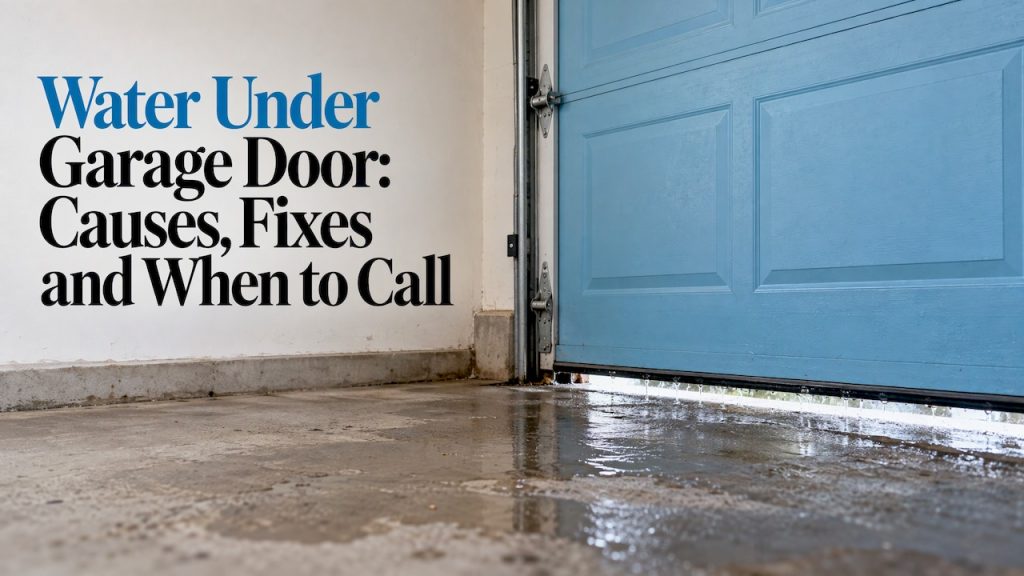
Water under a garage door almost always comes from one of three places: a worn or damaged bottom seal, a gap between the door and an uneven floor, or runoff that is pointed at your garage instead of away from it. Start by watching where the water first crosses the threshold, because that tells you which of the three you have. A seal or threshold fixes the first two. The third needs the ground outside changed.
This guide walks you through the diagnosis, the repairs you can do in an afternoon, the drainage problems a seal will never solve, and the moments when a door problem is really a job for a technician. We are a family-owned garage door company serving Massachusetts and Connecticut, so the examples lean toward New England weather.
TL;DR
- Look for daylight under the closed door, a draft, or water when the outside of the door gets wet. Any of these points to a seal that has stopped doing its job.
- A new bottom seal fixes door-edge leaks. An adhesive threshold fixes a floor that lets water slip under the door.
- If water pools broadly along the slab, the driveway slope or drainage is the real problem, and a seal will only hide it.
- Keep away from wet outlets, cords and the opener. Shut off power safely and call a licensed electrician if water reached them.
- A door that is bent, misaligned or has damaged sections will not seal no matter what rubber you fit. That is a repair, not a weatherstrip job.
Table of Contents
- Is it normal for water to get under a garage door?
- Find the source: seal, floor or drainage
- Replace the bottom seal
- Add a threshold for uneven floors
- When drainage is the real problem
- When the door itself is the problem
- Electrical safety when water reaches the garage
- A New England seasonal routine
- Get the door checked
- FAQ
- Sources
Is it normal for water to get under a garage door?
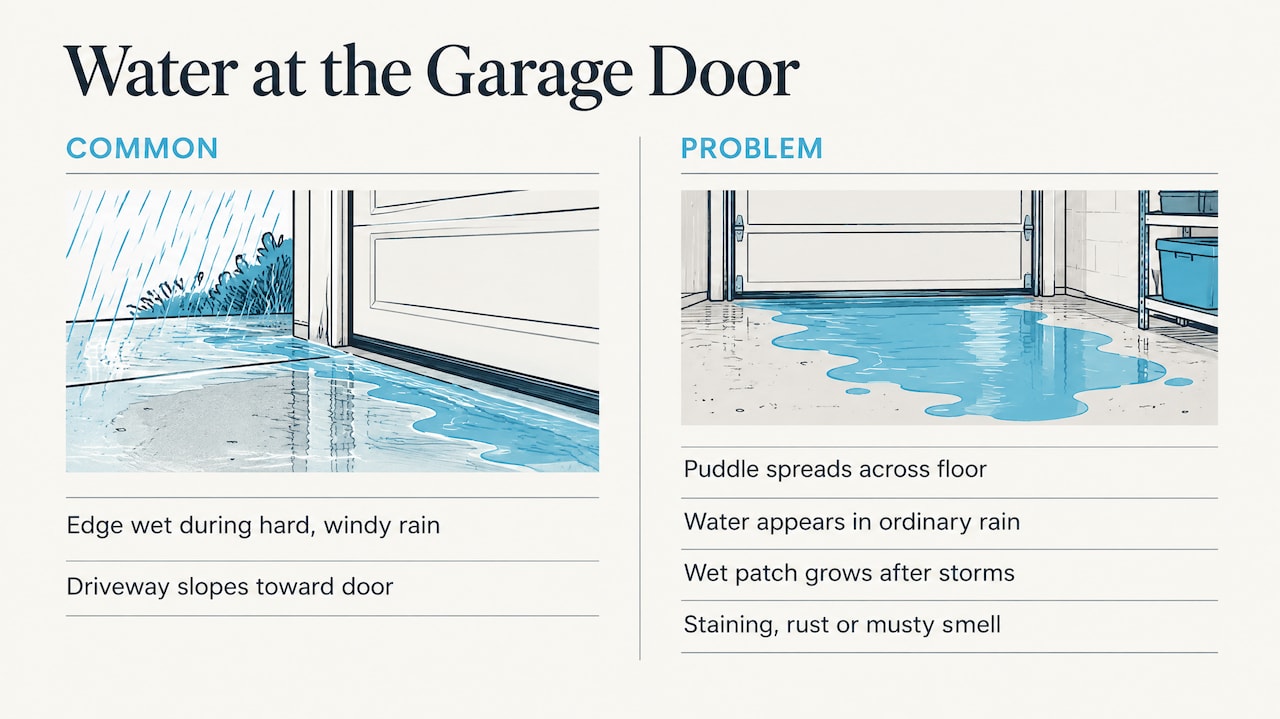
A little water at the very edge during a hard, wind-driven rain is common, especially when the driveway slopes toward the door. But a puddle that spreads across the floor, or water that shows up in ordinary rain, means something has failed or was never set up well.
Think of it this way. A garage door is not a window. It is a large, moving panel that has to close against a concrete floor that was poured and finished by hand. The seal at the bottom is the only thing that bridges the small, uneven gap between them. When that seal is fresh and the floor is reasonably flat, the gap is closed. When it hardens, tears, flattens or the floor has settled, water finds the gap.
The useful question is not whether it is normal, but whether it is getting worse. Take a photo of the damp area after each storm. If the wet patch grows, or if you now see staining, rust on the bottom of the door, or a musty smell, treat it as a problem to fix this season.
Find the source: seal, floor or drainage
Fixing the wrong thing is the most common reason water keeps returning. Run through these checks before you buy anything.
Check the bottom seal
Close the door. In the daytime, stand inside and look along the bottom edge. Daylight under a closed door, a draft, or water when the outside of the door gets wet all suggest that the bottom seal needs replacing. Then look at the rubber itself:
- Is it cracked, brittle or torn?
- Is it flattened or pulled out of its channel at one end?
- Does it look pinched or shredded where it meets the door corners?
If the seal is damaged, replacing it is the right first move. Weatherstripping on the top and sides matters too. The same source notes that if the old stripping no longer seals against the door, you should install new stripping there.
Check the floor
If the seal looks fine but water still gets in, lay a straight board or a long level on the floor right under the door line. Gaps between the board and the concrete, or a dip in the middle, mean the floor is letting water through even where the seal touches down. Dips are common in older garages where the slab has settled, and in the middle of wide doors where the concrete sags slightly.
A rough test: pour a cup of water along the outside of the closed door and watch where it travels. If it slides under at one low spot, a threshold will fix it. If it runs under the full width, the issue is the seal or the door itself.
Check what happens outside
Walk the driveway during or right after rain. Water that arrives in a sheet from uphill, from a downspout, or from a low spot in front of the door is a drainage problem. Look at where the gutter downspouts discharge, whether the driveway pitches toward the garage, and whether leaves or snow melt have no place to go.
This is where a lot of homeowners get tripped up. If water pools broadly near the slab, a seal can only hold back so much. The University of Minnesota Extension describes a drainage plane that directs water outward and downward, with layers overlapping like shingles. The same idea applies at ground level: the surface in front of your garage should carry water away from the opening, not toward it.
Quick diagnosis table
| What you see | Likely cause | First fix |
|---|---|---|
| Daylight along the bottom edge of the closed door | Worn, torn or flattened bottom seal | Replace the bottom seal |
| Water at one low spot only | Dip in the concrete | Adhesive threshold |
| Water along the whole width, pooling outside | Driveway slope or runoff | Fix grading or add a drain |
| Water enters at one corner | Damaged seal end, bent track, or misaligned door | Inspect the door and tracks |
| Water only in wind-driven rain | Gap at sides or top | Replace side and top weatherstripping |
Replace the bottom seal
A new bottom seal is the least expensive fix and the one that works most often. Seals come in two common styles: strip-style seals and U-shaped gaskets that slide into a channel. Check what is on your door now, and buy the same type, in the same width, so it fits the retainer on the bottom of the door.
The general steps look like this:
- Open the door to a comfortable working height and make sure it cannot drop on you. If it does not stay put, stop and call a technician.
- Slide out the old seal from the retainer channel. Pull it from one end.
- Clean the channel of dirt, old rubber bits and debris.
- Measure the door width and cut the new seal a little long, so it can be tucked in at the ends.
- Slide the new seal into the channel, taking care not to tear the lip as it goes in.
- Close the door and check along the bottom for light and for even contact with the floor.
A tip for New England homeowners: do this job on a mild day. Rubber stiffens in the cold and is harder to feed into the channel without tearing. If you wait for a deep freeze, the work is slower and the seal is more likely to crack.
If the door has been dragging, if the bottom panel is dented or rusted through, or if the retainer itself is bent, a new seal will not sit right. That is a section problem, not a seal problem. Our section and track repair work covers exactly this.
Add a threshold for uneven floors
When the floor is the problem, the standard answer is an adhesive threshold: a raised strip of rubber or vinyl that glues to the concrete and meets the closed door. It gives the bottom seal something to press against and creates a small dam in front of the opening.
Installation matters more than the product. The manufacturer instructions for one common type, the Storm Shield threshold, call for clean, dry concrete above 40°F (5°C), alignment with the closed door, adhesive applied as directed, and at least 24 hours of cure time before you drive over it. Those are good rules for most adhesive thresholds. In practice:
- Sweep and scrub the strip of floor where it will sit. Oil and dust stop adhesive from bonding.
- Let the concrete dry fully. A threshold glued over damp concrete peels.
- Dry-fit the strip with the door closed so the door’s seal lands on the slope, not past it.
- Keep cars off it for the full cure time.
In Massachusetts, that 40°F rule rules out much of the winter. If you are reading this in November and rain is coming, plan the work for the next dry day above that temperature, or for spring. Meanwhile, towels and a squeegee are a temporary measure, not a plan.
When drainage is the real problem
If water sits in front of the garage or comes in from uphill, the door is only where the problem shows up. Two fixes are common.
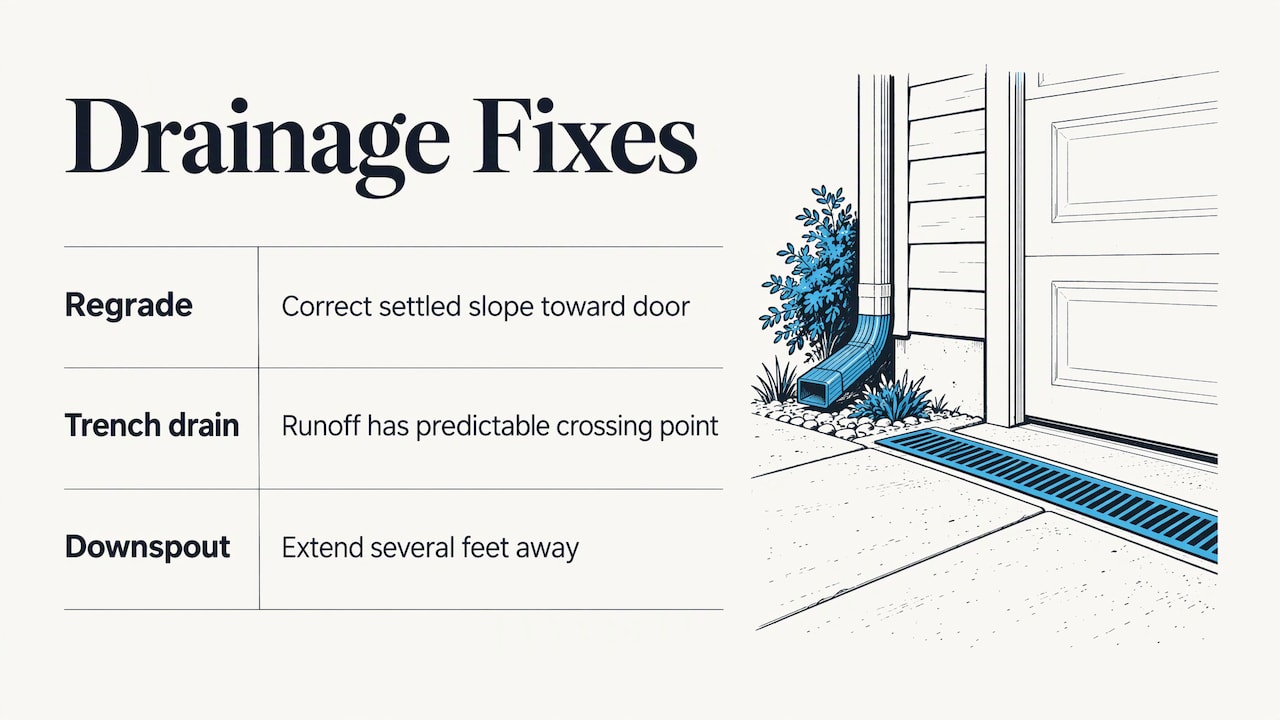
Regrade the approach. Driveways should slope away from the garage. A shallow low spot, or a driveway that settled toward the door, can be corrected. Masonry and paving contractors handle this. If your fix involves gravel or a drainage bed, this overview of drainage gravel size and where to use it is a handy guide to what goes where.
Add a trench drain. A channel drain across the driveway works when surface runoff has a predictable crossing point. SturdyMark notes that the drain needs a safe place to discharge and regular maintenance, because grates collect leaves and sediment. The same source advises checking grading first when water pools broadly near the slab, since a drain can otherwise become a permanent patch over a larger pitch problem.
One more outdoor check: gutters. A downspout that dumps beside the garage door sends a lot of roof water straight at the opening. Extending the downspout several feet away is a cheap step that often changes how much water reaches the door.
A seal and a drain are not either-or. Many garages need both: drainage that moves the bulk of the water, and a seal that handles splash and wind-driven spray.
When the door itself is the problem
Sometimes the weatherstripping is fine, the floor is fine, and the door still lets water in. Then look at the door.
- Bent or dented bottom section. The seal cannot sit evenly against the floor.
- Misaligned tracks. One side of the door hangs lower or higher than the other, leaving a wedge-shaped gap.
- Worn rollers or loose hardware. The door sags as it closes.
- Spring imbalance. A door that is not balanced may stop short of the floor or hit it unevenly.
- Opener travel limits set wrong. The door stops before it fully closes.
If the door is not closing all the way, the cause may not be water-related at all. Our guide on a garage door that won’t close covers the safe checks you can make.
Torsion springs, cables and the bottom brackets are under high tension. Do not loosen or adjust them yourself. That work calls for trained technicians with the right tools.
Electrical safety when water reaches the garage
If water has reached outlets, extension cords, the opener or other electrical equipment, treat it as a hazard first and a leak second. Do not touch wet electrical equipment or stand in water near it. If you can reach the breaker panel without wading through water, switch off the circuits serving the garage. If you cannot, or if you are unsure, call your utility or a licensed electrician before doing anything else.
A wet opener should be checked before it is used again. Our technicians can look at the opener, sensors and receiver once the power situation is made safe, but the electrical side belongs to a licensed electrician.
If you are also thinking about the garage’s security after a storm, a door that does not close fully is an open invitation. Reading a garage door security guide can help you decide what else to tighten up.
A New England seasonal routine
Water problems tend to show up in spring thaw, heavy fall rain and nor’easters. A short routine keeps them from surprising you:
- Late fall: inspect the bottom seal and side stripping before the freeze. Clear leaves from gutters and from the driveway in front of the door.
- Winter: keep snow banks from piling against the door. Melting snow that sits against the seal gets pushed under it. We cover more in our guide to preparing your garage door for a New England winter.
- Spring: look for new settling cracks and low spots after the thaw. Check the threshold glue line.
- Summer: a good time for adhesive jobs, since the concrete is warm and dry.
Regular door maintenance also catches the small things, like loose hardware and worn rollers, that cause gaps before they turn into leaks.
Our perspective
In our experience, most homeowners treat water under the garage door as a rubber problem and stop there. We see the door as a system. The seal, the bottom section, the tracks, the springs and the opener travel all decide whether the door closes flat against the floor. When one of them drifts, the seal is the first place the trouble shows.
That is why we start by looking at how the door closes, not just at the strip along the bottom. A seal fitted onto a sagging or misaligned door is a short-lived fix. A door that is aligned, balanced and closing fully gives a good seal the best chance to do its job.
We are a family-owned team, and we would rather explain what we find in plain language than sell you more than you need. If the water is coming from your driveway, we will say so and point you toward the right trade. If it is the door, we can fix it the same day in many cases.
the author
Get the door checked
If your door is dragging, bent, out of alignment, or simply not closing flat, a technician can find out why. Speedy Garage Door Services handles section and panel replacement, track repair, rollers, springs, cables and openers for homes and businesses across Massachusetts and Connecticut, with same-day service and 24/7 emergency repairs. Details are on our repairs page.

If your door is old enough that sections keep failing, a new door installation may be a better use of money than another patch. If you are near Chicopee, our local team is the quickest to reach you. You can also start from speedygarageservices.com and book from there.
FAQ
Why is water coming under my garage door only when it rains hard?
That pattern usually points to a marginal seal or a driveway that slopes toward the door. In light rain the seal copes, but heavy or wind-driven rain pushes more water at the gap. Replace the bottom seal first, then check how water moves across the driveway.
What can I put under a garage door to keep water out?
The two usual answers are a new bottom seal on the door and an adhesive threshold on the floor. The seal closes the gap at the door edge, and the threshold raises the floor line where the concrete dips. Follow the manufacturer’s directions on temperature and cure time.
Can I fix the seal myself?
Replacing a bottom seal is a job many homeowners do with basic tools. Springs, cables and brackets are different. They are under heavy tension, so leave them to a trained technician. If the door will not stay open at working height, do not work under it.
When should I call a professional?
Call when the door is bent, sagging, closing unevenly, or has damaged sections or tracks. Call a licensed electrician if water has reached outlets, cords or the opener. For slope and drainage, a paving or drainage contractor is the right call.
Sources
- 6 Ways to Weather-Seal a Garage Door, The Spruce
- Sealing roofs, walls, windows and doors to keep water out, University of Minnesota Extension
- Storm Shield Installation Instructions
- Trench Drains for Driveways & Garages, SturdyMark
- Drainage Gravel Size: What to Use and Where
- Why Secure Garage Doors: A Homeowner’s Safety Guide