

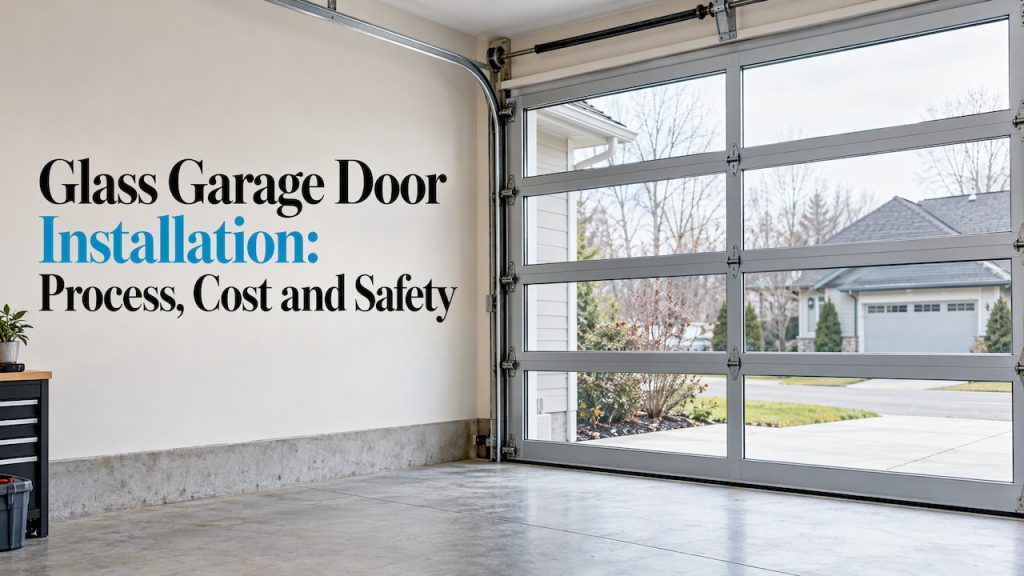
A glass garage door is a full new door installation: measuring the opening, hanging aluminum-framed glass sections on tracks, setting the springs, connecting the opener and testing the safety reversal. Expect to pay roughly $2,500 to $8,000 for the door and labor. The most dangerous step, winding the springs, should go to a trained technician. We install new doors across Massachusetts and Connecticut, and this guide walks through what a good installation involves so you can judge any quote.
TL;DR
- Glass garage door installation costs about $2,500 to $8,000 in most projects, with labor typically $700 to $1,500 of that.
- Glass and aluminum sections are heavy and fragile, and the torsion spring stores enough energy to cause serious injury. Spring winding is a professional job.
- The job ends with tests: balance, even gaps, a full-length bottom seal and an opener that reverses on contact with an obstruction.
- Cracked, fogged or loose panes do not always mean a new door. Often a section or panel replacement fixes it.
- Check local building codes before you order, especially for glazing type, wind ratings and permits.
Table of Contents
- What a glass garage door installation includes
- Step 1: Measuring the opening
- Step 2: Removing the old door
- Step 3: Assembling and stacking the glass sections
- Step 4: Tracks and rollers
- Step 5: Springs and cables
- Step 6: Opener, sensors and testing
- How much glass garage door installation costs
- Code checks before you order
- Glass garage door replacement: door or just the glass?
- Why a professional installation makes sense
- Get your glass door quoted
- Keeping a glass door in good shape
- FAQ
- Sources
What a glass garage door installation includes
A glass door is built differently from a standard steel door. Each section is usually an aluminum frame holding a large glass panel, which gives you the full-view look: daylight in the garage and a modern front elevation. The installation sequence is the same as for any sectional door, but the margin for error is smaller. A mistake that is invisible on a solid steel door shows up immediately on a glazed one.
The work breaks into six stages:
- Measuring and preparing the opening.
- Removing the old door, springs and hardware.
- Assembling and stacking the glass sections.
- Mounting the tracks and rollers.
- Installing and setting the springs and cables.
- Connecting the opener and testing everything.
We cover each below, with where it tends to go wrong.
Step 1: Measuring the opening
Everything starts with measurements. The width and height of the opening are the obvious numbers, but the space around the opening matters just as much. Manufacturer guidance for sectional doors calls for at least 3-3/4 inches of side room on each side for standard springs, about 10 inches of headroom for extension springs or 12 inches for torsion springs, and the door height plus 18 inches of backroom. Those figures decide whether a particular door fits your garage at all.
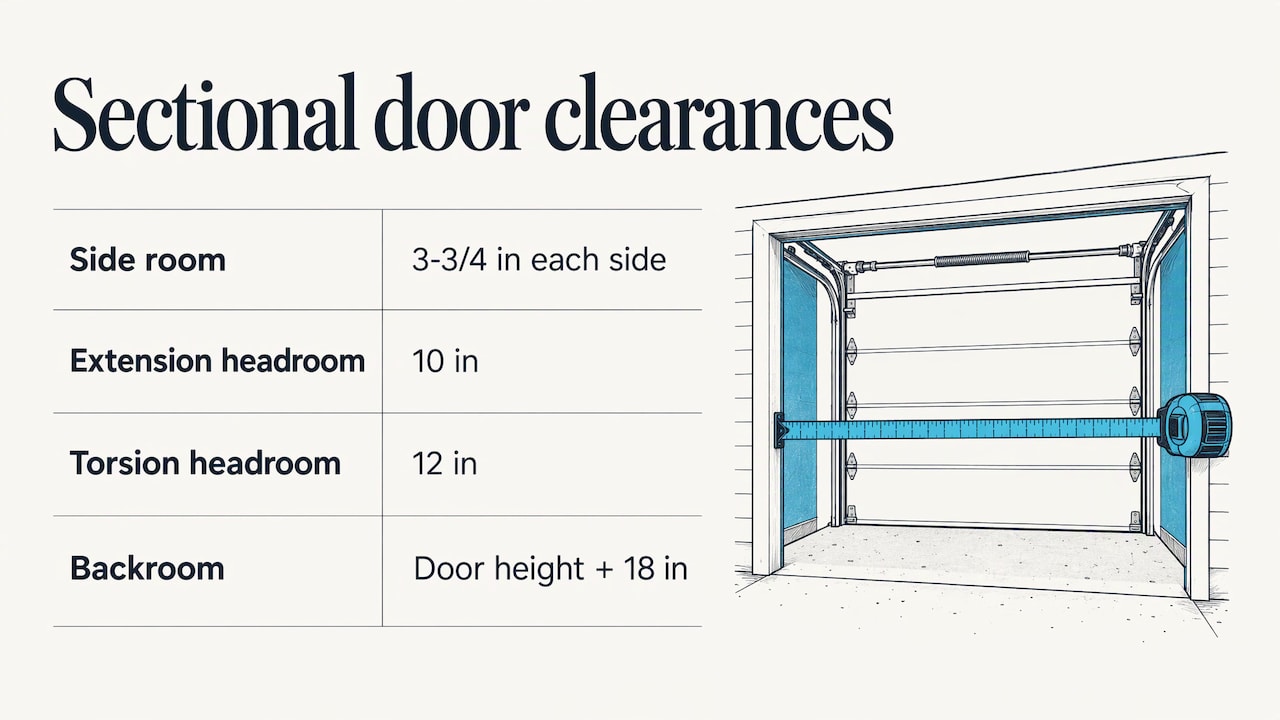
A careful measurement visit also checks that the floor is level across the opening, that there is enough headroom for the tracks in the raised position, and where the structural framing sits, because the tracks must bolt into solid members rather than drywall.
Where it goes wrong: ordering from a nominal size rather than a measured one, or ignoring a floor that slopes. On a glass door a floor that is out of level leaves an uneven gap along the bottom seal that you will see every day. When we handle a new door installation, the measuring is part of the job, so the door you order is built for your actual opening.
Step 2: Removing the old door
Taking the old door out is not simple demolition. The garage stays open and unsecured while the old door comes down and the new one goes up. If the garage door is the only way in or out, you cannot leave the space until the track is installed, so move vehicles, tools and anything you need before the crew starts.
An old door under spring tension is hazardous. An unsprung door can be very heavy, and a torsion spring that is still wound can cause severe injury if released wrongly. This is the stage where a trained technician earns the fee. Our broken spring repair and spring adjustment service covers the same spring work that a door replacement involves.
Step 3: Assembling and stacking the glass sections
The bottom section goes in first, then each section is stacked and hinged to the one below. Hinges, rollers and struts attach to the frames before the sections go up. This is the stage where glass doors demand more care:
- Sections must be handled flat and supported, never flexed.
- Panel alignment is visual as well as mechanical. Manufacturer guidance notes that a 2 mm step between panels is invisible on a solid door but obvious on a glazed one.
- Fasteners must be tightened evenly so the frame does not twist and put stress on the glass.
A crew that installs doors every week knows how much torque a frame takes and how to carry a full-view section without stressing it. That experience is much of what you are paying for.
Step 4: Tracks and rollers
The vertical and horizontal tracks guide the door as it travels. They must be plumb, level and parallel, and fixed to structural framing. The rollers are inserted as sections go up. If the tracks are even slightly out of line, the door binds, the rollers wear fast and the glass frames take uneven stress.
On glass doors, smooth travel is not only about noise. Repeated binding transmits vibration into the frames and glazing. A correctly aligned track set is the cheapest protection against future panel problems. If your current door scrapes or sticks, see our guide on what to check when a garage door won’t close.
Step 5: Springs and cables
Springs do the lifting. A glass door with full-view aluminum sections can weigh quite differently from a steel door, so the springs must be matched to the actual door weight and height, not to a generic size. Manufacturer guidance is clear that the torsion spring should be wound only after the door is fully assembled and the tracks are confirmed, following the specified number of turns, and that this is the step where people get hurt.
We do not suggest homeowners wind these springs themselves. A technician brings the winding bars, the experience and the correct spring for your door. Cables are then attached and checked for even tension on both sides, because uneven tension tilts the door and strains the glass frames. We also offer cable, roller and track repair for the same parts as they age.
Step 6: Opener, sensors and testing
The opener is connected last. Federal rules matter here. Residential openers made on or after January 1, 1993 must have inherent entrapment protection that reverses the door within two seconds, plus secondary entrapment protection. In practice, that means a photoelectric sensor near the floor and a door that reverses when it meets resistance.
The federal safety rule’s instructions say that after installation the door must reverse when it hits a 1-1/2 inch object, or a 2 by 4 laid flat, on the floor, and the opener should be tested monthly. The Consumer Product Safety Commission updated its garage door operator rule, effective May 13, 2024, to reflect changes to the UL 325 standard, including changes to how sensors are tested. A current opener sold today already meets it.
If you want to replace or upgrade your opener along with the door, see our opener repair and installation page, which also covers keypads, remotes, sensors, receivers and gears.
The final check
After installation, the door should pass these tests:
- Balance: disconnected from the opener, it stays put at mid-travel when released.
- Gaps: the perimeter gap is even all around.
- Seal: the bottom seal touches the floor along its full length.
- Reversal: the opener reverses on obstruction.
- Cycles: five full open and close cycles with no rubbing, slack cable or hinge movement.
These checks are the point of a professional installation: you get a door that has been proven to work, not just hung. For more on why post-work checks matter in any home system, read about safety checks at home.
How much glass garage door installation costs
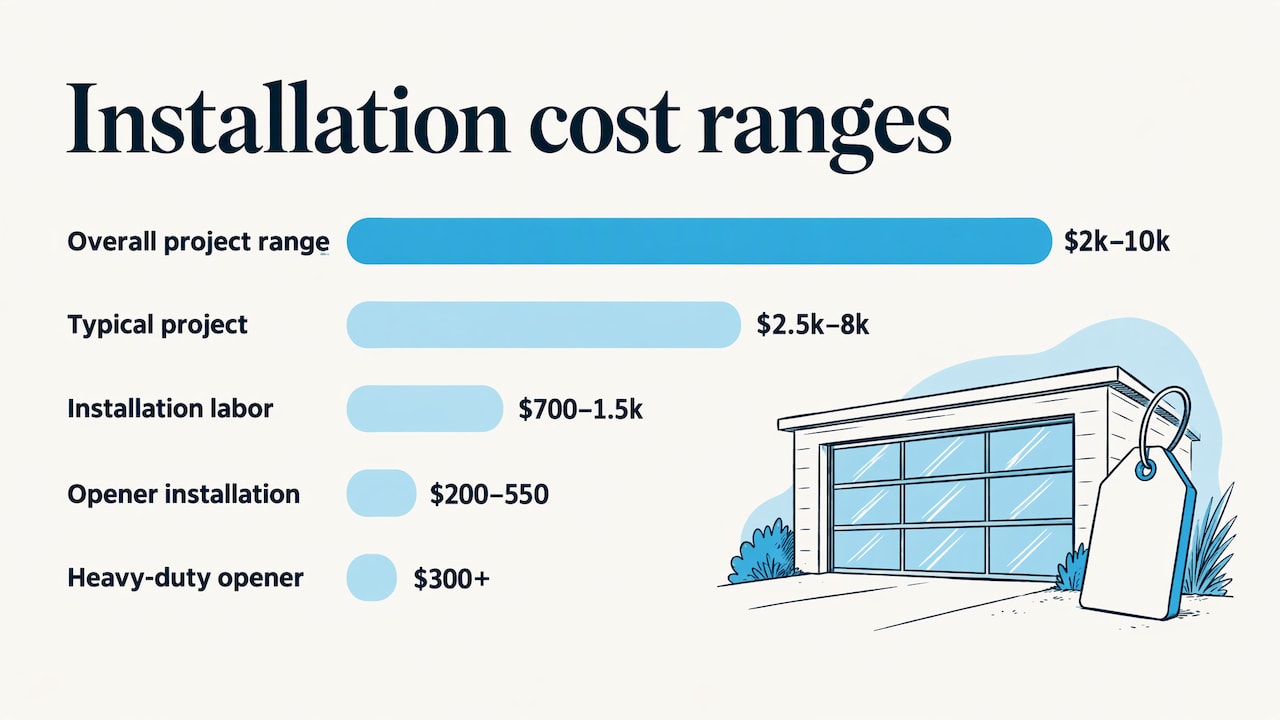
National figures give a useful range. HomeAdvisor’s 2026 cost guide puts glass garage door installation at $2,500 to $8,000 for most projects, with an overall spread of $2,000 to $10,000. The same guide lists typical installation labor at $700 to $1,500 and opener installation at about $200 to $550, with heavy-duty openers at $300 or more.
What moves the price:
| Factor | Effect on cost |
|---|---|
| Door size | A double-wide door needs more glass, frame and spring capacity |
| Glass type and thickness | Tempered, insulated or tinted glass costs more than basic panes |
| Frame material | Aluminum is the usual choice for full-view doors, and finishes vary |
| Customization | Special colors, sizes or layouts add cost |
| Opener | A new or heavy-duty opener is a separate line item |
| Old door removal | Labor and disposal, especially if springs need safe unwinding |
These are national figures, and the price for your house depends on your opening and your door. We do not publish fixed prices, because the right quote follows a look at your garage. For a deeper breakdown of what drives a total, see our guide to what a garage door replacement really costs.
Code checks before you order
Glass in a garage door is regulated glazing, and requirements vary by town and state. Two points to confirm before you order:
Glazing type. Many areas require tempered safety glass in garage door windows, and some wildfire-prone jurisdictions are stricter. For example, California’s wildland-urban interface rules say exterior glazing, including glazed openings in garage doors, must use multipane glazing with at least one tempered pane or another approved assembly, and those rules also limit gaps around the door to 1/8 inch to resist embers. That is a California rule, not a national one, but it shows how local codes can drive the product you choose.
Wind and permits. In hurricane or high-wind regions, the door may need an impact rating and extra reinforcement beyond standard instructions. Some towns require a permit for a new door. In Massachusetts and Connecticut, your local building department can tell you what applies to your address, and we can walk you through it when we quote the job. Our page on custom garage door installation, cost, process and code checks goes into more detail.
Glass garage door replacement: door or just the glass?
Many people searching for glass garage door replacement have a cracked pane, not a failed door. Sort your situation like this:
- One cracked or loose pane, frame in good shape: a panel or section replacement is usually the sensible fix.
- Fogging between layers: the seal in an insulated pane has failed. Replace that pane.
- Several broken panes, bent frames, or a door that no longer balances: replacement of the door is often the better value, because you would be repairing a worn system piece by piece.
- Sharp edges or shattered glass: keep people and pets away from the door and call for service. Broken tempered glass crumbles into small pieces, but the edges and the weakened frame are still a hazard.
If you are unsure, our guide on whether to repair or replace your garage door lays out the decision step by step. We handle panel replacement and new door installation, so you do not have to choose a door type before you know what is wrong.
If the door is stuck open or will not close because of damage, treat it as a security issue and call us for 24/7 emergency service.
Why a professional installation makes sense
The difficulty with a glass door is that mistakes show. Hung out of true, a steel door still works. A glass door looks wrong, binds, and puts stress on frames and panes. The work also involves heavy sections, a wound spring and an opener that must meet federal safety requirements. A crew that does this regularly brings the right tools, a helper for lifting and a repeatable testing routine.
A full installation also commonly takes most of a day, so scheduling and preparation matter. Clear the garage, plan for the opening to be unsecured for part of the day, and decide in advance where vehicles will go.
Our view
We are a family-owned company, and we see the same pattern with new doors. People pick a door for how it looks, and the part that decides whether they are happy in five years is the installation: the measurements, the track alignment, the spring match and the final safety tests.
A glass door shows every error, so it rewards care. We handle new door installation, spring work, opener and sensor installation and ongoing maintenance, which means one team can take the door from the old opening to a tested finished door. When something does go wrong later, we offer same-day service and 24/7 emergency repairs across Massachusetts and Connecticut.
Our advice: get the door measured properly, confirm local code requirements for the glass before ordering, let a technician handle the springs, and book a maintenance visit once a year so small wear never becomes a broken panel.
the author
Get your glass door quoted
If you are planning a glass garage door, our team handles new door installation for homes and businesses in Massachusetts and Connecticut, including opener installation, spring work and testing. Request a new door installation, or see our garage door installation in Massachusetts page. Businesses can look at our commercial garage door installation services.
Keeping a glass door in good shape
A new door lasts longer with simple routine care. Manufacturer guidance suggests checking springs annually, looking for frayed cables, bent tracks or broken hinges, and inspecting the bottom weather seal. Add these glass-specific habits:
- Wipe the glass and frames with a soft cloth and mild soap, not abrasive cleaners.
- Look for new fogging between panes, which signals a failed seal.
- Keep the opener’s safety test on your calendar: reversal on a 2 by 4, once a month.
- Keep sensors clean and aligned. A blocked or misaligned sensor is the most common reason a door will not close.
Our garage door maintenance service covers tune-ups for springs, cables, rollers and tracks, so wear is caught before it reaches the glass.
FAQ
How long does glass garage door installation take?
Plan on most of a working day. Installation guidance for sectional doors puts a typical job at roughly nine to twelve hours, and glass sections need slower, more careful handling. Removing the old door, setting the track and testing the opener all add time.
Can I replace just one glass panel instead of the whole door?
Often yes. If the frame is straight and the door still balances, a single pane or section can be replaced. If several panels are damaged or the frame is bent, replacing the door usually costs less in the long run than repeated repairs.
Do I need a permit for a new glass garage door?
It depends on your town. Many areas do not require one for a like-for-like door swap, but some require a permit or specific glazing, such as tempered glass. Check with your local building department before ordering, and we will go over it when we quote the job.
Does the opener have to be replaced with the door?
Not always. Federal rules require openers made since 1993 to have entrapment protection, so most existing openers can work with a new door if they are in good condition and strong enough for the door’s weight. We check the opener and sensors during installation and replace parts that do not pass.
Sources
- HomeAdvisor: glass garage door cost
- Clopay: how to install a garage door
- HIHAUS: installing an aluminum glass garage door
- DASMA: federal and state residential garage door operator requirements
- Cornell Law: 16 CFR 1211.16
- Federal Register: CPSC garage door operator rule, 2024
- UpCodes: exterior windows, skylights and doors
- Clopay: garage door replacement parts guide