

A replacement garage remote has to match your opener’s brand, model and radio system, and it has to be programmed to the opener’s memory. If the remote is simply dead or weak, the cause is often the battery, a nearby source of interference or the opener’s receiver, and a new remote will not cure that. We are Speedy Garage Door Services, and we handle remotes, keypads, receivers and opener repair for homes and businesses in Massachusetts and Connecticut. Below is the full routine: how to tell what is wrong, how to pick the right remote, how to program it and what to do if one is lost.
TL;DR
- Test the wall button first. If it opens the door and the remote does not, the problem is the remote, its battery, its programming or interference, not the door.
- Replace the battery, then reprogram, before you buy anything. If every remote fails at once, suspect the opener’s receiver or circuit board.
- A replacement remote must be compatible with your opener’s brand and model. The label on the opener tells you which one you have.
- Lost or stolen remote: secure the door and erase the opener’s memory so the missing remote is useless.
- Our Keypads & Remotes and opener service covers diagnosis, replacement and programming.
Table of Contents
- First, Work Out Why the Remote Stopped Working
- Weak Signal and Short Range: Look Past the Remote
- How to Choose a Replacement Garage Door Remote
- How to Program a Replacement Remote
- Lost or Stolen Remote: Secure the Door First
- When Replacing the Remote Is Not the Answer
- Keep the Whole System Healthy
- Remote Replacement With Speedy Garage Door Services
- FAQ
- Sources
First, Work Out Why the Remote Stopped Working
Buying a new remote is the right move only when the remote itself is the failed part. A few minutes of sorting saves you a purchase that does not fix anything.
Start with the wall-mounted door control. The hand-held remote and the wired wall control work independently, so a dead remote battery can leave the wall button working normally. That is the manufacturer’s own explanation, and it is the quickest split in the whole process:
- Wall button works, remote does not: the fault is in the remote, its battery, its memory in the opener or radio interference.
- Neither works: look at the opener’s power, the safety sensors, the door itself or the opener’s logic board. Our guide to why a garage door light blinks and the door will not open covers that case.
- All remotes stopped at the same moment: that points to the receiver or circuit board in the opener, not to a batch of remotes dying together.
The checks, in the order that wastes the least time
- Change the battery. The Door and Gate Operator Remote Control Troubleshooting Guide from the industry’s trade association lists old or incorrectly installed batteries first among the common causes of poor remote performance, and recommends changing them first. Check the polarity and the contacts while you have the case open.
- Look for a lock setting on the wall control. Many wall controls have a Lock button that disables every remote. If the opener lights blink twice when you press the remote, this is a likely cause. Press and hold the Lock button on the wall control for about two seconds to turn it off.
- Check the opener has power. An unplugged opener or a tripped GFCI outlet can look like a remote failure. If the wall button also does nothing, start here.
- Reprogram the remote. Memory can be lost or corrupted. Repeat the programming steps further down. If it takes, the remote was never broken.
- Test for interference. Hold the remote a few feet from the opener and press the button. If it works up close and fails at your usual distance, interference or a weak signal is the likely cause.
- Try a second remote or a car’s built-in transmitter. If those work, the first remote has failed. If none work, the opener is the problem.
If you get through all six and nothing changes, you have either a failed remote or a failed receiver. Telling those two apart is exactly what a technician with the right test equipment does in one visit.
Weak Signal and Short Range: Look Past the Remote
A remote that only works from the driveway’s last few feet is rarely fixed by a new remote. The trade association’s guide names several common sources of trouble: damaged transmitters, certain light bulbs, security and communication systems, and commercial radio or TV transmitters.
Light bulbs
Some LED and compact fluorescent bulbs generate radio frequency noise that reaches the opener’s receiver. The same guide recommends removing or switching off the suspect bulbs, in the opener’s light sockets and nearby, to see whether range improves. Many manufacturers publish lists of approved bulbs, so you can swap in a compatible one rather than going without light.
Things you added recently
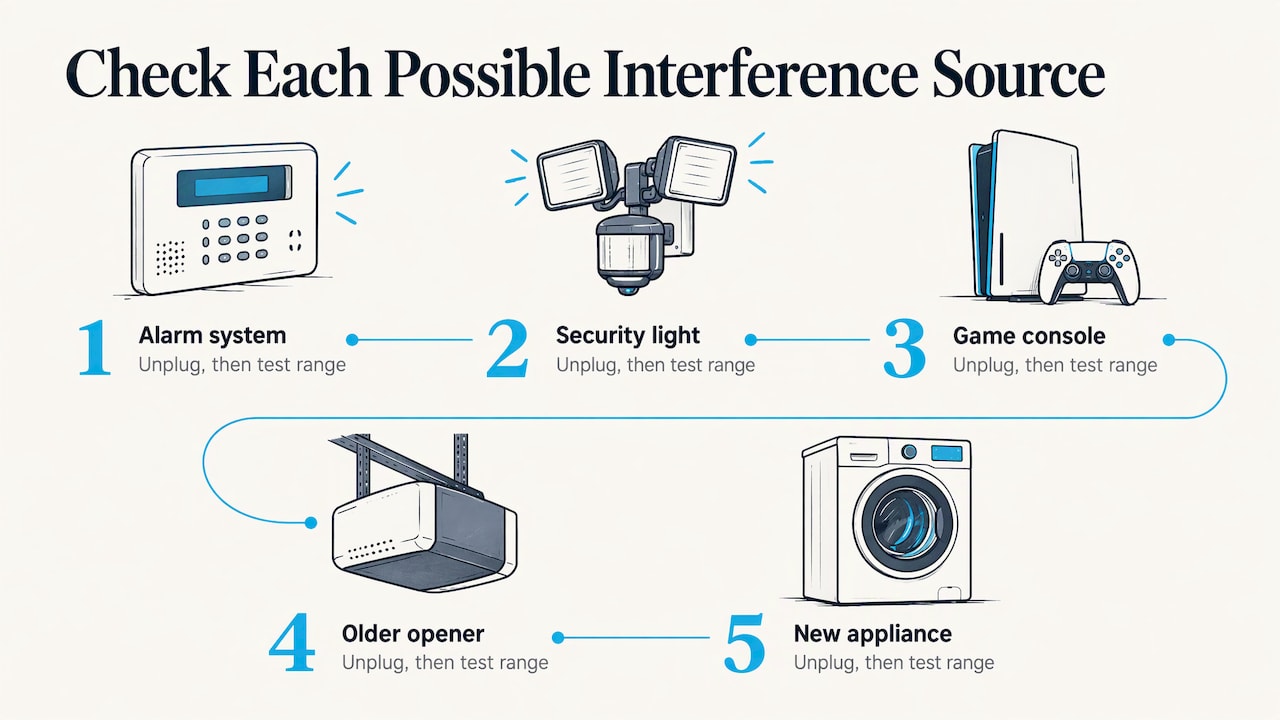
What changed around the time the range dropped? A new alarm system, a motion-sensing security light, a game console in the garage, a second older opener or a new appliance can all add competing signals. Unplug items one at a time and test after each. It is a slow process of elimination, but it works.
Location
The same guide says that as many as 40 million homeowners with door or gate operators could be affected by interference from a military radio system that began operating at military installations in 2004. If you live near a base and your remotes have become unreliable, location may be part of the story. Massachusetts and Connecticut both have military sites, so it is worth keeping in mind.
The receiver may be the weak link
When several remotes lose range together and the interference checks turn up nothing, the opener’s receiver is the next suspect. A receiver that has aged or been damaged does not respond well even to a perfectly good remote. This is a repair we do: our team handles receiver service, sensor replacement and gear replacement on openers, so a weak signal does not end in buying remote after remote. If you want to understand more of what can go wrong with the opener itself, see our guide to garage door opener repair: causes, costs and next steps.
If your problem is remote-control range in general, troubleshooting a remote that stops responding follows a similar battery, range and interference logic for another type of motorized product.
How to Choose a Replacement Garage Door Remote
The rule is the same everywhere: the replacement has to work with your specific opener. Family Handyman’s guide says the first step is to determine the brand and type of your opener, which is usually printed in large letters on the side of the unit, and to buy a remote compatible with that model.
Find the information you need
Write down these four things before you shop:
- Brand and model number from the label on the opener’s housing.
- The Learn button and its color or shape. On many openers it sits near the antenna wire, under the light cover. Its color or the style of the button helps identify the opener’s generation.
- The age of the opener. An opener installed in the last decade or two is likely to have a Learn button. A much older one may use switches instead (see below).
- How many buttons you need. The more buttons, the more doors or devices one remote can control, which matters if you have a second garage door or a gate.
Brand-matched or universal?
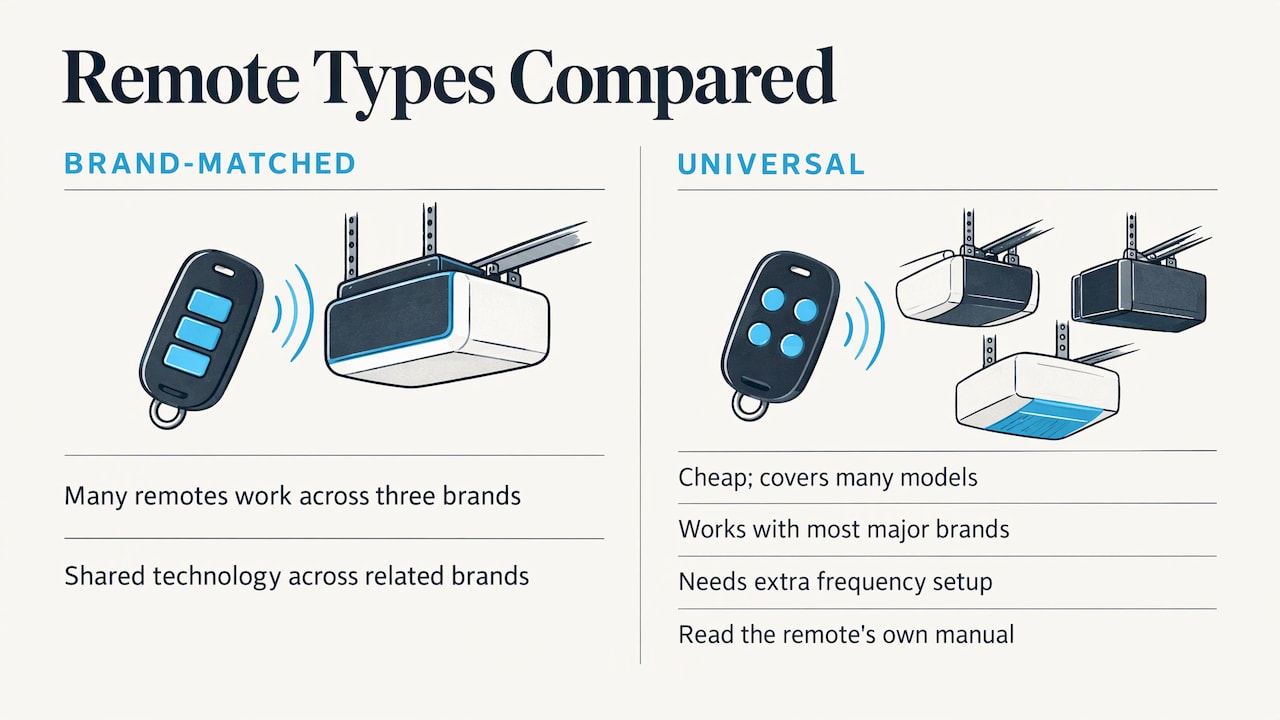
Some manufacturers share technology across brands. Family Handyman notes that one major manufacturer also makes two other opener brands, and many of its remotes work with all three. It also notes that universal remotes from the secondary market work with most major opener brands.
Universal remotes are tempting because they are cheap and cover many models. The catch is the setup. A universal remote often needs extra steps to make sure it is sending the right frequency for your opener, and you have to read the remote’s own manual to get that right. If you do not want to guess, our crew can supply and program the right remote for your opener as part of our remote repair and installation service.
Older openers with switches
Openers made before the mid-1990s often have no Learn button. They use a row of small DIP switches inside the opener and inside the remote. Family Handyman explains that you set the opener’s switches to any pattern and then set the remote’s switches to match, using a small screwdriver or paper clip. Remotes for these openers are harder to find, and some older systems are better served by a new opener, which is a conversation we have with homeowners regularly.
How to Program a Replacement Remote
The exact steps vary by brand, so the opener’s manual outranks anything written here. The general routine for a Learn-button opener is consistent:
- Park safely and clear the area. The door will move during programming, so keep people and objects out of its path. Standing a few feet away from the opener is a sensible habit.
- Find the Learn button on the opener’s motor unit, usually under the light cover.
- Press and release the Learn button. An indicator light next to it glows, which tells you the opener is ready to receive a new remote. You normally have about 30 seconds.
- Press and hold the button on the new remote (or press it a couple of times, depending on the brand) until the opener’s lights flash or you hear two clicks.
- Test it. Press the remote button and watch the door complete a full cycle. Test from the driveway too, not just from inside the garage.
- Program each remote separately if you are adding more than one.
Where it goes wrong
- The time window closes. If you take too long between pressing Learn and the remote, the opener leaves programming mode. Start over.
- The wrong button is pressed. On multi-button remotes, each button is its own command. Program the one you want for this door.
- The remote is the wrong frequency or system. Nothing will fix this except the right remote.
- The opener’s memory is full or its receiver is failing. Even correct steps will not save a worn receiver.
If you would rather not spend the afternoon on a stepladder, that is a perfectly sensible choice. Programming and testing the remote is a part of what our technicians do on an opener visit.
Lost or Stolen Remote: Secure the Door First
A missing remote that can open your garage is a home security matter, especially if it was in a car along with your address on registration papers. Treat it that way.
- Secure the door manually if you cannot get the opener reset right away. Pulling the emergency release cord disconnects the door from the opener, and the door can then be locked or secured so it cannot be lifted. Never work on the door’s springs or cables yourself, because they carry dangerous tension.
- Erase the opener’s memory. Most openers let you clear every programmed device by holding the Learn button for several seconds until the indicator light goes out. Check your manual for the exact hold time on your model.
- Reprogram everything you still own. Erasing the memory removes all remotes, wireless keypads and in-car transmitters, so each one you are keeping must be programmed again. The wall control keeps working throughout.
- Change your keypad code if you have one and it could have been seen by someone with the missing remote.
If you want that sequence handled for you, with new remotes and keypads supplied and everything reprogrammed in one visit, you can reach us any hour: we offer 24/7 emergency service as well as same-day service.
When Replacing the Remote Is Not the Answer
A new remote is a fix for a dead or lost remote. It is not a fix for these situations:
- Every remote and keypad fails together, which points to the receiver or the opener’s circuit board.
- The wall button does not work either, which points to power, wiring, safety sensors or the door.
- Range keeps shrinking despite a new battery and a new remote, which points to interference or an aging receiver.
- The opener is very old, where finding compatible remotes is hard and replacing the opener can be the simpler fix.
- The opener hums but the door does not move, which usually means a spring, cable or gear problem rather than anything in the remote.
Those are all jobs for a technician, and they are on our list: opener repair and installation, receiver service, sensor replacement, gear replacement, spring and cable repair. Because we cover both the remote and the machinery behind it, a single visit can identify which part is at fault rather than leaving you to guess.
Keep the Whole System Healthy
Remotes get blamed for problems that begin elsewhere. A door that binds, a dry track or a worn roller makes the opener work harder and fail earlier. Routine upkeep keeps the opener and door in good shape, and regular lubrication of moving parts is part of that, as this guide to lubricating a garage door explains. For a hands-off approach, our door maintenance service takes tune-ups off your list, and in New England it makes sense to check the system before the cold season, as we describe in how to prepare your garage door for a New England winter.
Remote Replacement With Speedy Garage Door Services
We are a family-owned company serving homes and businesses across Massachusetts and Connecticut. Our work covers remotes and keypads, receiver service, sensors and opener repair or installation, plus broken springs, cables, rollers and new doors. Same-day service and 24/7 emergency repair are part of what we offer. We do not publish a flat price for remote work, since the right remote and the work involved depend on your opener. Tell us the brand and what is happening and we will tell you what it takes.
Start with our Keypads & Remotes and opener service page, or contact the team in Chicopee, MA or Ellington, CT.
Our View: Fix the Cause, Then Replace the Remote
A remote is a small part of a system, and in our experience as a family-owned garage door company the best result comes from looking at the whole system. The remote talks to a receiver, the receiver tells the opener’s logic board what to do, and the opener moves a door that rides on springs, cables, rollers and track. When a customer calls about a remote, we want to know whether the door moves smoothly, whether the wall button works and whether the sensors are aligned, because a remote problem and an opener problem can look identical from the driveway.
That is why we like to handle remote replacement together with the opener work. Our technicians offer remote and keypad installation, receiver service, sensor replacement and gear replacement, so we can match the remote to the opener, program it and make sure the opener is sound before we leave. Clear communication matters to us here: you should know what failed and what we did.
Safety is the other reason we prefer to be involved. A lost remote is a security question, and a door that will not close is a safety question. We would rather you call us early than leave a half-working door in place.
the author
FAQ
Why did my garage door remote suddenly stop working?
The most common cause is a dead battery, so replace it first. Other causes include a lock setting on the wall control, lost programming, new interference such as a bulb or alarm device, or a failing receiver in the opener. If the wall button still works, the opener itself is probably fine.
Can I use a universal remote to replace my garage door remote?
Often yes, since universal remotes are made to work with most major opener brands. They can need extra steps to match the right frequency, and the remote’s own instructions will tell you how. We can supply and program a remote matched to your opener if you prefer.
Do I need to reprogram other remotes after getting a new one?
Not when you are simply adding a remote. You only need to reprogram the others if you erase the opener’s memory, which is the right step after a remote is lost or stolen. Erasing clears every remote, keypad and in-car transmitter, and the wall control keeps working.
Why does my remote only work when I am close to the garage?
Try a fresh battery first. Then look for interference from LED or compact fluorescent bulbs, alarm systems, motion-sensor lights or recently added electronics. If range is still short, the opener’s receiver may be worn, and that is worth having a technician look at.
Sources
- Door and Gate Operator Remote Control Troubleshooting Guide
- How to Program a Garage Door Opener | Family Handyman
- Lubricate Your Garage Door: Quiet, Smooth, and Long-Lasting
- Awning Remote Not Working: 9 Checks Before You Call