

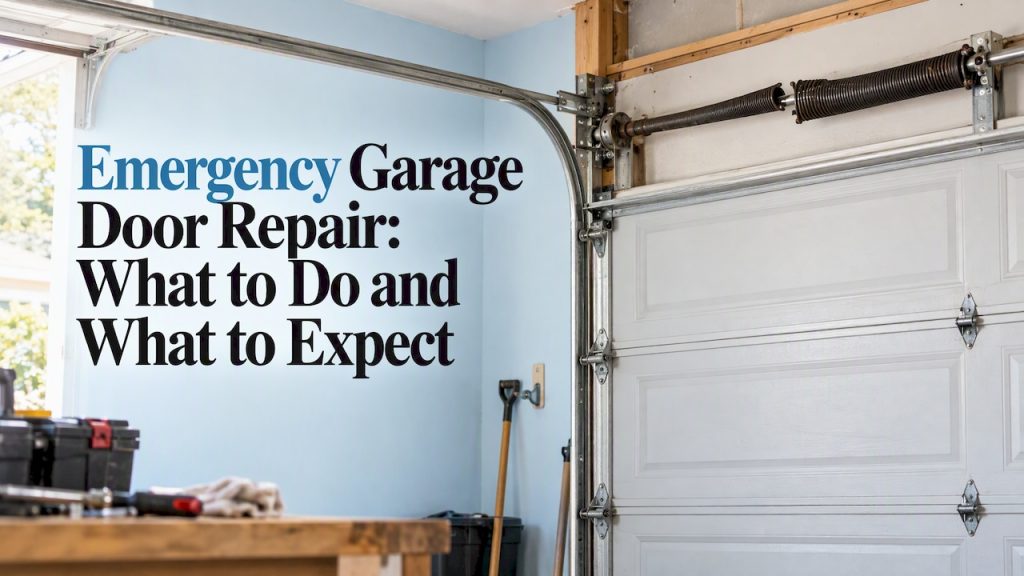
If your garage door won’t open, won’t close, or has come off its track, treat it as an emergency when the door is stuck open, when a spring or cable has snapped, or when the door moves unevenly or crashes down. Keep people and cars clear, use the red emergency-release cord only if it is safe, and call a trained technician. Do not try to fix springs or cables yourself. In Massachusetts and Connecticut, our 24/7 garage door repair team handles these calls every day.
This guide covers what really counts as an emergency, a safe first-ten-minutes checklist, what an emergency visit usually includes, what drives the price, and how to avoid a repeat.
TL;DR
- A door that is stuck open, crooked, off its track, or has a snapped spring or cable is an emergency. A door that is only noisy or slow can usually wait for a normal appointment.
- Never adjust or repair springs and cables yourself. Their tension can cause serious or fatal injury.
- Pull the emergency-release handle only when the door is down and you understand the risk, or when someone is trapped.
- Emergency pricing depends on the part, the time of day and the distance. Ask for the total, including any after-hours fee, before work starts.
- A monthly 30-day check and a yearly tune-up are the cheapest way to avoid the next midnight call.
Table of Contents
- What counts as a garage door emergency
- What to do first when the door won’t open or close
- Can you open the door if the spring is broken?
- What an emergency visit typically includes
- What emergency garage door repair costs
- Why emergencies tend to happen on a bad day
- Reduce the chance of another urgent call
- How to choose an emergency garage door company
- Need help right now?
- Our perspective on garage door emergencies
- FAQ
- Sources
What counts as a garage door emergency
Not every garage door problem needs a 2 a.m. call. The line sits between a security or safety risk and an inconvenience.
Call right away when:
- The door is stuck open. Your home and everything in the garage is exposed, and you may be unable to leave a vehicle inside overnight.
- The door is stuck closed with a car inside. You need to get to work, or to the hospital.
- A spring has snapped. You’ll often hear a loud bang from the garage. The door becomes extremely heavy and the opener may strain or fail.
- A cable has snapped or come loose. One side of the door can drop or hang crooked.
- The door is off its track, bent, or has taken a vehicle impact.
- The door is unbalanced, binding or sticking. The U.S. Consumer Product Safety Commission warns that a severely unbalanced door could crash to the floor and strike someone beneath it, and says unbalanced, binding or sticking doors should be serviced by a professional.
- The door doesn’t reverse when it hits something. This is a safety failure, not a convenience problem.
Can usually wait for a scheduled visit:
- A remote that needs a new battery or reprogramming
- A squeaky door that still runs smoothly
- A keypad that has stopped working while the remote still works
- Weatherstripping that has worn out
When in doubt, the International Door Association says that if something doesn’t look or sound right, it could signal a more serious issue, and recommends having a trained technician inspect the system.
What to do first when the door won’t open or close
Stay calm and go through this order. It takes about ten minutes, and it tells you (and the dispatcher) exactly what is wrong.
1. Keep everyone clear
Keep children, pets and cars away from the door. InterNACHI advises keeping people away from moving doors and keeping fingers and hands away from pulleys, hinges, springs and the points where panels meet, because a closing door can crush body parts. If the door is partly open, never stand or reach under it.
2. Check the simple things
These fixes take a minute and cost nothing:
- Power. Is the opener plugged in? Has a breaker tripped? Did the power go out in your neighborhood?
- Remote and wall button. Try the wall button. If it works and the remote doesn’t, the problem is the remote or the receiver, not the door.
- Lock setting. Many wall consoles have a lock or vacation button that disables remotes. Check that it isn’t engaged.
- Sensors. The two small eyes near the floor on each side must be clean, aligned and showing steady lights. If a sensor is blocked or knocked out of line, the door will refuse to close or will reverse right away.
- Obstruction. Look for something in the track or under the door.
3. Look, but don’t touch, the hardware
From a safe distance, look for a visible gap in the torsion spring above the door (a break in the coil), a frayed or dangling cable, a roller that has popped out of the track, or a door sitting crooked. Take a photo with your phone. It helps the technician bring the right parts.
4. Use the emergency release only when it’s safe
The red cord with a handle hanging from the opener rail disconnects the door from the opener. InterNACHI calls the emergency-release handle vital in emergencies, such as a person trapped beneath the door or a power outage. That makes it the right tool for those situations.
A few rules:
- Pull it with the door fully closed whenever you can. If the spring is broken, a door that is open can fall fast once it is disconnected.
- Never use it to “help” a door with a broken spring. The door may feel as heavy as it really is.
- If someone is trapped, release the door, call 911 and do not leave them.
5. Call for help
Tell the dispatcher what you saw and heard: a loud bang, a gap in the spring, a cable hanging, the door off track, the make of the opener if it is on the label. Say whether the door is open or closed and whether a car is inside. That lets them decide how fast to send someone and what to bring.
Can you open the door if the spring is broken?
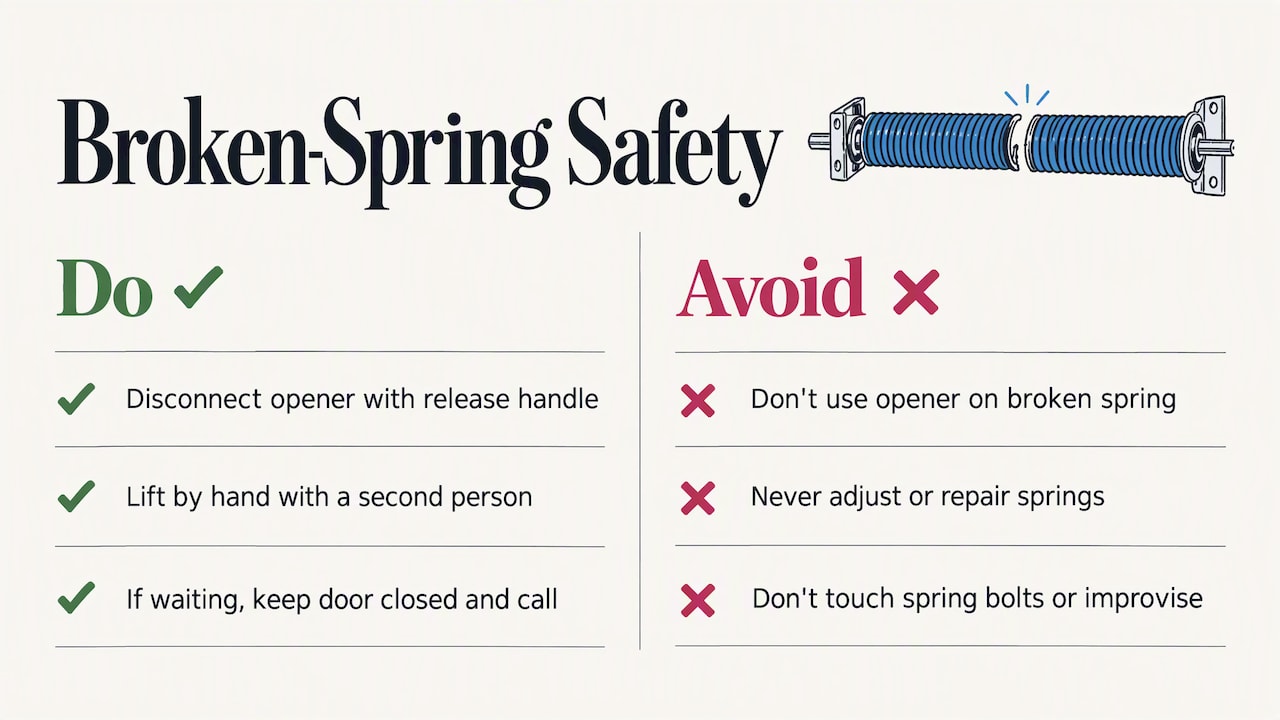
Yes, in a limited way, and only with care. A broken spring means the door has lost the counterbalance that normally makes it feel light. Many openers are built to move a balanced door, not to lift its full weight, so using the opener risks burning out the motor or stripping the gears.
If you need the car out now, the safest approach is to disconnect the opener with the release handle and lift the door by hand with a second person. Even then, a broken-spring door is heavy and can drop. InterNACHI is clear that homeowners should never adjust or repair springs because their high tension can cause serious or fatal injury. Leave the bolts on the spring assembly alone, and don’t try to wind a new spring with improvised tools.
If you can wait, leave the door closed and call. Learn more about how we handle this repair on our broken spring repair page, and see our guide to the warning signs a spring is about to break so you can catch the next one early.
What an emergency visit typically includes
A good emergency call is more than a quick patch. Here is how it normally goes:
- Phone triage. You describe the problem, and the dispatcher gives you an arrival window and tells you what not to touch.
- Safety first. The technician secures the door so it can’t fall, often by clamping it in place.
- Diagnosis of the whole system. Springs, cables, rollers, tracks, hinges, panels and opener are checked together, because one failure often stresses another part. A broken cable, for instance, can bend a track.
- A clear quote before work begins. You should hear the total, including parts, labor and any after-hours charge.
- The repair. Common emergency jobs are spring replacement, cable replacement, putting the door back on its track, replacing rollers, sensors or gears, and fixing an opener that has stopped.
- Testing. The technician checks balance, travel limits and the auto-reverse function before leaving.
At Speedy Garage Door Services we offer same-day service and 24/7 emergency repairs, and we repair springs, cables, rollers, tracks, sections, panels, openers, sensors, receivers, gears, keypads and remotes. Arrival time depends on where you are, the time of day and how many urgent calls are ahead of yours, so the dispatcher will give you a realistic window when you call.
Common emergency repairs and what they involve
| Problem | What you notice | What the technician does |
|---|---|---|
| Broken spring | Loud bang, door heavy, won’t lift | Replaces the spring and checks balance; may suggest replacing both springs |
| Snapped or slipped cable | Door hangs crooked, one side drops | Replaces the cable and inspects drum and track |
| Off-track door | Rollers out of the track, door jammed | Resets or replaces rollers and straightens or replaces the track |
| Opener failure | Motor hums or runs but door doesn’t move | Replaces gears, receiver, or the opener |
| Sensor fault | Door closes then reverses, lights blink | Realigns or replaces sensors |
| Damaged panel | Dented or cracked section after impact | Replaces the section or panel |
You can see the full list of repairs on our repairs page, and opener work on the opener repair and installation page.
What emergency garage door repair costs
We don’t publish fixed prices because each job depends on what is broken, which parts your door needs and when you call. Instead of a number that may not fit your door, here is what moves the price, so you can judge any quote you get, ours or anyone’s.
What drives the total:
- The part. A spring or cable costs less than a new opener or a damaged section. Heavier doors and double-wide doors use stronger springs.
- The scope. A door that is off track with a bent track needs more than a roller reset.
- The hour. Nights, weekends and holidays often carry an after-hours or emergency fee, because a technician is being called out of normal scheduling. Ask for it by name.
- Door type and age. Older or custom doors can need parts that take longer to source.
- Residential or commercial. Commercial doors are larger and heavier, and their downtime costs more.
Questions to ask before you agree:
- Is the quote the total, including parts, labor, trip and any after-hours charge?
- Are the springs and cables warrantied, and for how long?
- Will you check the whole system and test auto-reverse before leaving?
- If you find something else, will you tell me the price before you do the work?
A reputable company answers these directly. Be cautious of anyone who quotes a very low number by phone and adds charges on arrival.
Why emergencies tend to happen on a bad day
Springs have a limited lifespan counted in open-and-close cycles, and cold weather makes metal and lubricant less forgiving. New England winters are rough on garage doors: freezing mornings, snow against the bottom seal, and doors used more as everyone comes and goes. That’s why calls tend to bunch up on the first hard cold snap. A door that has been quietly straining for months chooses a Monday at 6:30 a.m. to give out.
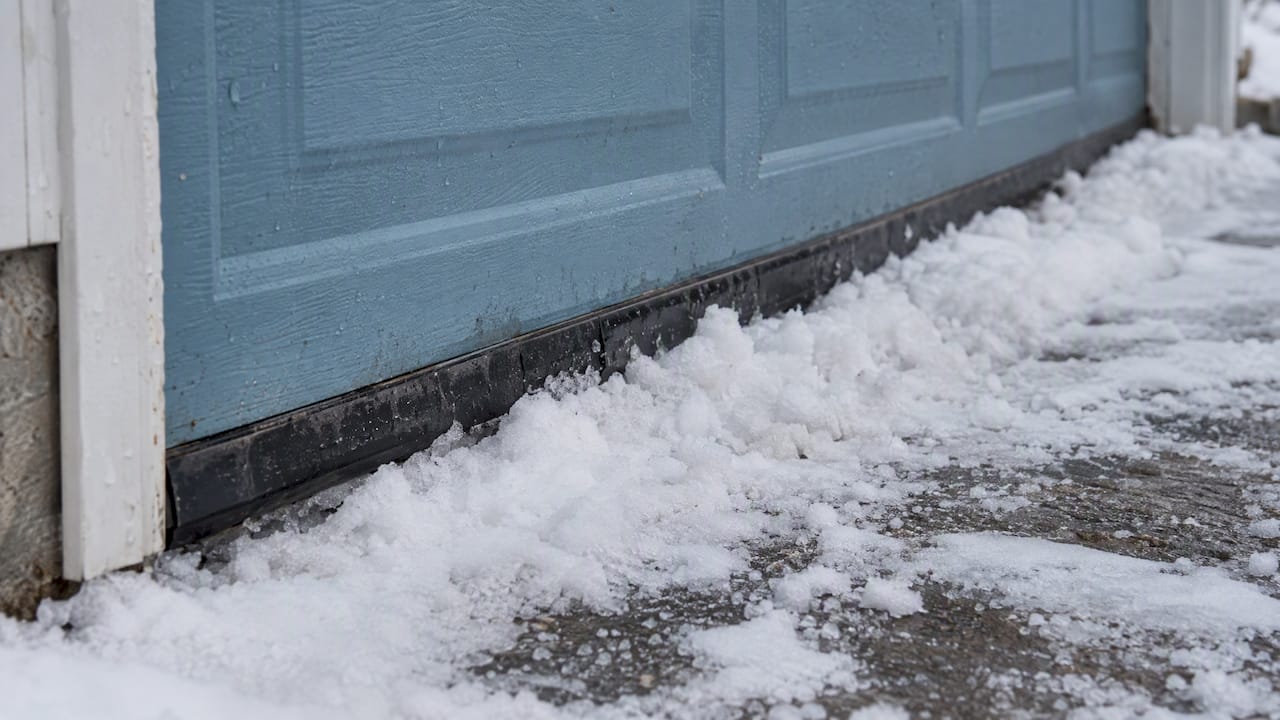
It also explains why waiting rarely saves money. A door that is running with a weak spring wears the opener, and one that is binding wears the tracks.
Reduce the chance of another urgent call
Most emergencies send warning signs first. A 15-minute monthly check catches most of them.
The 30-day check
The CPSC advises inspecting the door and opener every 30 days, testing the opener’s reverse function with a 2×4, and checking springs, hardware and fittings. The IDA likewise recommends a monthly visual inspection of springs, cables, rollers, pulleys and mounting hardware, and says fraying, damage or unusual operation warrants inspection by a trained technician.
A simple routine:
- Look. Check springs for gaps, cables for fraying and rollers for wear.
- Listen. Grinding, popping or scraping means something is off.
- Balance test. With the door closed, disconnect the opener with the release handle and lift the door by hand to about waist height. A balanced door stays put. If it falls or shoots up, stop and call a professional. Do not touch the springs.
- Reverse test. Lay a 2×4 flat under the door and close it. The door should reverse when it touches the board.
- Check the sensors. Wave an object through the beam while the door closes. It should stop and reverse.
Good lighting makes this check easier and safer, particularly in a dim garage. If yours is poorly lit, these garage lighting ideas cover layers and zones so you can actually see worn hardware.
Know if your opener is outdated
U.S. openers made or imported for sale after January 1, 1991 must have reversing systems, and the CPSC added that external entrapment protection arrived in 1993. The CPSC has urged people to replace openers without automatic reversal. If your opener predates those rules, an upgrade is a safety matter.
Schedule a tune-up
A professional tune-up covers lubrication, balance, tightening hardware and replacing worn parts before they fail. See our garage door maintenance services. Businesses with several doors can use scheduled commercial maintenance.
How to choose an emergency garage door company
When the door is stuck, the temptation is to call the first ad. Take 60 seconds to check:
- A local address and a real answer. Ask where the technician is coming from. Local companies arrive faster and are easier to hold accountable.
- Clear communication. You should get an arrival window, a quote and an explanation of the problem in plain words.
- Whole-system diagnosis, not just the broken part.
- Warranty on parts and labor, in writing.
- Reviews that describe specific jobs, not just stars.
- Insurance and training. Springs are dangerous work. Ask whether the technician is trained for them.
We serve homeowners and businesses across Massachusetts and Connecticut, including Chicopee, Springfield, Agawam, Longmeadow, Ludlow, Westfield and Belchertown, as well as Bloomfield, CT.
Need help right now?
If your door is stuck, off track or has a broken spring, we can help. Speedy Garage Door Services is a family-owned company offering same-day service and 24/7 emergency repairs for homes and businesses in Massachusetts and Connecticut. Tell us what you see and hear, and we’ll tell you what to do until we arrive. Call or book our 24/7 emergency repair service.
Prefer to start with the problem? Go straight to broken spring repair, cable repair or opener repair.
Our perspective on garage door emergencies
Most of the emergency calls we take could have been shorter, cheaper or avoided with one earlier look at the door. A spring that is slowly weakening, a cable that is fraying, a roller that is wearing out: each gives notice. The trouble is that a garage door is the largest moving object in most homes, and people only think about it when it stops.
That is why we do two things at once on every emergency visit. First we make the door safe and working. Then we look at the whole system, so the repair we do tonight doesn’t set up the next failure. We explain what we found in plain words and give you the options, because you should understand your own door.
We are a family-owned company, and we treat each call the way we’d want our own family’s call handled: fast response, clear communication and work that lasts. Springs and cables carry enormous tension, so we never suggest doing them yourself. Call us, keep clear of the door, and we’ll take it from there.
the author
FAQ
How much does emergency garage door repair cost?
It depends on the part that failed, the size and weight of the door, and the time of the call. Nights, weekends and holidays often include an after-hours fee. Ask for a total quote, including that fee, before work starts. Contact us for a quote based on your door.
What is a garage door emergency?
It is any failure that leaves your home unsecured, traps a vehicle, or makes the door unsafe. That includes a broken spring or cable, a door off its track, a door stuck open or closed, and a door that is crooked or won’t reverse. Noise or slow movement alone can usually wait for a regular appointment.
Who do I call if my garage door won’t open?
Call a local garage door company that offers 24/7 emergency service, after you check power, the remote, the lock setting and the sensors. If someone is trapped under the door or hurt, call 911 first. Don’t try to repair springs or cables yourself.
Is there a way to open a garage door if the spring is broken?
Yes, but with care. Pull the emergency-release handle to disconnect the opener, then lift the door with a second person, since a door without a working spring is very heavy. If you can wait, leave it closed and call a technician rather than handling the spring.
Sources
- CPSC Publication 523: Non-Reversing Automatic Garage Door Openers
- InterNACHI: Garage Doors and Openers
- IDA: Safety & Maintenance
- CPSC: Government and Industry Move to Reduce Garage Door Opener Child Entrapment Deaths