

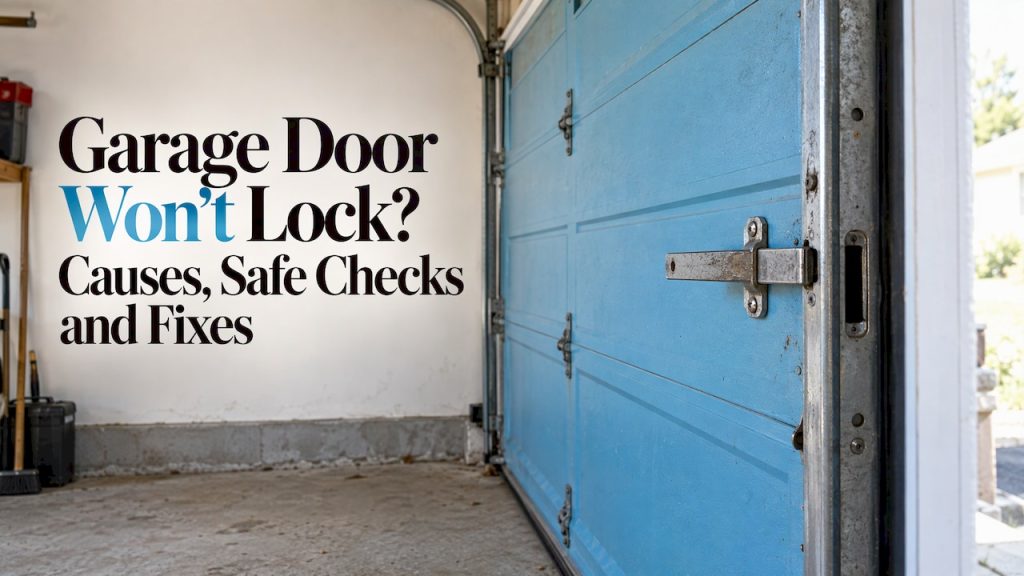
A garage door that won’t lock or latch is almost always one of three things: a lock that no longer lines up with its slot, a door that is out of balance or out of alignment, or an opener and sensor problem that stops the door from reaching the fully closed position. You can tell which in about ten minutes with a few safe checks. If the checks point to springs, cables or track, stop and call a pro. We repair these doors across Massachusetts and Connecticut, including same-day and 24/7 emergency calls, and the sections below show you where the safe part of the job ends.
TL;DR
- A lock only works when the door sits fully closed and square. Start by asking whether the door closes all the way, not by blaming the lock.
- Pull the red emergency-release handle and move the door by hand. A smooth door that stays put points to the opener. A heavy, sticking or dropping door points to balance or hardware.
- Never force a lock on a door that is jammed, slams down or feels heavy. That is a spring or cable warning, and it can cause serious injury.
- Until it is fixed, secure the door with a slide bolt or built-in latch, and keep the opener from running against it.
- Springs, cables, tracks and balance adjustments are work for a trained technician. Call us and we will come out the same day.
Table of Contents
- First, work out which kind of lock you have
- Why a garage door lock stops working
- Safe checks you can do in ten minutes
- What the results tell you
- What not to do
- Securing the garage until it’s fixed
- When the key won’t turn the lock
- Why a technician beats a weekend fix
- We fix the cause, not just the lock
- Get the door locking again
- Keeping the lock working
- FAQ
- Sources
First, work out which kind of lock you have
“Garage door won’t lock” means different things depending on the hardware. Most residential garage doors in our area use one of these:
- The opener itself. Many homeowners rely on the opener to hold the door shut. There is no separate lock, so a door that “won’t lock” is really a door that won’t close fully or won’t stay down.
- A manual lock on the door. A lock handle or key cylinder on the outside, with a bar or latch that slides into a hole in the track. This is the classic “key turns but nothing happens” case.
- Slide-bolt or vacation locks. A bolt you slide by hand into the track, used when you are away.
- An automatic lock. A small unit near the track that extends when the door closes and retracts before the door moves.
The fix for each is different, so identify yours before you touch anything.
Why a garage door lock stops working
A lock is only as good as the door’s position. The bar or latch needs to meet its slot at exactly the right height and angle. Anything that moves the door a half inch from where it used to rest can make the lock miss.
The door is not fully closed
If the door stops short of the floor, no lock will engage. The usual reasons are an obstructed or misaligned photo eye, an obstruction in the track, or an opener whose close limit has drifted. Manufacturer troubleshooting guidance notes that an obstructed or misaligned photo eye can keep a garage door from closing all the way. If your door reverses or stops a few inches up, read our guide on what to do when a garage door won’t close first, because fixing the closing problem often fixes the lock.
The lock and its slot no longer line up
The key turns freely, the bar moves, but it misses the track hole or catches the edge. This happens when the door has shifted on its rollers, when the track has moved slightly, or when the lock bar has bent. A door that has dropped or sagged on one side will do it, and so will worn rollers.
An automatic lock is blocked or mismatched
For automatic locks, the installation instructions say the lock should protrude through the track when the door is fully closed, retract before the door moves and re-engage when the door reaches the fully closed position. The same instructions list the things that can make an automatic lock fail: an engaged manual lock, an obstruction, an unbalanced door, broken springs, incorrect wiring or an incompatible opener. Notice how many of those are door problems, not lock problems.
The door itself is out of balance or alignment
Worn rollers, impact damage or poor installation can pull a door out of alignment. Raynor’s guidance says signs include difficult movement even when the opener is disconnected, scraping sounds and significant resistance, and that a qualified technician is needed to correct it. A balance problem usually means a spring is worn or broken. Our page on the seven warning signs a garage door spring is about to break lists what to look and listen for.
Floor and threshold changes
Worn thresholds and changed floor heights at the garage entry can change how a door sits when it closes. If you are re-finishing the transition between garage and interior flooring, floor edge trims and thresholds are one way to finish the joint neatly, but make sure the garage door still closes fully against the floor afterward.
Safe checks you can do in ten minutes
These checks do not involve springs, cables or tension. Work in daylight, with the opener unplugged if you will be near moving parts.
1. Look at the closed position
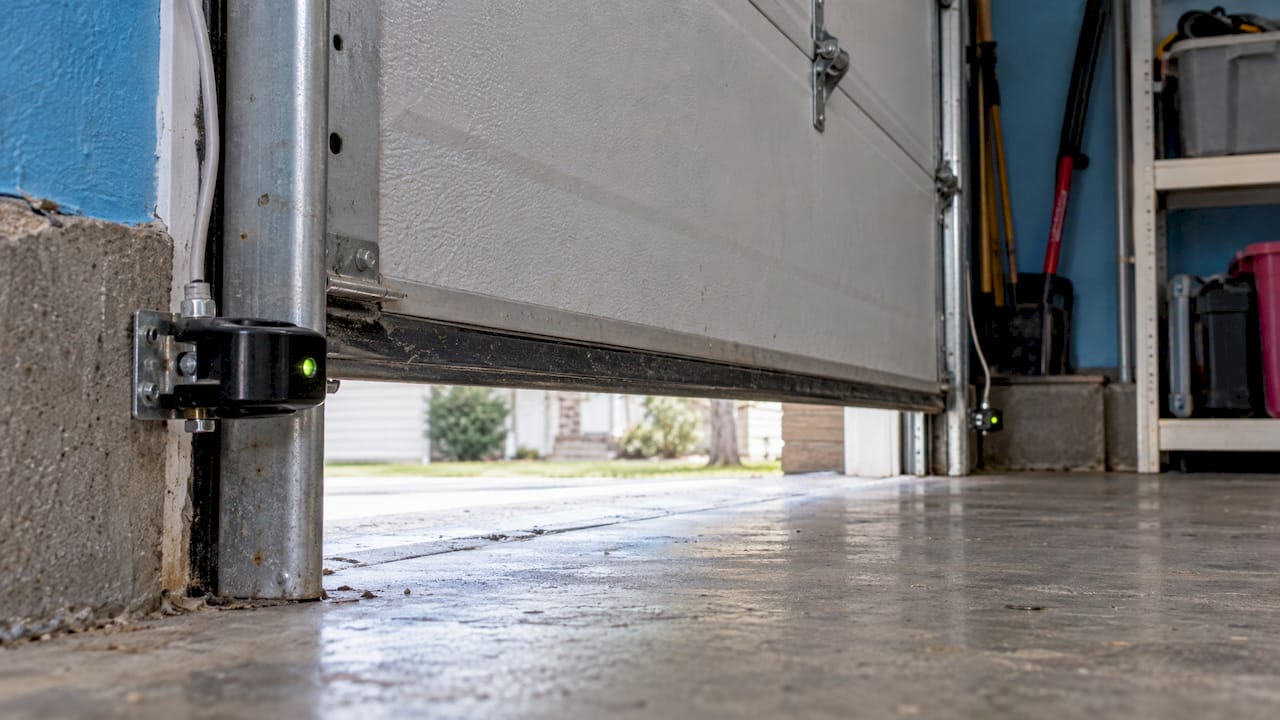
Close the door with the wall button. Does it reach the floor and stop on its own? If it stops early or reverses, check that nothing is in the track and that both photo eyes near the floor are clean, facing each other and showing steady lights. Wipe the lenses and gently re-aim any that were knocked. This is the most common cause of a door that won’t latch.
2. Check for a lock left engaged
If you have a slide bolt or vacation lock, make sure it is fully retracted. Manufacturer guidance says not to operate the opener while slide-bolt locks are engaged, and to unplug the opener when using them. Running the opener against a bolt can damage the door, and a forgotten bolt is a common reason a door seems stuck or won’t lock properly afterward.
3. Try the key and handle with the door open
With the door fully open or fully closed, turn the key and move the handle. If the cylinder is stiff or the key will not turn at all, the problem is the lock itself. If the key turns easily but the bar misses its hole, the problem is alignment. That difference is useful to know when you call.
4. Do the manual test
Pull the red emergency-release handle with the door closed, then lift and lower it by hand. Chamberlain’s diagnostic is that a smooth door that stays in place points toward an opener issue, while a heavy or sticking door points toward balance or door hardware. Chamberlain also notes an opener is designed to move a balanced, easy-to-lift door, so a heavy door is likely the door’s problem, not the opener’s.
A caution here: if the door feels heavy, drops quickly, or slams, stop. Do not lift it fully. A heavy or fast-slamming door indicates a spring problem that needs professional attention.
5. Check whether the opener is in bypass mode
If the door moves freely by hand but not with the opener, the trolley may be disconnected. This Old House explains that pulling the release rope toward the door and then activating the opener can let the trolley latch back onto the chain. A disconnected trolley can leave a door sitting a little off its closed position, which can make an automatic lock miss.
What the results tell you
| What you see | Likely cause | What to do |
|---|---|---|
| Door stops short or reverses | Photo eye, obstruction, opener limit | Clean and re-aim the eyes, clear the track, then see our won’t-close guide |
| Smooth by hand, won’t move with opener | Trolley in bypass or opener fault | Reconnect the trolley; if it persists, book opener repair |
| Key turns, bar misses the hole | Door shifted, bent bar, track out of position | Book a technician to realign the door and lock |
| Key won’t turn at all | Worn or damaged cylinder | Lock service or replacement by a technician |
| Door heavy, sticks, drops or slams | Spring, cable or balance problem | Do not use the door; call for spring repair |
| Scraping, resistance by hand | Alignment, worn rollers or track damage | Call a technician for roller and track repair |
What not to do
The temptation with a stubborn lock is to force it, lubricate it heavily or drill a new hole in the track. Don’t. Genie’s safety guidance says not to operate a door that is jammed or has a broken spring, and not to install an opener on an improperly balanced door, because severe injury may result. Springs and cables hold a lot of stored energy. Adjusting or replacing them is not a homeowner job.
The same goes for installing an automatic lock yourself. The installation instructions for one common model say existing manual locks must be removed first, that power must be disconnected, and that the door must be fully open or fully closed during installation. That is a lot of conditions for a door that is already misbehaving.
The balance test, and why we stop you there
Manufacturers describe a balance check: disconnect the carriage, raise the closed door about 36 inches and see whether it stays put. Movement of more than a few inches indicates imbalance, and the manufacturer says to call a professional dealer. That is the point where a lock problem has become a spring problem. If your door fails this test, leave it alone and call us. Our technicians handle spring adjustment and replacement as a routine job.
Securing the garage until it’s fixed
A garage that won’t lock is an open invitation, especially if it connects to the house. Here is what to do tonight.
- Close the door fully by hand if it is safe to do so. If the door is heavy or slams, do not move it. Leave it where it is and call.
- Use a slide bolt or built-in latch. For a manually operated door, This Old House notes a closed door can be secured with built-in latches or, where provided, a bolt through a track hole.
- Unplug the opener before you engage a bolt. The manufacturer’s guidance is to unplug the opener when using slide-bolt locks and not to run it while they are engaged, so nobody presses the button against the bolt.
- Lock the interior door to the house and keep the remote out of the car overnight if the garage cannot be secured.
- Call for service. If the door will not close or stay shut, our 24/7 emergency garage door repair line is there for exactly this. Our guide to what to do and what to expect in an emergency explains the visit.
When the key won’t turn the lock
If the lock is on the door and the key sticks, stays stiff or will not turn, the cause is inside the cylinder or the latch linkage, not the door position. A technician can tell whether the cylinder needs service or replacement and whether the bar or linkage is bent. Forcing the key risks snapping it in the cylinder, which turns a small repair into a larger one. Check first that the door is fully open or fully closed, because a door resting slightly off can bind the bar against the track and make a perfectly good lock feel stuck.
Why a technician beats a weekend fix
On paper a lock that won’t engage looks like a ten-dollar part. In practice the lock is a symptom. The same half-inch shift that makes it miss the track can come from a weakening spring, a worn roller, a bent track section or a drifting opener limit. Replace the lock alone and the real cause is still there, now with a new part on top of it.
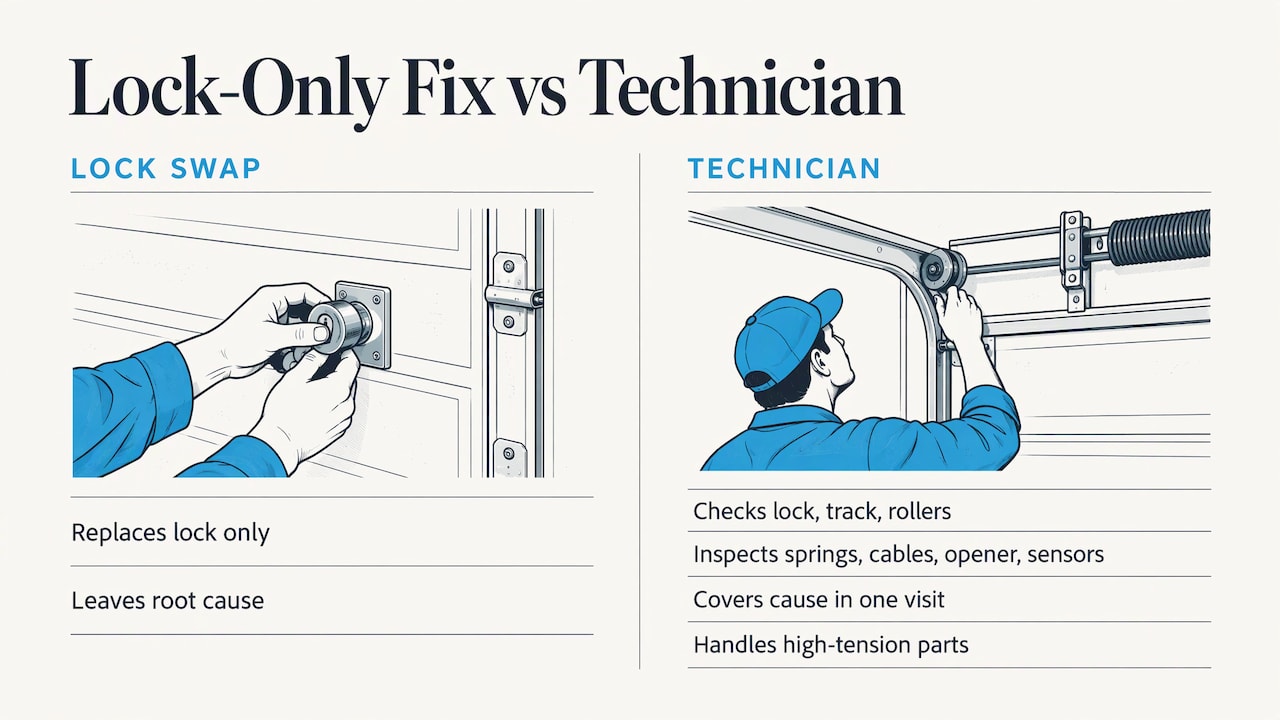
When we come out, we look at the whole system: the lock, the track alignment, the rollers, the springs and cables, the opener and the sensors. That means one visit covers the lock problem and whatever was causing it. It also means the dangerous parts, the high-tension springs and cables, are handled by someone trained and equipped for them, not by you on a stepladder.
We fix the cause, not just the lock
Over the years we have learned that a lock complaint is rarely about the lock. A homeowner calls because the door won’t latch, and the reason turns out to be a tired spring, a roller that has worn flat or a photo eye knocked out of line by a bumped bin.
That is why we start by watching how the door moves before we touch the lock. A door that closes square and stays balanced lets any lock do its job. A door that doesn’t will keep defeating new hardware.
We are a family-owned company serving Massachusetts and Connecticut, and we put safety first on every call. We repair springs, cables, rollers, tracks, openers, sensors and remotes, and we offer same-day service and 24/7 emergency repairs, so you are not left with an unsecured garage overnight. Our goal is for you to understand what we found and why, in plain words, before any work starts.
the author
Get the door locking again
If your door won’t lock, latch or close, we can come to your home or business in Massachusetts or Connecticut and find out why. We repair broken springs, cables, rollers and tracks, fix openers, sensors, keypads and remotes, and offer same-day service and 24/7 emergency repairs. For the springs and balance problems that most often sit behind a stubborn lock, start with our broken spring repair page, or reach us through the Speedy Garage Door Services home page. Near Springfield? See our Chicopee garage door repair page.
Business doors get the same attention. Our commercial service covers installation and scheduled maintenance, which keeps locks and hardware lined up before they fail.
Keeping the lock working
A few habits cut the odds of a lock failing:
- Watch the door close once a month. Does it come down square and stop cleanly? Anything new, such as a slight tilt, a pause or a scrape, is worth a call.
- Keep the photo eyes clean and aligned. A dusty or bumped sensor is one of the easiest ways to leave a door a few inches open.
- Never leave a slide bolt engaged with the opener plugged in. It can damage the door.
- Don’t ignore spring warning signs. Stiffness, noise and uneven movement come before a break.
- Book regular maintenance. A tune-up catches worn rollers and drifting hardware early. See our door maintenance and new door options.
FAQ
Why won’t my garage door lock when it is closed?
Usually the door is not sitting fully closed or square, so the lock bar misses its slot. Photo eye problems, worn rollers, a shifted track or a weak spring are the common causes. Check that the door reaches the floor, then do the manual test. If the door feels heavy or drops, stop and call a technician.
Why won’t my garage door latch?
For automatic locks, the latch should extend when the door reaches the fully closed position. If the door stops short, the lock cannot engage. An engaged manual lock, obstruction, unbalanced door, broken spring or wiring issue can all prevent it, according to manufacturer instructions. A technician can find which one applies.
Can I lock my garage door with a slide bolt while I wait for a repair?
Yes, on a closed door, if the bolt lines up with its track hole. Unplug the opener first and do not run it while the bolt is engaged, because that can damage the door. Do not try to close a door that is heavy, jammed or slamming.
What should I check if the key won’t turn?
Make sure the door is fully open or fully closed and that no slide bolt is engaged, then try the key again gently. If it still will not turn, the cylinder or linkage needs service. Do not force the key, since it can break off in the lock.
Do you offer emergency service if my garage can’t be secured?
Yes. We offer same-day service and 24/7 emergency repairs in Massachusetts and Connecticut. Call us and we will tell you how to make the door safe until we arrive.
Sources
- Garage door troubleshooting guide for residential and commercial doors
- Automatic garage door lock installation instructions
- Fixing a garage door motor that is not lifting the door
- Garage door won’t fully open or close
- How to fix a garage door that won’t close
- Garage door opener safety