

When a garage door remote stops working, the cause is usually one of five things: a dead battery, a locked wall control, signal interference, lost programming, or a failed remote or opener circuit board. The first four take minutes to rule out. If they don’t fix it, the fault sits in the opener’s receiver or logic board, and that is where a technician saves you the guessing. In Chicopee, our remote repair and installation service covers remotes, keypads, receivers and the opener itself, with same-day service and 24/7 emergency calls.
TL;DR
- Start with the battery, then the wall control’s Lock feature, then hold the remote a few feet from the opener to rule out interference.
- If the wall button works but no remote does, the problem is the opener’s receiver or circuit board, not the remotes.
- Holding the Learn button about 6 seconds erases every programmed remote, so you will have to reprogram all of them.
- A flashing opener light with a door that won’t close points to the safety sensors, not the remote.
- For a receiver, sensor, gear or opener replacement in Chicopee, we offer same-day service and 24/7 emergency repairs.
Table of Contents
- Why a garage door remote stops working
- Five checks to run before you call
- When the problem is the opener, not the remote
- Safety: sensors, springs and what to leave alone
- Repair, replace or reprogram: how to decide
- What does it cost?
- Perspective
- Get it fixed in Chicopee
- FAQ
- Sources
Why a garage door remote stops working
A remote is a small radio transmitter. It sends a coded signal, and a receiver inside the opener’s motor unit has to recognize that code. A failure can happen at three points: the remote, the signal path between them, or the receiver and circuit board. Knowing which one you have saves money, because the fixes are very different.
Sears PartsDirect lists the usual causes as a dead battery, the wall control’s Lock feature, radio-frequency (RF) interference, lost programming, and a defective remote or logic board. The logic board is the opener’s circuit board, the part that decides what to do when a signal arrives.
The pattern of failure tells you a lot:
| What you notice | Most likely cause |
|---|---|
| One remote is dead, the others work | Battery or that remote’s programming |
| Remote works only when you stand close to the door | Weak battery or interference |
| All remotes dead, wall button works | Lock feature, lost codes, or receiver/logic board |
| Remote and wall button both dead | Power, safety sensors, or opener fault |
| Remote works at some times of day or after a change at home | Interference from new devices or bulbs |
Five checks to run before you call
These are safe because none of them involve the door’s springs, cables or tracks. Stay on the remote and the opener’s control side.
1. Replace the battery
Sears PartsDirect advises checking the battery first, including the remote’s LED light if it has one. A remote whose light is dim or off needs a fresh battery. A remote with a good battery and a bright light is probably fine, which points you toward the opener.
2. Turn off the Lock feature
Many wall controls have a Lock button that makes the opener ignore remotes. Per Sears PartsDirect, a blinking green light on the wall control means the lockout is on, and holding the Lock button for two seconds turns it off. This is the most common reason every remote in a household dies at once. It often gets pressed by a child or by someone cleaning the garage.
3. Test for interference
Hold the remote a few feet from the motor unit and press the button, as Sears PartsDirect describes. If it works up close but not from the driveway, something is drowning out the signal. Genie’s troubleshooting page lists replacing the battery, removing competing signals and removing energy-efficient LED bulbs near the opener as fixes when range falls under about 25 feet. If you recently swapped the bulbs in the opener, try the old ones.
4. Reprogram the remote
Every opener has a Learn button on the motor unit, usually near the antenna wire or under the light cover. Pressing it puts the opener in a mode where it accepts a new remote code. The steps vary by brand, so use the instructions for your model.
Chamberlain’s support team notes that the color of the Learn button identifies the technology: yellow indicates Security+ 2.0, while green, red, orange, blue and purple indicate older systems. That matters because a remote must match the opener’s system. A new remote that doesn’t match will never pair, no matter how many times you try.
One warning: if simple reprogramming fails, Sears PartsDirect describes erasing all codes by holding the Learn button for about 6 seconds, until the Learn light goes off. After that, every remote and keypad on the opener has to be programmed again. Do this only when you have all of them in hand.
5. Reset the opener
The same Sears PartsDirect guidance suggests unplugging the opener for about a minute to reset the logic board, then reprogramming. If a remote still won’t pair after that, the opener’s receiver or board is the likely fault.
If you cannot get into the house because the garage was your entry point, see this guide on what to do when locked out of your house before you try anything that forces a door.
When the problem is the opener, not the remote
Genie’s page makes the key distinction: if the wall control works but no remote does, check every remote. If all remotes and wireless devices stopped at the same moment, the circuit board may need replacing. A single remote almost never takes down a whole household’s worth of remotes. A receiver or board does.
These signs also point to the opener:
- Remotes pair, then stop working again within days. The receiver may be failing intermittently.
- The opener hums or clicks but the door doesn’t move. This is a motor or gear issue, and a remote will not change it.
- The opener light flashes and the door won’t close. This is usually the safety sensors, covered below.
- The wall button, remotes and keypad all fail together. Check power first, then the board.
Opener parts such as the receiver, gears and sensors are replaceable. Our openers repair and installation page lists receiver service, gear replacement, sensor replacement, and keypads and remotes among the jobs we do. Replacing a part is often better value than replacing the whole opener, and the technician can tell you which makes sense on site.
Safety: sensors, springs and what to leave alone
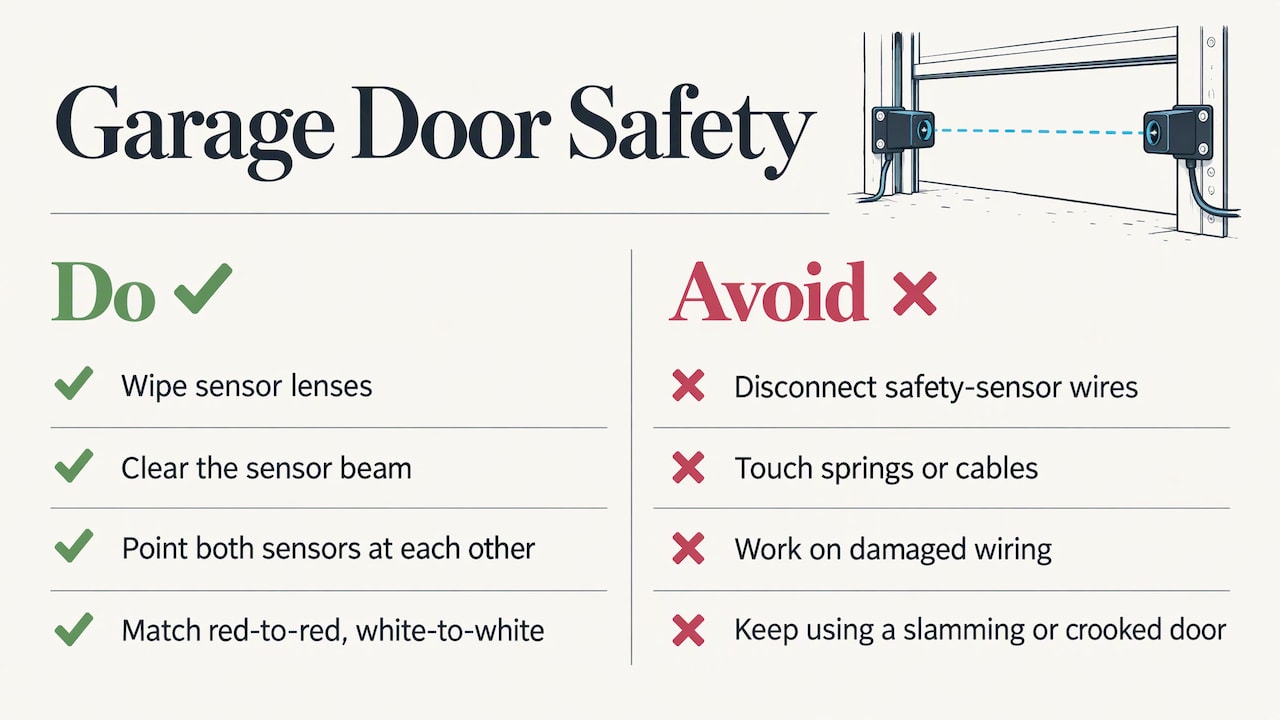
A remote problem and a safety problem can look alike from the driveway. If you press the button and the opener lights flash but the door won’t close, Chamberlain’s support guidance says this may mean obstructed or misaligned safety sensors. These are the two small eyes near the floor on either side of the door. Wipe the lenses, make sure nothing blocks the beam and that both are pointing at each other.
Chamberlain also advises against disconnecting the safety-sensor wires when working on the door control, and says to match red-to-red and white-to-white when wiring a control. If the wiring looks damaged, stop and have it looked at.
Some parts of a garage door should never be touched by a homeowner. The springs and cables hold enough tension to injure you badly. If your door slams down, sits crooked, or the opener strains and the door barely lifts, that is not a remote problem. Leave the door closed and call for a spring or cable check. We cover this in our guide to garage door spring repair in Chicopee, and our cable repair guide for Chicopee explains the next steps if a cable has snapped.
If the light is blinking and the door won’t move, our article on why a garage door light blinks and the door won’t open walks through the causes.
Repair, replace or reprogram: how to decide
There are four realistic outcomes for a failed remote, and each fits a different situation.
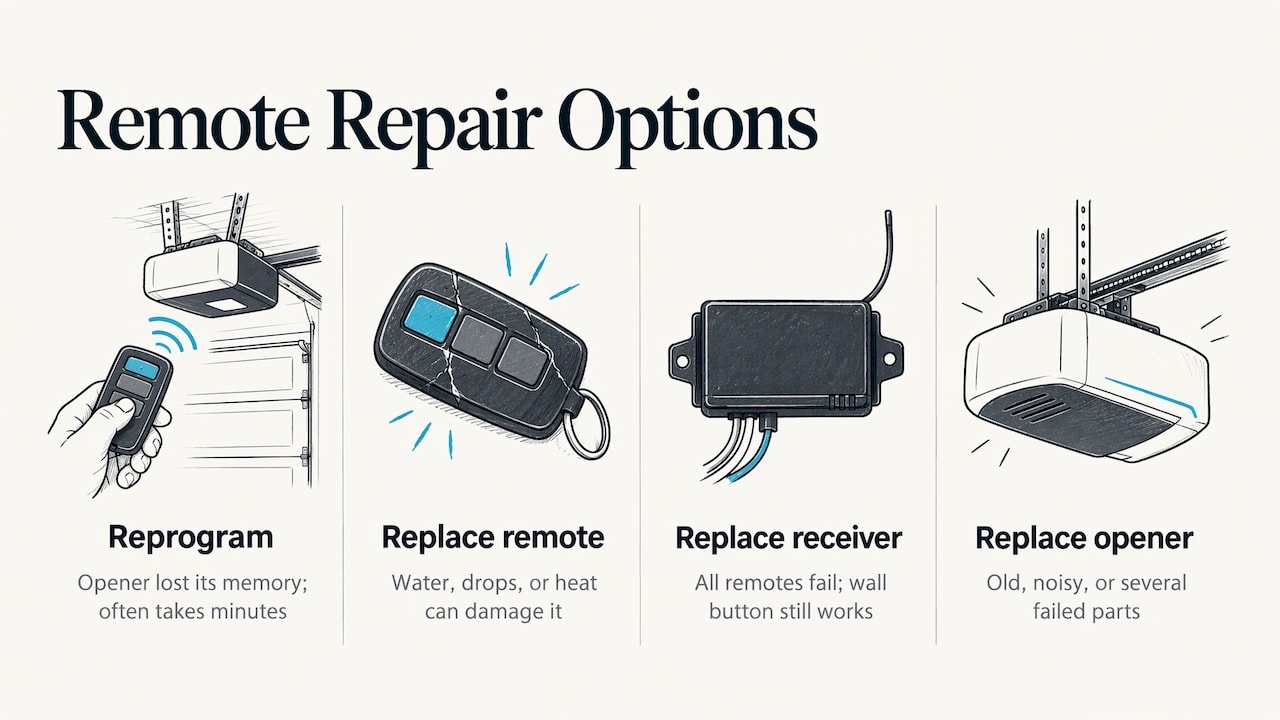
Reprogram. The remote is fine but the opener lost its memory. This is the cheapest fix and often takes minutes.
Replace the remote or keypad. The remote’s circuit is damaged by water, a drop, or years in a hot car. Remotes are sealed units, so a cracked or corroded one is replaced, not repaired. Make sure the new one matches your opener’s system.
Replace the receiver. The opener hears nothing from any remote, but the motor and wall button still work. Replacing the receiver restores remote control without replacing the whole opener.
Replace the opener. The opener is old, noisy, or has several failed parts at once. Replacement is also the moment to add a keypad and new sensors.
Universal remotes exist, but they only work with certain opener brands and code types, and older openers can be a poor fit. If you are unsure which remote suits your unit, a technician can match it by the model number on the motor unit.
What does it cost?
We don’t publish fixed prices for remote work, because the job depends on what is wrong: a battery and reprogramming is not the same as a new receiver. For context on opener replacement, Homewyse’s January 2026 estimate puts a basic 1/2 HP chain-drive opener with two remotes, a keypad and rail mounting at $456 to $765 per opener, including labor, equipment and debris disposal. That is a national estimate, so Chicopee quotes will differ.
What moves the price:
- The part that failed. A remote, keypad, receiver, sensor set or gear each cost differently.
- Opener age and brand. Older units can need a matched system, not just a single part.
- Whether the door itself has problems. A worn spring or cable is worth fixing at the same visit.
- Timing. Emergency calls at night or on weekends are a different service level from a scheduled visit.
Ask for a quote that names the part and the labor so you can compare it to the replacement figure above.
Perspective
Most remote calls start with a homeowner who has already changed the battery twice. By then, the real question is whether the remote, the receiver or the opener is at fault, and that is a diagnosis, not a guess.
We are a family-owned company, and we think a garage door should be treated as one system. A remote, a receiver, a pair of sensors, a set of gears and a spring all depend on each other. Fixing one and ignoring the rest is how you end up with the same call a month later.
That is why we handle remotes, keypads, sensors, receivers and gears together with springs, cables, rollers and tracks. Our technicians explain what they find in plain terms, so you know whether you need a reprogram, a part or a new opener before work begins. Our focus is safety and durability: a door that opens on command and stops when something is in its path.
the author
Get it fixed in Chicopee
If the checks above did not bring the remote back, or the opener is showing other symptoms, we can take it from here. We provide same-day service and 24/7 emergency repairs across Massachusetts and Connecticut, including garage door repair and emergency service in Chicopee. For remotes specifically, see our garage door remote repair service, or call to describe what your opener is doing and book a visit.
If your door also needs a tune-up, our Chicopee garage door maintenance guide explains what a regular visit covers.
FAQ
Can a garage door remote be repaired?
Sometimes. A dead battery or lost programming is fixed in minutes. A remote with water damage or a cracked circuit board is normally replaced, because the unit is sealed. If none of your remotes work, the cause is usually the opener’s receiver or circuit board rather than the remotes.
Why does my wall button work but my remote doesn’t?
The wall button connects to the opener by wire, while remotes use radio. So the opener is powered and the motor works. Check the battery, the Lock feature and interference first. If every remote fails together, the receiver or circuit board is the likely cause.
How much does it cost to fix a garage door opener?
It depends on the part. Homewyse’s January 2026 national estimate for a basic replacement opener with two remotes and a keypad is $456 to $765, and a single repair such as a remote or sensor costs less than a full replacement. We give you a quote once we know what failed.
Do I need to reprogram all my remotes after a reset?
Yes, if you erase the opener’s codes. Holding the Learn button about 6 seconds clears every remote and keypad, so you will need to program each one again, per Sears PartsDirect guidance.
Is it safe to fix the opener myself?
Battery changes, the Lock button and reprogramming are safe for most homeowners. Anything involving springs, cables, or the door’s weight is not. If the door is crooked, heavy or slams, leave it closed and call for service.
Sources
- Garage door opener remotes won’t work, Sears PartsDirect
- Garage Door Opener Troubleshooting, The Genie Company
- How to Troubleshoot a Door Control Panel, Chamberlain Group Support
- Cost to Replace Garage Opener, Homewyse