

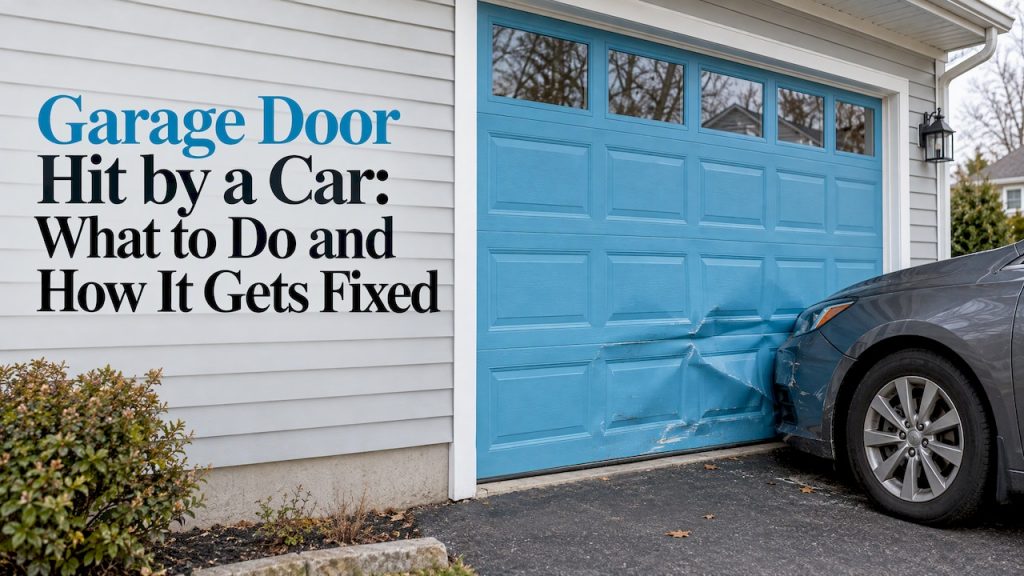
If your car has just hit the garage door, stop using the door, keep people away from it and have a trained technician inspect it before anyone presses the opener again. A hit that looks like a dent can bend the tracks, loosen cables and shift the springs that hold the door’s weight. The door can then jam or fall the next time it moves. We repair and replace garage doors across Massachusetts and Connecticut, with same-day service and 24/7 emergency repairs, and this is how we walk homeowners and business owners through the first hours and the repair.
TL;DR
- Stop, park the car safely, and do not run the door again. Keep children, pets and everyone else out from under and near it.
- The door industry’s guidance is clear: do not remove, adjust or repair the door, springs or hardware yourself. These parts are under extreme tension and can cause serious injury.
- Damage often hides in the tracks, cables, rollers and springs, not just the visible panels. A technician checks all of them.
- Your homeowner’s policy, not your car’s collision coverage, is normally the one that pays for the door itself. Take photos before anything is moved.
- Whether to repair or replace depends on how many panels and which hardware are damaged, and a technician can tell you on site.
Table of Contents
- The first ten minutes after the impact
- What an impact usually damages
- Why you can’t judge the damage from the outside
- When the door is stuck open or won’t close
- Repair or replace?
- Who pays: your insurance and the other driver’s
- If it’s a commercial door
- What we do on the visit
- Our perspective
- Get the door inspected
- FAQ
- Sources
The first ten minutes after the impact
Most impacts happen at low speed: a foot slipping off the brake, a car backing out at an angle, a vehicle left in the wrong gear. The shock is real, and the instinct is to see whether the door still works. Resist it.
Do this, in order:
- Put the car in park and turn it off. Then get out and look at the damage before moving the car. If it’s resting against the door, a bent track or loose panel may be under strain.
- Keep people clear. A garage door weighs a lot, and a damaged one can shift or drop without warning. Nobody should stand or walk under it, and children and pets should stay in the house.
- Do not press the opener or the wall button. A motor pushing a door with a bent track can bind, tear a cable or pull the door off its rollers.
- Look, but only look. Check for panels bent inward, gaps between sections, a track pulled away from the wall, cables hanging loose, or a door sitting crooked.
- Take photos. Photograph the door, the car and the surrounding area from several angles before anything is moved or cleaned up. You will want them for an insurance claim.
- Call a technician. If the door is stuck open and you need to secure the home or get the car out, that is an emergency call, not a do-it-yourself job.
The Door & Access Systems Manufacturers Association (DASMA) says building occupants should not remove, adjust or repair doors, springs or other door system components. It describes doors as large, heavy objects moving under extreme spring tension that can cause serious injury or death. Its guidance says that if a visual inspection reveals a problem, you should stop, not test the door by operating it, and contact a trained technician.
What an impact usually damages
A sectional garage door is a system. Panels ride on rollers in steel tracks, cables and springs counterbalance the weight, and an opener provides the push. A car hitting the panels sends force into every one of those parts. Here is what we look at on a job like this.
| Part | What an impact does to it | Why it matters |
|---|---|---|
| Panels and sections | Dents, creases, cracks, or a panel pushed in or out of line | A creased panel can bind in the tracks and weakens the door |
| Tracks | Bent, twisted or pulled away from the wall | The door jams, or rollers leave the track |
| Rollers and hinges | Bent stems, popped rollers, broken hinges | The door sags and moves unevenly |
| Cables | Kinked, frayed or slipped off the drums | A cable under tension can release suddenly |
| Springs | Shifted, stretched or broken | They carry the door’s weight, so this is the most dangerous part to touch |
| Opener and sensors | Misaligned rail, stripped gears, knocked-out safety eyes | The door may not reverse or close properly |
Spring damage is the one to take most seriously. The DASMA residential checklist says that if a spring is broken, do not operate the door until the spring is replaced, and that repairs and adjustments must be done by a trained door systems technician with proper tools. Our broken spring repair work covers spring replacement and adjustment, and conversion to a different spring system.
Why you can’t judge the damage from the outside
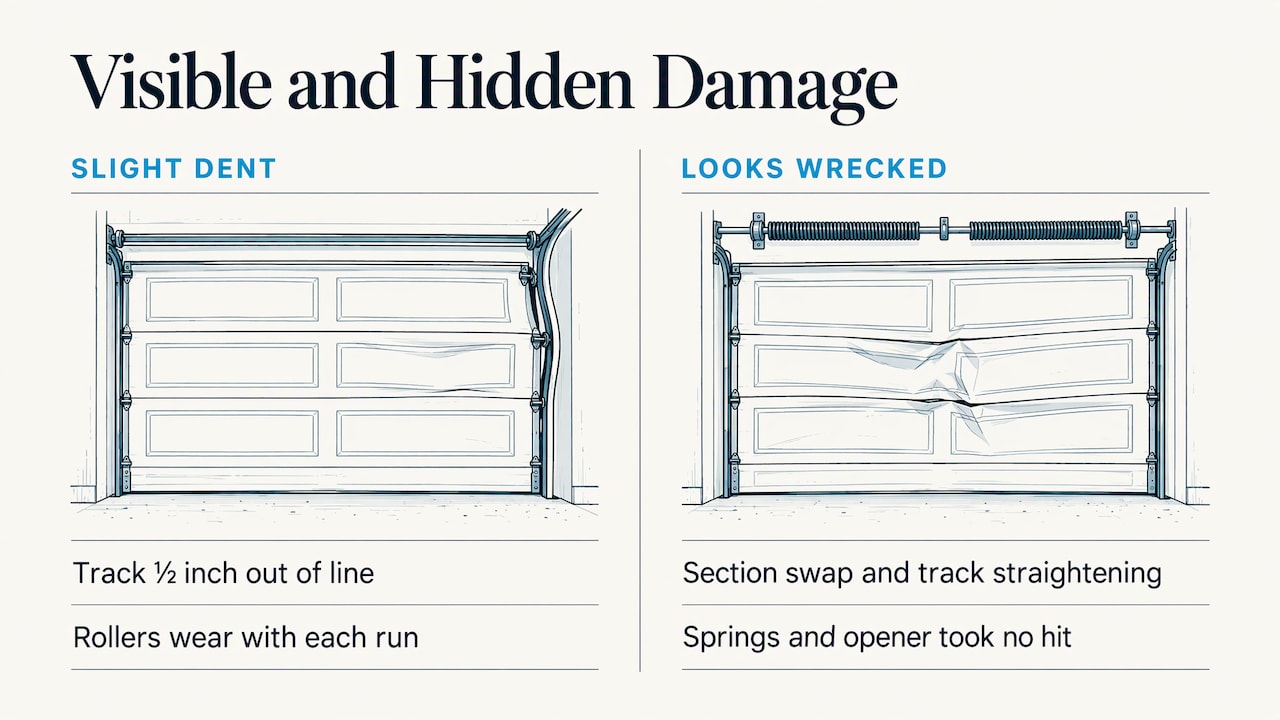
A door that still goes up and down after a hit is not necessarily fine. The panel may look only slightly dented while the track behind it is a half inch out of line. Each time the door runs, the rollers wear against the bend, and eventually something gives.
The reverse also happens. A door that looks wrecked may need only a section swap and track straightening, because the springs and opener took none of the hit. That is why we inspect the whole system and don’t quote from a photo of the dent.
A door that won’t close fully, sits crooked or makes a new grinding noise after an impact is showing you the hidden damage. Our guide on why a garage door won’t close lists the safe checks you can make from the floor without touching the hardware. For a door that has stopped closing and locking properly, this guide on garage door closing problems explains common causes, which are often alignment faults like those an impact creates.
When the door is stuck open or won’t close
This is the situation that sends most people to the phone at night. The car is in the garage, the door is off its track, and the house is open to the street.
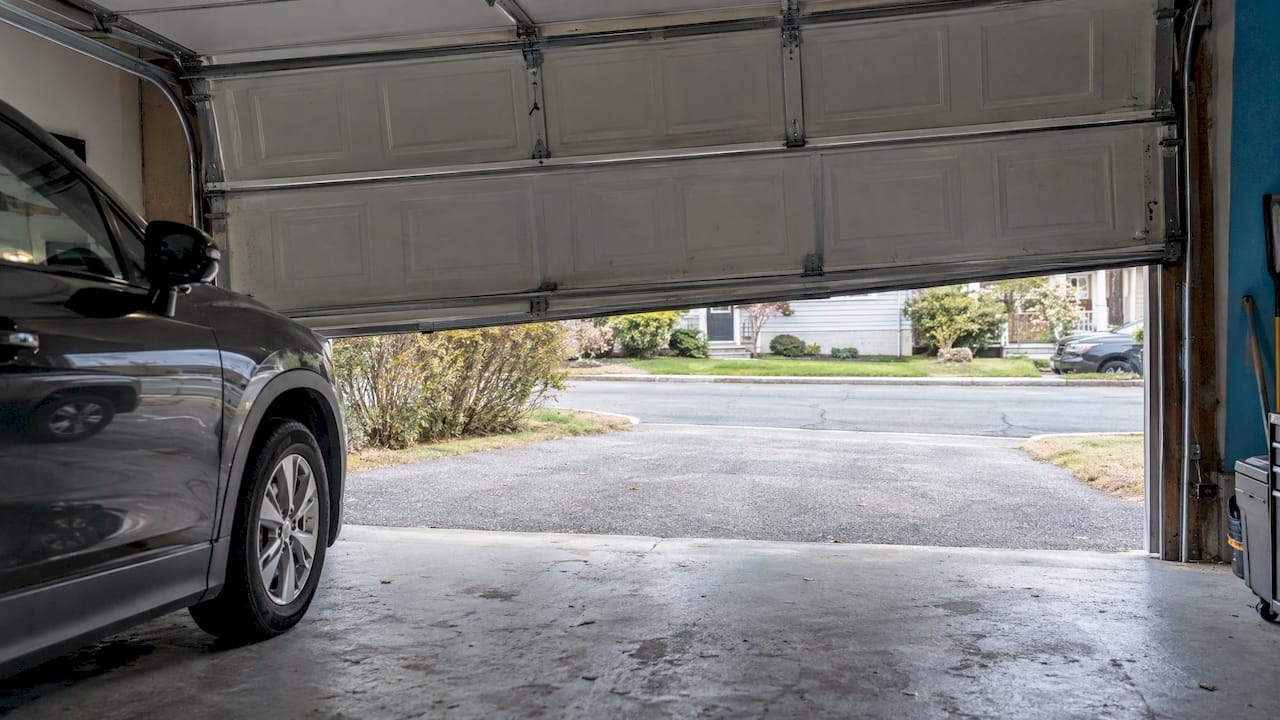
The tempting fixes are the dangerous ones: forcing the door down, lifting it back onto the track, or loosening a spring or cable to free it. Don’t. The same DASMA guidance applies here: a door that cannot be operated safely is a reason to stop and call. If you’re in our area, our 24/7 emergency garage door repair exists for exactly this. We can come out the same day, and a technician can make the door safe and secure the opening. Our page on what to do and expect in an emergency repair describes the process.
Repair or replace?
There is no single rule, but the pattern is consistent.
Repair is usually realistic when:
- One or two panels are damaged and the rest of the door is straight
- The tracks are bent but not torn from the framing
- The damage is to rollers, hinges, cables or the opener rather than the door’s structure
- A matching replacement section is available for the door model
Replacement is usually the better route when:
- Several panels are creased or cracked, so the door no longer holds its shape
- The door is old enough that matching panels are hard to find, and the finish or style would not match after a section swap
- Damage runs across the track, springs and panels together, so the repair would rebuild most of the door anyway
- The door has a long history of repairs and the impact is the last straw
We do section and panel replacement, track repair, roller and cable repair, and complete new door installation, so the answer depends on what we find rather than on what we sell. Our guides on repairing or replacing a garage door and dented garage door repair go deeper on how that decision works. If a replacement is the right call, our new door installation page shows what is involved.
One practical point: if the impact also damaged the opener, sensors or remotes, that repair is separate from the door. We handle openers, keypads, sensors and gear replacement as part of the same visit, which keeps it to one appointment.
Who pays: your insurance and the other driver’s
Cost is the second question after safety. Insurance rules differ by policy and state, so read your own policy or ask your agent, but the general split is the same across most U.S. policies.
- If you hit your own door: your car’s collision coverage, if you carry it, applies to the car, not the door. According to Plymouth Rock, the door falls under your homeowner’s policy, under Other Structures coverage if the garage is detached.
- If someone else hit your door: their auto policy’s property damage liability should pay for it. Get the driver’s name, license, plate and insurance details at the scene.
- If you hit a neighbor’s or a business’s door: your property damage liability covers damage you cause to other people’s property, but it does not cover your own.
- Deductibles: a separate deductible applies to each claim. Plymouth Rock notes that if repairs cost about as much as the deductible, filing may not be worth it. A written estimate from a technician tells you which side of that line you are on.
Whatever the case, your photos and a clear description of the damage are the backbone of a claim. If a claim is filed, your insurer decides what it covers.
If it’s a commercial door
A delivery truck backing into a loading door or a customer’s car hitting a storefront door is a business problem as well as a repair. The opening may need to be secured the same day, and a closed door means lost working hours.
Property damage liability is third-party coverage, so it pays for someone else’s property you damage, not your own. The same source notes business policies can include loss-of-use costs such as income lost while the business is closed for repairs. Check your own policy for what applies. On the repair side, we install commercial doors and run scheduled maintenance for commercial properties. Our guide to commercial garage door repair explains what to fix, when, and what drives the cost.
What we do on the visit
We’re a family-owned company, and our technicians are experienced with damaged doors of every type. On an impact call, here’s how we work:
- We make the door and the opening safe first.
- We inspect the full system: panels, tracks, rollers, cables, springs and opener.
- We explain what is damaged, what can be repaired, and what would be better replaced, in plain language.
- We do the repair, or the replacement, and leave the door running smoothly.
That clear communication matters when you’re stressed and the garage is open to the street. The repair is also part of why we focus on safety and product durability: a door that has been hit is only as good as the repair that follows.
Our perspective
Every impact call starts the same way. The homeowner is embarrassed, the car is in the driveway or half in the garage, and the first question is “Can I just close it?” Our answer is no, and not because we want the job. A door under spring tension that has taken a hit is not predictable, and we would rather make it safe first and talk about repair second.
What we want people to know is that most of these jobs are fixable and do not mean a whole new door. We look at the system as a whole, because the track and spring damage you cannot see is what causes the second, worse failure a few weeks later. A good repair addresses all of it in one visit.
We are a family-owned business serving Massachusetts and Connecticut, with same-day service and 24/7 emergency repairs, because garage doors do not get hit at convenient times. If yours has been, call us before you touch it.
the author
Get the door inspected
If your garage door has been hit, we can make it safe and tell you what it needs. We cover repairs such as broken cables, rollers, tracks and sections, plus opener work and full door replacement, for homes and businesses in Massachusetts and Connecticut. Our local pages cover Chicopee, Springfield, Longmeadow and Agawam. For anything urgent, start with our 24/7 emergency service.
Once the door is repaired, regular upkeep keeps small problems from becoming big ones. Our door maintenance service covers tune-ups for exactly that.
FAQ
Can I still use the garage door after I hit it?
Not until a trained technician has looked at it. Bent tracks, loose cables and shifted springs can make the door jam or fall, and DASMA’s guidance is to stop and call a technician if an inspection shows a problem. If the door is stuck open or closed, treat it as an emergency call.
Does homeowners insurance cover a garage door hit by my own car?
Usually the door is a homeowner’s policy matter, while collision coverage, if you have it, pays for the car. Plymouth Rock also notes that a separate deductible applies to each claim. Confirm the details with your insurer or agent, and keep photos and a written repair estimate.
What is the most common repair after a car hits a garage door?
Panel or section replacement and track straightening are the most common, followed by roller, hinge and cable repair. Spring and opener problems appear when the impact was hard or the door was moving at the time. A full inspection shows which apply.
Can I fix the door myself to save money?
We advise against it. The springs hold the door’s full weight under extreme tension, and DASMA warns that occupants should not remove, adjust or repair springs or other door components. Our technicians do this work every day with the right tools, and we handle it the same day in our service area.
Sources
- DASMA TDS174: Building Occupant, Checking a Garage Door for Damage
- DASMA TDS167: Residential Sectional Garage Door and Electric Operator Checklist
- Plymouth Rock: Does car insurance cover hitting a garage door?
- Liberty Insurance: Property damage coverage