

A garage door that opens on its own almost always has a traceable cause: a stuck remote button, a neighbor’s remote paired to your opener, a worn wall control sending false signals, or a safety sensor that keeps reversing the door. Most of these can be narrowed down in an afternoon. The ones that involve springs, cables or an unbalanced door should be handled by a trained technician, and that is where our team in Massachusetts and Connecticut comes in, with same-day and 24/7 emergency service.
TL;DR
- The usual culprits are a stuck or damaged remote, a faulty wall button or keypad, radio interference or a neighbor’s remote, misaligned safety sensors, and wiring or logic board faults.
- Work out the pattern first: does it happen at certain times, after you close it, or only when you are away? The pattern points to the cause.
- Safe checks include removing remote batteries, cleaning buttons and sensor lenses, and erasing and reprogramming the opener’s remotes.
- A door that binds, sticks or will not stay put halfway is a balance and spring problem. Stop, and call a professional.
- A door standing open while you are away is a security risk, so do not leave a recurring problem for weeks.
Table of Contents
- First, make sure it really opened by itself
- The common causes, from most to least likely
- A quick way to narrow it down
- A safe troubleshooting routine
- When to stop and call a technician
- Why a professional visit beats repeated guessing
- Is it a security risk?
- How we approach it
- Get it checked by our team
- FAQ
- Sources
First, make sure it really opened by itself
Before you chase a fault, rule out the simplest explanation. If you drive off while the door is still closing, it can bounce back up if something interrupts it, and you come home to an open door. Watch the door travel all the way down and stay down before you leave. Check the surface the door lands on too, since debris at the floor can make it reverse.
Also think about where your remote lives. A clicker in a pocket, a visor, a drawer or a center console can be pressed by other objects without you noticing. If the door opens when you are driving or when the car is parked and loaded, start with the remote.
Keep notes for a week. Write down the time, whether anyone was home, whether the door was fully closed beforehand and whether the weather was wet or windy. A door that opens at random hours points somewhere different from one that reopens a few seconds after every close.
The common causes, from most to least likely
A stuck or damaged remote
Worn contacts or a cracked case can leave a button held down, so the remote keeps transmitting. Low batteries can also produce false signals, and dirt buildup on remote, wall switch and keypad buttons can trigger unintended activation. This is the cheapest thing to rule out. Take the batteries out of every remote and keypad for a few days. If the door settles down, put them back one at a time to find the guilty one, then replace it.
Many openers have an indicator light near the learn button. If that light flashes constantly while the door is idle, the opener is receiving a continuous signal. Pull each remote’s battery in turn. When the flashing stops, you have found the stuck remote.
A neighbor’s remote or radio interference
Openers listen for a radio code. On older openers that use a fixed code set with small switches, a neighbor with a matching setting can open your door without knowing it. Openers from before the mid-1990s that use these switches are the most vulnerable, while newer rolling-code models make this far less likely. Radio towers and electronics in the home can also interfere with the signal.
The standard fix is to erase the opener’s memory and reprogram only your own remotes and keypads. Most openers have a learn button on the motor unit. The hold time to erase differs by brand and model, so follow the instructions for your unit. If your opener is old enough to use switch settings, replacing it with a rolling-code model is the lasting solution, and we install and repair openers across our service area. You can see what that covers on our opener repair and installation page.
A faulty wall control or keypad
The wall button inside the garage is wired to the opener with thin low-voltage wire. If the contacts inside it have worn, corroded or shorted, it can send a steady signal or pulse on and off. A keypad on the outside can do the same when moisture gets in.
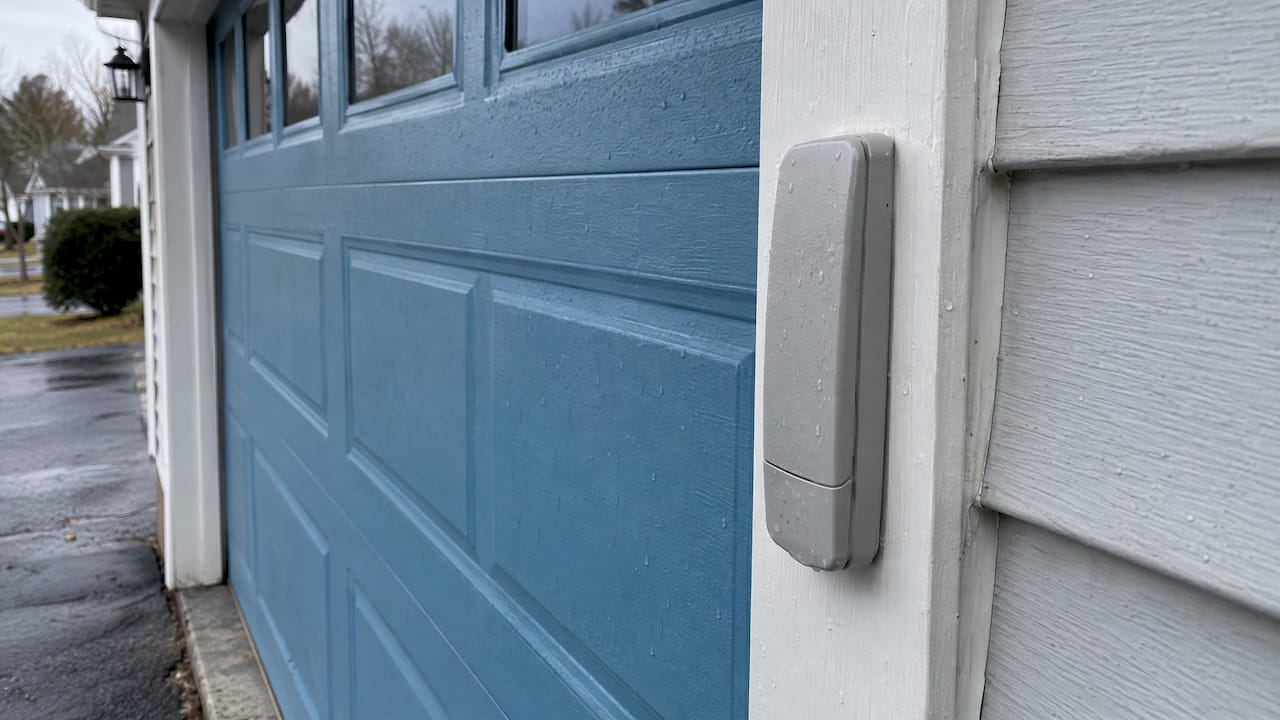
A simple test: disconnect the wire from the wall control at the opener and operate the door with a remote only. If the problem disappears, the wall control or its wiring is the cause. A frayed or pinched wire running along the ceiling or around a staple can cause an intermittent short, which is why the fault seems random. Replace the control and check the wire run for damage.
Safety sensors that are dirty or out of line
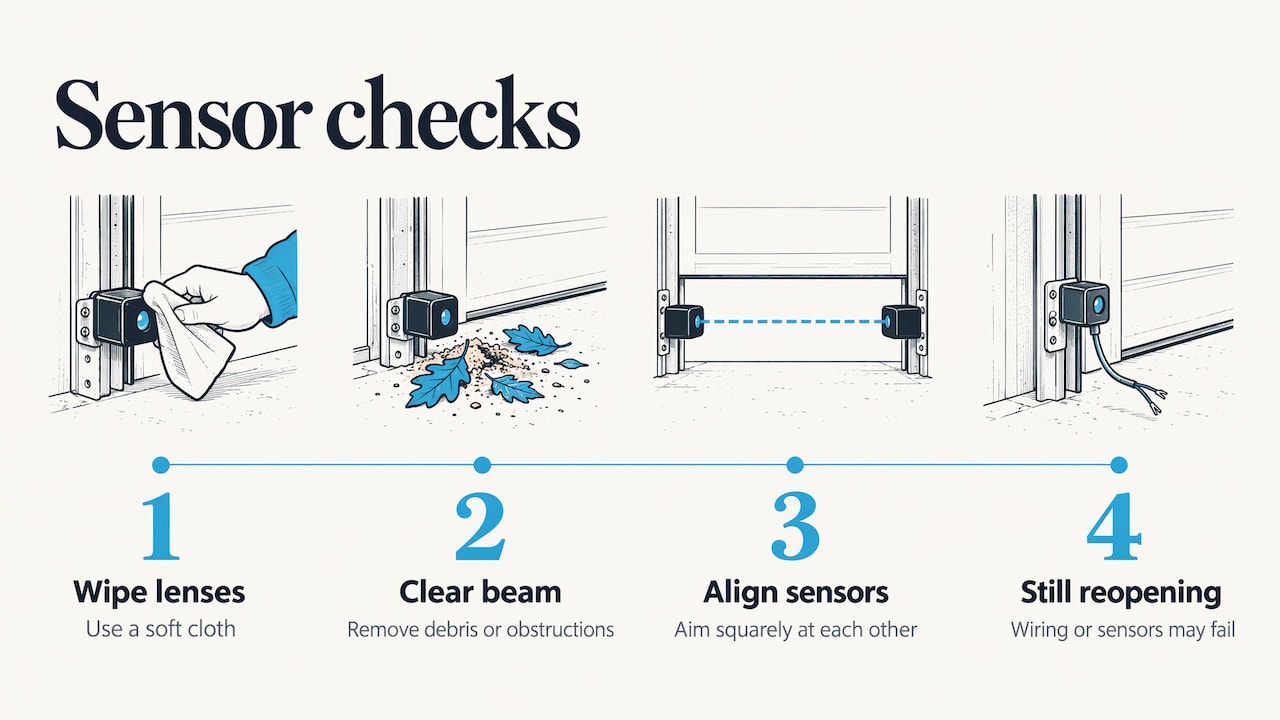
Two small sensors sit near the floor on either side of the door. They send an invisible beam across the opening. If something breaks the beam while the door is closing, the opener reverses. When the sensors are knocked out of alignment, or leaves, sawdust or other debris interrupt the beam, the door can bounce back up every time you close it. A physical obstruction in the path, such as a trailer hitch, can have the same effect.
Wipe both lenses with a soft cloth, check that nothing blocks the beam, and make sure the two sensors point squarely at each other. Many sensors have a small light that glows steadily when they are aligned. If the door keeps reopening after you have done this, the sensor wiring or the sensors themselves may be failing. If the door will not stay closed for other reasons, our guide on what to do when a garage door won’t close covers the related checks.
Limit and travel settings
The opener has settings that tell it where the door’s fully closed position is. If the closed limit is set too high or the force is too low, the door can reach what the opener thinks is an obstruction, then reverse. This often shows up as a door that closes, touches the floor, and rises again. Adjusting these settings correctly takes care, because setting the force too high defeats the safety reversal. Keep the settings in line with your opener’s manual or have a technician do it.
Wiring faults and a failing logic board
The logic board is the opener’s control circuit. Age, power surges, moisture or a loose connection can make it misread signals and trigger on its own. Signs include a door that acts up regardless of which remotes are in use, with the batteries out and the wall control disconnected. At that point, the repair needs a technician who can test the board and the wiring. Our overview of a faulty garage door opener, with causes and safe checks explains what to expect.
A quick way to narrow it down
| What you notice | Most likely cause | Safe next step |
|---|---|---|
| Opens when you are driving or the car is loaded | Remote pressed in a pocket, visor or console | Move the remote, check for a worn button |
| Opens at random times, nobody home | Stuck remote, neighbor’s remote or interference | Remove batteries, erase and reprogram the memory |
| Indicator light flashes constantly | A remote or the wall control sending a steady signal | Pull remote batteries one by one, disconnect wall control wire |
| Reopens a second or two after closing | Sensor misalignment, debris, or limit setting | Clean and realign the sensors, check the floor edge |
| Opens and closes in a loop | Wall control short or board fault | Isolate the wall control, then call a technician |
| Door slams down, sticks or will not stay halfway | Balance or spring problem | Stop using it, call a professional |
A safe troubleshooting routine
Work through these in order. Each step is low risk and takes minutes.
- Watch a full close. Stand inside, close the door with the wall button, and confirm it reaches the floor and stays there.
- Remove every remote battery. That includes keypads and any car-mounted remotes. Leave them out and watch the door for a few days.
- Clean the buttons and sensor lenses. Dirt on a button can hold it down, and a smudged lens can break the beam.
- Isolate the wall control. Disconnect its wire at the opener and run the door from a remote only. If the door behaves, replace the control or repair the wiring.
- Erase and reprogram. Clear the opener’s memory using the learn button, then reprogram only the remotes and keypads you use. This removes any neighbor’s remote.
- Lock the interior door. If your garage is attached to the house, lock the door between them while you work through this, since an open garage is an open entry.
We can handle every one of these steps on a visit, including testing the wall control, replacing keypads and remotes, and sensor replacement. If you would rather not run the checks yourself, our remote repair and installation service takes it off your hands.
When to stop and call a technician
A door that opens by itself is usually an electronic issue. A door that is out of balance is a mechanical one, and it is more dangerous. The springs and cables that carry the door’s weight are under extreme tension, and a severely unbalanced door could unexpectedly crash to the floor and hurt someone.
Here is a simple balance test from a fire department’s safety guidance. With the door fully closed, use the quick-release handle on the opener to disconnect the door from the motor. A properly balanced door stays put when you stop it at any partly open position. If it drifts up or drops, binds or sticks, do not try to adjust it yourself. Keep your hands away from pulleys, hinges and springs, which can cause crushing injuries, and call a professional.
That means call us if you see any of these:
- The door is heavy to lift by hand, or it falls when released halfway.
- You see frayed cables, gaps in a spring or a spring that has snapped. Our page on broken spring repair lists what we fix, and the warning signs a spring is about to break are worth a read.
- The opener acts up with the batteries out, the wall control disconnected and the memory erased.
- The door will not reverse when it meets an obstruction.
- The door is stuck open and you cannot secure the house.
If you have a battery backup on your opener, remember that unplugging the unit may not cut the power completely, so do not rely on that as your safe state. A technician can isolate the opener properly.
Why a professional visit beats repeated guessing
Ghost openings tend to have more than one contributing cause. A weak remote battery, a slightly misaligned sensor and an old wall control can all be present at once, and fixing one leaves the symptom alive. That is why people replace a remote, see a few quiet days, and then find the door open again.
A technician checks the whole chain in one visit: remotes, receiver, wall control, wiring, sensors, limit settings, and the balance of the door itself. The last part matters because an opener that has been fighting a poorly balanced door for years wears its gears and board faster. We do opener repair and installation, keypads and remotes, sensor replacement, receiver service and gear replacement, and we also repair springs, cables, rollers and tracks, so one visit can cover both the electronics and the hardware. Our page on garage door opener repair, causes and next steps explains the process in more detail.
Is it a security risk?
Yes, and it is worth taking seriously even if nothing has been stolen. A door that opens while you are at work leaves tools, bikes and cars exposed, and if the garage connects to your house, it leaves a path inside. Lock the interior door, bring the remotes inside rather than leaving them in a parked car, and fix the cause within days rather than weeks. If you cannot resolve it before you leave, ask a technician to secure the door.
How we approach it
Most of the calls we get about a door opening on its own turn out to be a short list of things, and the trick is to take them in order instead of replacing parts at random. We start with the remotes and wall control because they are the cheapest to rule out, then we look at the sensors, the opener’s settings and its wiring.
The step we never skip is the balance of the door. An opener can only do its job if the springs are carrying the door’s weight, and a door that is out of balance is a hazard no matter how clean the electronics are. As a family-owned company, we would rather spend the extra ten minutes making sure the whole system is sound than leave a family with a door that fails again next week.
If your opener is old, replacing it with a modern rolling-code unit and fresh keypads and remotes is often the cleanest way to end the problem for good. That is why we offer repair and installation side by side, so you get the option that fits your door, not the one that is easiest for us.
the author
Get it checked by our team
If your garage door keeps opening on its own, we can test the remotes, wall control, sensors and wiring, check the balance of the door and repair or replace what is at fault, for homes and businesses in Massachusetts and Connecticut. We offer same-day service and 24/7 emergency repairs, and you can start from our residential garage door services page or see the Chicopee, MA service page.
Businesses with several doors can also arrange scheduled maintenance, and homeowners can book a regular door tune-up so small faults get caught before the door misbehaves.
FAQ
Can a garage door open by itself?
Yes. The usual reasons are a stuck or damaged remote, a worn wall control or keypad, a neighbor’s remote paired to your opener, radio interference, misaligned safety sensors, or a wiring or logic board fault. It is often a combination, so it helps to note when it happens.
Why does my garage door keep opening after I close it?
The opener is most likely reading something in the path of the safety beam. Dirt on the sensor lenses, sensors that no longer face each other, or an object near the door can make it reverse. Clean and realign the sensors, and if it persists, have the sensors, wiring and limit settings checked.
How do I stop my garage door from opening on its own?
Take the batteries out of all remotes, isolate the wall control, then erase the opener’s memory and reprogram only the remotes you use. If the door still acts up, the logic board or wiring is the likely cause and needs a technician.
Could a neighbor’s remote open my garage door?
It is possible, mainly with older openers that use switch-set codes. Newer rolling-code openers make it far less likely. Erasing the memory and reprogramming your own remotes removes any unknown remote from the opener.
Is it safe to keep using a door that opens by itself?
Only if it still balances and reverses properly. If the door binds, sticks, drifts when released halfway or does not reverse on contact, stop using the opener and call a professional. Springs and cables are under high tension, so repairs belong with a trained technician.
Sources
- What To Do If Your Garage Door Opens By Itself, Family Handyman
- Garage Door Safety, Albertson Fire Department