

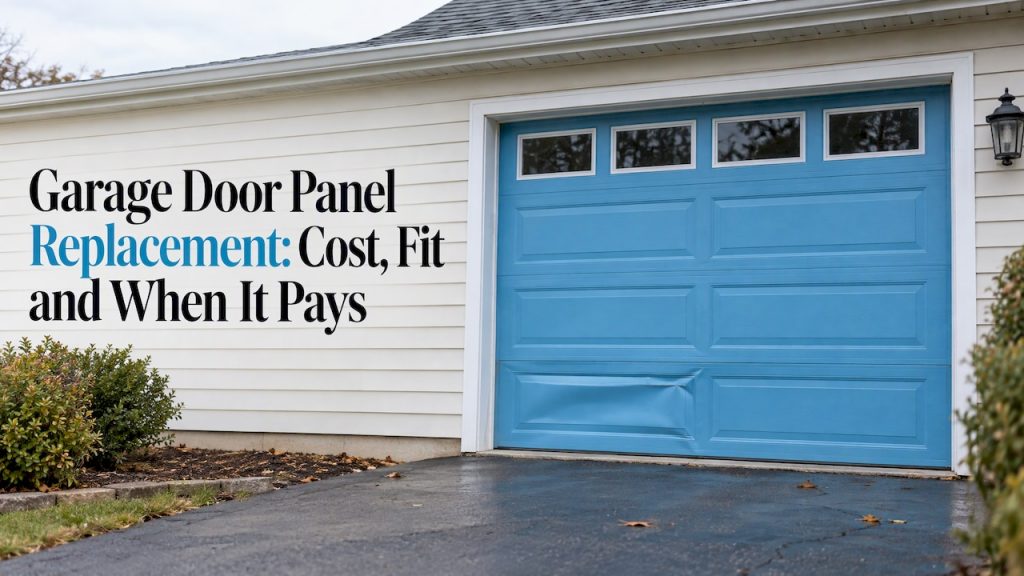
You can often replace a single damaged panel without replacing the whole door, but only when the damage is limited, the rest of the door is sound and an exact matching section can be sourced. Published U.S. estimates put one installed panel at roughly $350 to $900, and the final number depends on your door’s material, size and age. If you are in Massachusetts or Connecticut, we replace panels and sections on residential and commercial doors, and we can tell you on site whether a section swap or a new door makes more sense.
TL;DR
- One or two damaged sections on a door under about 15 years old, with a working opener and tracks, is the case where panel replacement makes sense.
- National cost guides put a single installed panel between about $300 and $900, with averages from $550 to $860 depending on the guide and its date.
- If repairs would cost more than about half the price of a new door, or exact sections are no longer made, replacing the door is the better value.
- A minor dent on a door that still opens, closes and seals normally may only need a repair, not a new section.
- Panels sit in the door’s frame of tracks, rollers, cables and springs under high tension, so this is work for a trained technician, not a weekend project.
Table of Contents
- Can you replace just one garage door panel?
- Repair, replace the panel, or replace the door
- What does garage door panel replacement cost?
- How to identify and match the right panel
- What the job involves, and why it is not a DIY project
- What to check after any panel replacement
- Planning around a New England winter
- Our perspective on panel replacement
- Getting your panel replaced
- FAQ
- Sources
Can you replace just one garage door panel?
Yes. A sectional garage door is built from horizontal panels, usually called sections, joined by hinges. Each section can be unhooked from its neighbors, so in principle one damaged section can come out and a new one can go in.
The catch is the replacement itself. A new section has to match your door’s size, material, insulation, color and design, and the manufacturer has to still make it. This Old House’s 2026 panel replacement guide says section replacement is most sensible when one or two sections are affected, the door is under 15 years old, and the opener and tracks work properly. Outside that window, you are paying skilled labor to fit a part onto a door that may soon need replacing anyway.
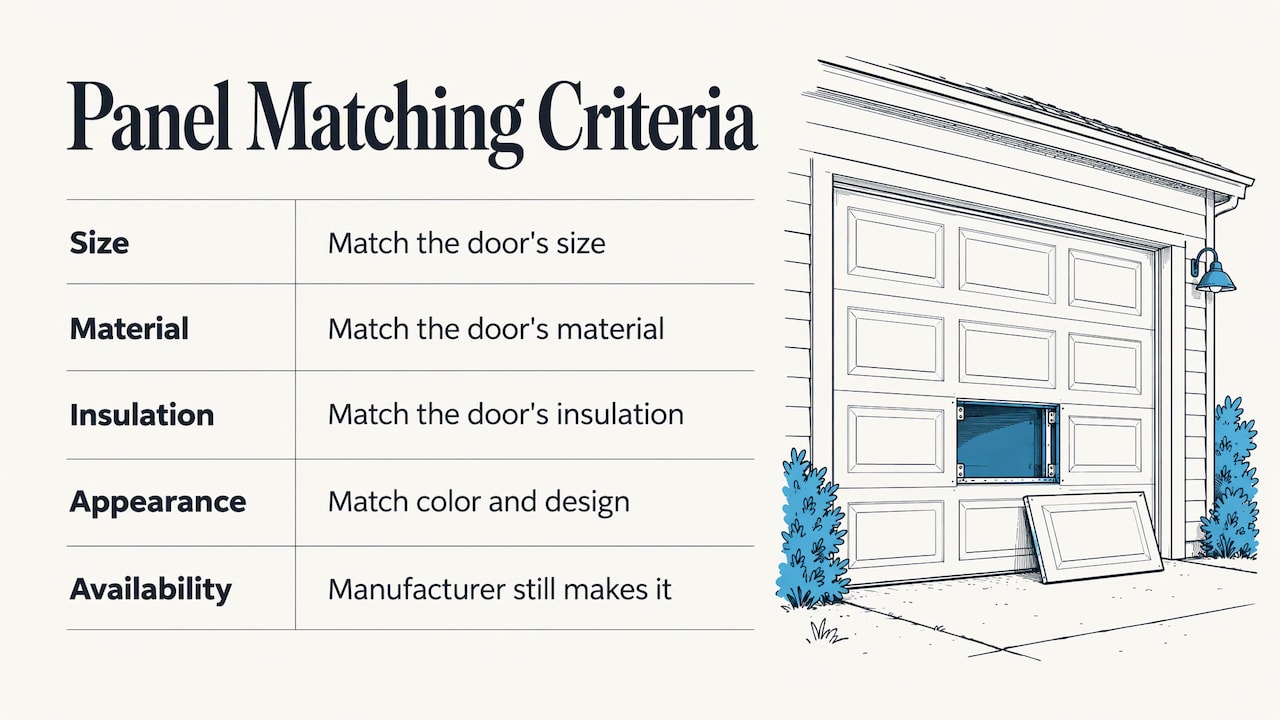
That is why the first question is never “what does a panel cost?” It is “is a matching panel available, and is the rest of the door worth putting it on?”
Repair, replace the panel, or replace the door
There are three realistic outcomes, and the damage in front of you points to one of them.
When a repair is enough
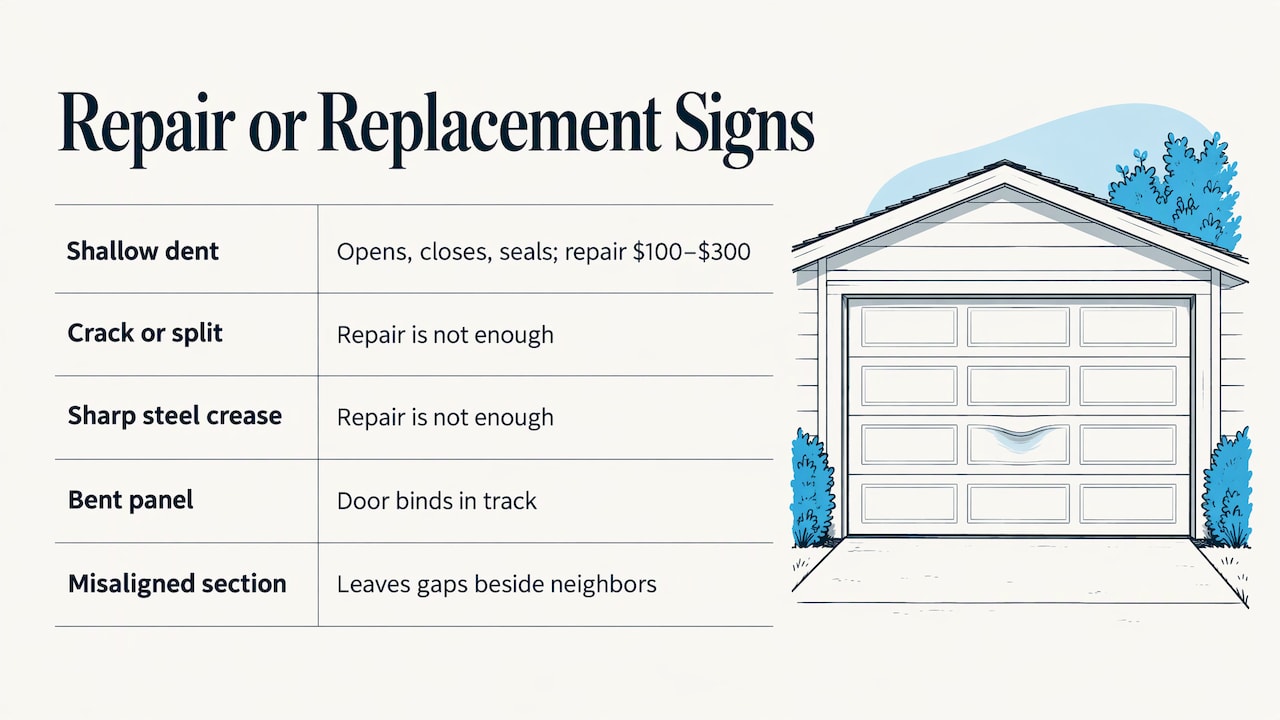
A shallow dent or crease on a door that still opens, closes and seals normally may not need a new section at all. One cost guide reports a minor dent repair range of $100 to $300, which can be well under the price of a new section. Our own page on dented garage door repair walks through what can be fixed and when a dent crosses the line into replacement.
Signs that a repair is not enough: the section is cracked or split, the steel has creased sharply, the panel has bent so the door binds in the track, or the section no longer lines up with its neighbors and leaves gaps.
When a panel replacement is the right call
The pattern that favors a new section is consistent across the sources we reviewed:
- Damage is limited to one or two sections.
- The door is relatively new. One manufacturer’s homeowner guide puts the range at roughly 10 to 15 years old.
- Tracks, springs, cables and the opener are working.
- An exact match is available in size, color, material and window layout.
A typical example is a backed-into bottom section on a three-year-old steel door. The bottom panel takes most of the abuse from cars, snow plows and ice, and replacing it restores both the look and the weather seal at the floor.
When a new door wins
The same guides point the other way in these situations:
- More than two sections are seriously damaged, or the damage affects the door’s mechanical integrity, as the manufacturer guide puts it.
- The door is old and the model has been discontinued, so no exact section exists.
- The total repair would cost more than about half the price of a new door, the threshold This Old House flags.
One trade rule of thumb circulates widely: if you need two panels on a four-panel door, you may already be paying a large share of the price of a new door. That is a good reason to get both numbers on the table before you decide. Our guide to repairing or replacing your garage door lays out how we weigh it, and the garage door replacement cost page covers the other side of the comparison.
What does garage door panel replacement cost?
There is no single national number, and the published ones differ because they measure different things. Here is what the main U.S. cost guides report:
| Source and period | What it reports |
|---|---|
| This Old House, updated April 2026 | $860 average for one section; $860 to $3,440 overall panel replacement range |
| RoofToYard, citing August 2026 figures from a home services marketplace | $350 to $900 installed for one panel, $550 average; $150 to $800 for the panel and $200 to $500 for labor |
| The same RoofToYard guide, citing a June 2025 consumer cost guide | $300 to $900 |
The spread comes from the things that actually set the price on your door:
- Material and insulation. A basic uninsulated steel section costs far less than an insulated, wood, or custom-finish one.
- Size. A section for a 16-foot double door is bigger and costs more than one for a single-car door.
- Windows and design. Sections with glass, raised panels or decorative stamping are priced higher.
- Hardware. A new section may need new hinges, rollers or struts, and sometimes paint or finish work to blend in.
- Labor and local rates. Labor alone runs a few hundred dollars in the marketplace figures above.
We do not publish a flat price for panel replacement, because the right quote depends on your door. When you request one, ask that it list the panel, the labor and any related hardware or paint separately, so you can compare it with the cost of a new door on the same terms.
How to identify and match the right panel
Most of the time spent on a panel job is not the install. It is getting the right part. These are the details a replacement has to match, and the ones to have ready before you call.
- Photograph the damage. Take wide shots of the whole door and close-ups of the damaged section, including the hinges and rollers on it.
- Measure the damaged section. Record its width and height. Sections on a standard residential door are usually the same height from top to bottom, but top sections can differ, and measuring avoids guesswork.
- Note the material, color, design and windows. Steel or wood, insulated or not, flat or raised panel, plain or with glass.
- Find the manufacturer label. This Old House recommends checking the label on a section or the frame, which tells you the maker and model.
- Note the position. Top, middle and bottom sections are not always interchangeable, because the bottom section carries the weather seal and the top section carries the opener bracket.
If the label is gone, painted over or unreadable, do not assume a standard size will fit. A section that is a fraction off will not align with its neighbors, will leak air, and can bind in the track. Matching an unlabeled door is where an experienced technician earns the job: we can look at the door in person, identify what it is, and tell you honestly whether an exact section can be had.
What the job involves, and why it is not a DIY project
Swapping a section sounds simple, and videos make it look quick. The steps themselves are straightforward to describe:
- Secure the door so it cannot move, and disconnect the opener.
- Remove the damaged section’s connections: hinges, rollers and any hardware tying it to the sections above and below.
- Lift the section out and support the rest of the door while the gap is open.
- Position the new section, then refit the hinges and rollers.
- Check alignment, balance and the weather seal, then reconnect the opener and run the door through full cycles.
Where it goes wrong is the weight and the tension. A garage door is among the heaviest moving objects in a house, and its torsion or extension springs hold enough stored energy to cause serious injury if they are loosened or released wrongly. Removing a middle or bottom section changes the balance of the whole door, and a door that is out of balance can drop or jam. Never loosen or remove springs yourself.
Our technicians handle the whole sequence, including checking the springs and cables that carry the door’s weight, so the door is balanced and safe when they leave. If a broken spring or cable is part of the story, see our broken spring repair page, because a section that was damaged in a spring failure often comes with other hardware that should be looked at in the same visit.
What to check after any panel replacement
A good job is visible in how the door behaves, not only how it looks. After the work, confirm the following:
- Smooth travel. The door should rise and lower without shuddering, scraping or catching at the joint where the new section meets the old.
- Even gaps. The seams between sections should look uniform, with no daylight or twisting.
- Seal at the floor. If the bottom section was replaced, the rubber seal should sit flat across the slab.
- Balance. With the opener disconnected, a properly balanced door stays roughly in place when lifted halfway. Have a technician do this test, not you, since a door that falls is dangerous.
- Opener response. The opener should run without straining and reverse when it meets an obstruction.
If the door was working before the damage and is not working right after the repair, that is a reason to call the installer back, not to live with it.
Planning around a New England winter
In Massachusetts and Connecticut, panel damage often shows up after a snowy stretch: a bumper strike on an icy morning, a plow bank pushed against the door, or a section that cracked in cold. Insulated sections also matter more here, because a gap or a mismatched panel lets cold air into the garage and the rooms next to it. If you are weighing timing, our guide to preparing your garage door for a New England winter covers what to check before the cold sets in, and our door maintenance service helps catch worn rollers and hinges before they stress the panels.
For businesses, a damaged section on a commercial door is a security and operations problem as much as a cosmetic one. Our commercial garage door page covers installation and scheduled maintenance for those doors.
Our perspective on panel replacement
Most calls about a damaged panel start with the same question: can you just fix that one piece? Often the honest answer is yes, and we are glad to do it. A single new section on a sound door is a good outcome for everyone.
What we have learned to do first is look at the whole door. A dented section is rarely the only thing a door is telling you. Worn rollers, frayed cables and tired springs show up while a section is open, and we would rather you hear about them at the same visit than get a second emergency call in a month.
As a family-owned company, we care about giving you a clear answer in plain language: what can be repaired, what needs a new section, and when the better value is a new door. Our technicians handle springs, cables, tracks, rollers and openers every day, so a panel job is done with the full door in mind, not just the one piece in front of us.
We offer same-day service and 24/7 emergency repairs, because a door with a broken section can be stuck open or shut at the worst time.
the author
Getting your panel replaced
If you have a damaged section in Massachusetts or Connecticut, our panel replacement and new door installation page is the place to start. We provide panel replacement, section replacement, track, roller and cable repair, and new door installation for homes and businesses, with same-day service and 24/7 emergency repairs when you need them. Send photos of the damage and the door’s label if you can find it, and we will tell you whether a new section or a new door is the better route.
If you are near Chicopee, our Chicopee garage door repair and emergency service page has local details.
FAQ
How much does it cost to replace one garage door panel?
Published U.S. guides put a single installed panel at about $300 to $900, with one 2026 guide reporting an $860 average per section. Material, size, windows, insulation and local labor drive the difference. Ask for a quote that separates the panel, labor and any hardware or paint.
Can I buy just one garage door panel?
Often yes, if the manufacturer still makes sections for your door model. Sections for older or discontinued doors may be unavailable, and in that case a full door replacement is usually the better option. Having your door’s label, section size, color and position ready speeds up the search.
Is it cheaper to repair a damaged panel than replace it?
For a minor dent on a door that still works and seals normally, repair can cost less, with one guide listing $100 to $300 for dent repair. Cracked, split or sharply creased sections generally need replacement. A technician can tell you which applies after seeing the door.
When should I replace the whole door instead?
Consider a new door when more than two sections are badly damaged, the door is older than about 15 years, matching sections are unavailable, or repairs would approach half the cost of a new door. Those thresholds come from This Old House and a manufacturer’s homeowner guide.
Sources
- Garage Door Panel Replacement Cost (2026 Price Guide), This Old House
- Garage Door Panel Replacement Cost (2026): Panel vs New Door, RoofToYard
- Garage Door Replacement Panels: When to Repair or Replace, Amarr