

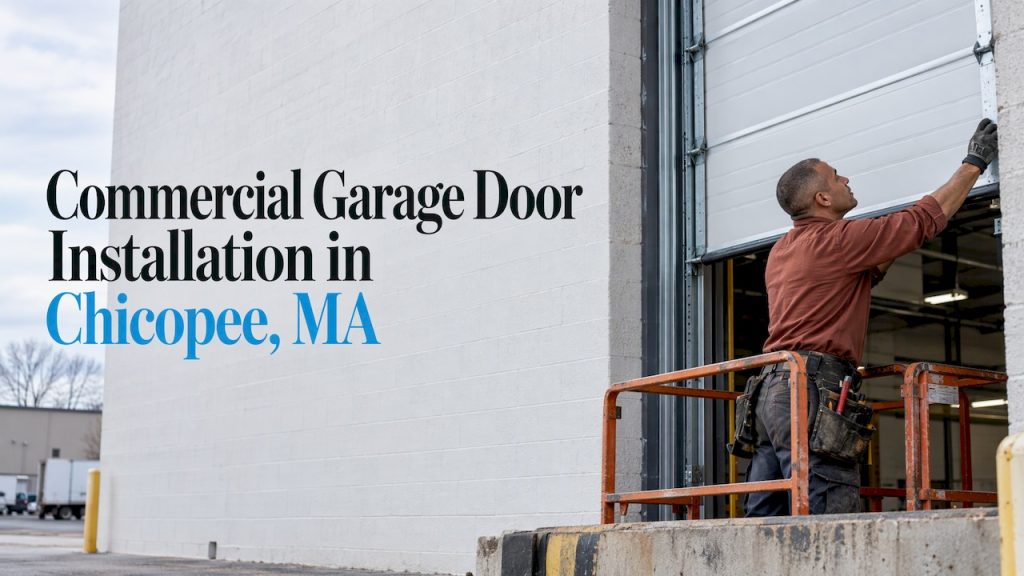
A commercial garage door installed right is a door you stop thinking about: it opens thousands of times, closes safely and does not stall a delivery. Getting there in Chicopee takes four decisions: the right door type for your business, an accurate check of the opening, the permit and code basics, and an installer who also keeps the door running afterward. Speedy Garage Door Services installs commercial doors and runs scheduled maintenance for businesses in Massachusetts and Connecticut, with same-day service and 24/7 emergency repairs when a door fails before the planned work happens.
This guide walks through each decision in the order you will face it.
TL;DR
- Match the door to the job: insulated sectional doors for heated spaces, full-view doors for showrooms and service bays, rolling doors for docks and storage.
- Installed prices for commercial doors are often quoted between $1,500 and $7,000 in 2026, and larger, insulated or high-speed doors can run well past that.
- Measure headroom, sideroom and the structure that will carry the tracks before you order anything.
- Chicopee follows the Massachusetts State Building Code, so confirm permit requirements with the city before work starts.
- Plan maintenance at the same time as installation: busy doors need service every 6 to 12 months.
Table of Contents
- Choosing the right commercial door for your Chicopee business
- Check the opening before you order
- What installation involves, step by step
- Permits, code and safety in Chicopee
- What commercial garage door installation costs
- Maintenance: the part that protects your investment
- When a door fails before the new one goes in
- Get a commercial door installed in Chicopee
- FAQ
- Sources
Choosing the right commercial door for your Chicopee business
Residential doors are built for a few cycles a day. Commercial doors are built for many more, and the type you pick should follow what happens in the doorway.
Insulated sectional doors. These are the usual choice for conditioned buildings, warehouses and manufacturing space, where you want to hold heat in during a Pioneer Valley winter. Manufacturer buying guides, such as this 2026 commercial buyer’s guide, list insulated sandwich-panel doors for heated or cooled buildings, fire stations and truck terminals.
Full-view aluminum doors. Glass-panel doors suit restaurants, storefronts, dealerships, service centers and fire stations, where visibility matters. The same guide pairs them with those uses.
Ribbed steel doors. A plain, non-insulated steel door fits dock doors, outbuildings and storage facilities where you need durability more than climate control.
Rolling doors. A rolling service door coils above the opening, which helps when ceiling space is tight, and it is a common fit for loading docks and storage. Security grilles with an open-air design suit retail and food businesses that want protection after closing.
A quick way to decide:
| Your business | Door to consider | Why |
|---|---|---|
| Warehouse or distribution dock | Insulated sectional or rolling steel | Durability, daily cycles |
| Auto repair or service center | Full-view sectional | Light and visibility |
| Heated manufacturing space | Insulated sectional | Holds temperature |
| Storage or outbuilding | Ribbed steel | Lower cost, simple use |
| Retail or restaurant | Full-view or security grille | Visibility, after-hours protection |
If you are unsure which row describes your building, our team can talk through the opening and the traffic it sees. Our commercial page outlines commercial door installation and scheduled maintenance.
Check the opening before you order
Most commercial installation problems start with measurements, not hardware. Before a door is ordered, the building has to be assessed for:
- Opening size and shape. Width and height, plus whether the jambs are plumb and the header is level.
- Headroom and sideroom. One commercial door specification calls for 14 inches of normal clearance above commercial-size doors, against 12 inches for residential, and at least 3 inches beyond the door width on each side for the track assemblies. Low-headroom hardware exists for buildings that fall short.
- Structure. Tracks and hardware must mount to load-bearing members, not thin siding or loose block. DASMA’s code inspection guidelines make this a final-inspection item.
- Power and controls. Where the operator will mount, where the control station will go and how it will be wired.
- Daily cycles. A door that opens 50 times a day needs heavier springs and hardware than one that opens 5 times.
The same specification asks for components rated for at least 20,000 operation cycles and approved shop drawings before fabrication. If your door is custom-sized, expect that drawing step to add time before the install day.
One practical task falls to you: clear the work area. Pallets, shelving and stored stock near the opening slow a crew and put your inventory at risk. If the area has turned into overflow storage, a warehouse cleanout plan helps you clear it quickly before install day.
What installation involves, step by step
A commercial install follows a predictable sequence. Here is what each step takes and where it goes wrong.
- Site assessment and quote. Measuring the opening, headroom and sideroom, and noting the structure. The mistake here is quoting from a phone description. Wrong measurements mean a door that does not fit.
- Door and hardware selection. Door type, insulation, windows, operator and safety devices, matched to traffic and climate.
- Removal of the old door. Old torsion springs and cables are under heavy tension. Manufacturer installation instructions warn that springs, cables and bottom brackets can cause severe injury or death if mishandled. This is trained-technician work.
- Track and hardware mounting. Tracks must be plumb, aligned and fastened to solid structure. A track that is a fraction out of line causes binding and early wear.
- Panel assembly, spring and cable setup. Balance is set here. A door that is out of balance strains the operator and can drop unexpectedly.
- Operator and controls. The operator must be matched to door weight and cycle count, with the control station mounted correctly.
- Safety testing and walkthrough. Smooth travel, balance, alignment, operator function and safety systems should all be confirmed before the door goes into regular service.
We handle the full sequence for commercial customers, including the spring and cable work that is the riskiest part of the job. You do not have to coordinate separate crews for removal, installation and operator hookup.
Permits, code and safety in Chicopee
Chicopee’s building ordinance adopts the Massachusetts State Building Code (780 CMR) as the controlling standard within city limits, and it states that a building permit is not issued until the prescribed fees are paid. The same ordinance carries a fee schedule: alterations and repairs to commercial buildings are listed at $20 plus $0.40 per square foot, with a $320 minimum, and online permits are discounted by $20. That schedule dates from 2007 and fees get updated, so confirm what applies to your project with the City of Chicopee’s Building Department before you schedule work. Whether a given door replacement needs a permit depends on the scope, for example whether the opening or structure is being altered, and the department can tell you.
Structural conditions matter for larger openings. The Massachusetts code’s table of local design factors (2009 edition) lists Chicopee at a 35 psf ground snow load and a 95 mph basic wind speed. Those numbers are why the door’s wind rating and the framing around it deserve a look. The Commonwealth’s structural design chapter requires construction documents to show wind design data, so ask your installer which rating the door carries.
What an inspector will look at on a sectional door is spelled out in the DASMA inspection checklist:
- Installation matches the manufacturer’s documents.
- Tracks are securely connected to load-bearing members.
- Warning labels are in place.
- The control station is mounted at least 5 feet above walking surfaces.
- Photoelectric or sensing-edge safety devices are installed and tested. For a commercial operator they may be omitted only if the control station uses constant pressure.
The same document tells inspectors to look at spring anchor brackets and cable attachments but never touch them, and to advise the owner to call a trained door systems technician if anything looks loose. Treat your own staff the same way: nobody on the floor should adjust a spring or cable.
What commercial garage door installation costs
No honest number exists without a site visit, and we do not publish fixed prices for installation. Published 2026 guides give a useful range for budgeting:
- OfficeFinder’s April 2026 guide puts most commercial doors at $1,500 to $7,000 installed, with larger, insulated, high-speed or heavy-duty doors at $10,000 to $20,000 or more. It lists basic overhead doors at $1,500 to $4,500, insulated doors at $2,500 to $8,000 and up, and high-speed doors at $5,000 to $15,000 and up.
- Housecall Pro’s 2026 guide says commercial installations often start around $2,000, and lists commercial opener installation at $600 to $1,500.
These are national averages compiled from online marketplaces, not Chicopee quotes. Four things move your number most:
- Size. Wider and taller doors mean more panels, heavier springs and more labor.
- Insulation. Insulated doors cost more up front and save on heating in a New England winter.
- Operator and controls. Heavier operators, access control and safety devices add cost.
- Structural work. Reinforcing a header or mounting surface is separate from the door itself.
When you compare quotes, compare scope: door model, insulation, operator, removal of the old door, permit handling and what the testing and walkthrough cover. A low number that leaves out removal or the operator is not a lower price.
Maintenance: the part that protects your investment
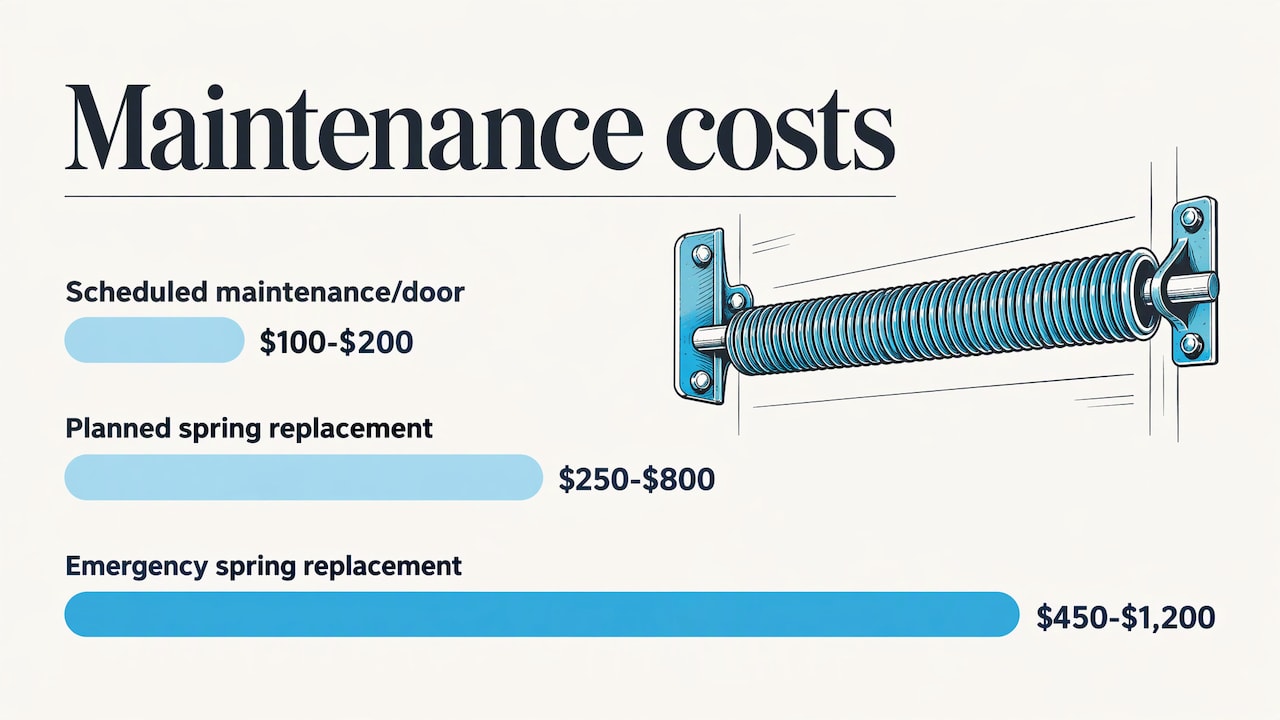
A new door is the start of the cost, not the end. For high-use doors, one 2026 cost guide suggests service every 6 to 12 months depending on cycle count, twice a year for doors that run more than 50 cycles a day, and a look at high-cycle springs every 3 to 6 months. The same guide estimates scheduled maintenance at $100 to $200 per door, twice a year, and gives a planned spring replacement as $250 to $800 against $450 to $1,200 as an emergency. Those are national estimates, but the pattern holds: a failure on your schedule is cheaper than a failure in the middle of a shipment.
The guide also offers a rule of thumb for replacement over repair: consider replacing when the door is 15 to 20 years old, several major components fail in the same year, or a single repair quote tops half the price of a new door.
A maintenance visit typically covers springs, cables, rollers, tracks, the operator and safety sensors, which are services we provide. Our commercial page covers scheduled maintenance, and for broken parts between visits, spring repair and cable, roller and track repair are available.
When a door fails before the new one goes in
If your current door jams open, you have a security and safety problem the same day. Keep people and vehicles clear of the opening, do not try to lift a door with a broken spring and call a technician. Our 24/7 emergency service and same-day availability exist for this: we can secure the door and get it working, and plan the replacement properly afterward. The 24/7 repair page explains how to reach us.
Our view: install for the next ten years, not the next ten days
We are a family-owned company, and what we see in commercial garage doors comes down to one idea: the door, the hardware and the operator are one system. When they are specified together and installed by trained technicians, the door runs smoothly and safely. When they are not, wear and safety problems follow.
That is why we start with the opening and the way your business uses it, not with a catalog. A dock door, a service bay and a storefront all ask different things of a door.
It is also why we pair installation with scheduled maintenance. Springs and cables are the parts that fail, and they are the parts that injure people when handled wrong. Keeping them on a service schedule, with the same crew that installed the door, is the most reliable way we know to keep a business open.
the author
Get a commercial door installed in Chicopee
Speedy Garage Door Services installs commercial garage doors and maintains them on a schedule, across Massachusetts and Connecticut. We offer same-day service, 24/7 emergency repairs and clear communication from the first call.
To plan an installation or set up maintenance for the doors you already have, start at our commercial garage door page. For other door work, such as a new residential door, see garage door installation in Massachusetts.
FAQ
How long does a commercial garage door installation take?
The install itself is often completed in a day for a standard sectional door, though larger or custom doors take longer. Doors made to size need approved drawings and fabrication first, so lead time can be longer than the install. We confirm the schedule after measuring the opening.
Do I need a permit in Chicopee?
Chicopee enforces the Massachusetts State Building Code, and permits are issued only after fees are paid. Whether a door replacement needs one depends on the scope of work, so check with the City of Chicopee Building Department before scheduling.
Can I keep my existing opener?
Sometimes, if it is rated for the new door’s weight and cycle count and its safety devices meet current requirements. Heavier insulated doors often need a stronger operator. We assess this during the site visit.
Which commercial door is best for a heated building?
Insulated sectional doors are the standard choice for conditioned spaces, because the insulated panels help hold temperature. Add weather seals and a properly balanced door, and the opening stops being your weakest point in winter.
Sources
- Commercial garage door buyer’s guide (2026)
- Types of commercial garage doors
- Commercial door specification: clearances and cycle ratings
- DASMA TDS 151 General Code Inspection Guidelines for Garage Doors
- Garage door installation instructions and safety warnings
- City of Chicopee, Chapter 122: Building Construction
- Massachusetts Building Code, Chapter 16 design factors (2009)
- 780 CMR 16.00 Structural Design
- Commercial garage door cost guide, April 2026
- Garage door price guide 2026
- Commercial garage door repair cost 2026
- Warehouse cleanout plan: a step-by-step guide