

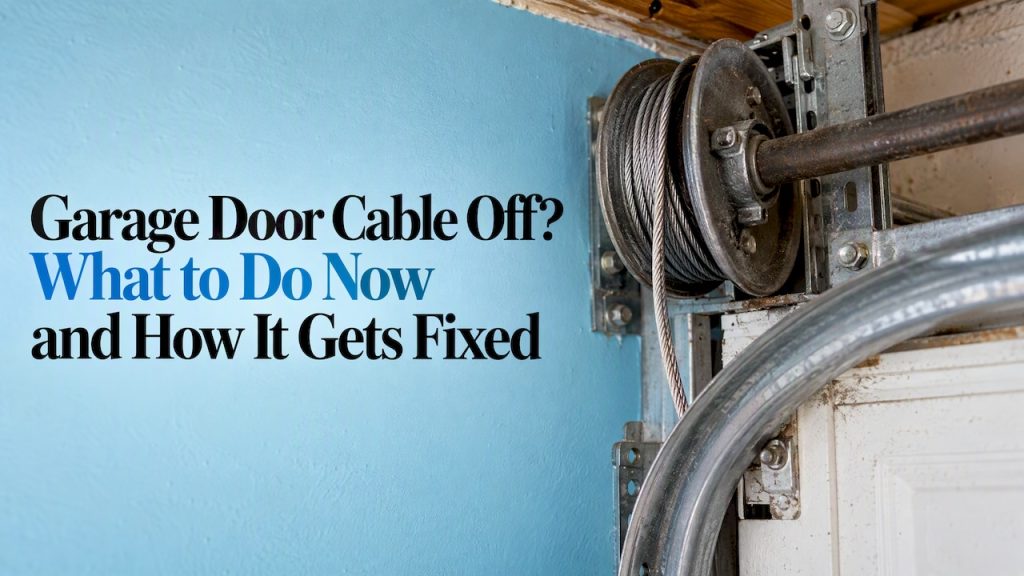
If the cable has come off your garage door, stop using the door, unplug or disconnect the opener, and keep people and cars clear of it. Do not try to put the cable back on yourself. The cable is connected to a spring system under extreme tension, and the door usually weighs well over 100 pounds. A trained technician needs to rebalance it. In our area that is a same-day call for most homes.
This guide explains what to do in the first ten minutes, why cables slip off the drum or pulley, what a technician checks, what the repair typically costs in the US, and how to keep it from happening again.
TL;DR
- Stop using the door. Do not run the opener, and do not lift the door by hand.
- A cable usually comes off because it went slack: the door hit something, a roller bound up, the track is out of line, or the spring tension is off.
- Cable repair is not a DIY job. Industry safety guidance says cables should be replaced only by a trained technician.
- Typical US cost for cable work runs about $150 to $350, with emergency calls at the top of that range.
- Fix the cause, not only the cable. If the root problem stays, the cable will come off again.
Table of Contents
- What to do right now when the cable comes off
- Why the cable came off the drum or slipped off the pulley
- Is it safe to use a garage door with a cable off?
- Can you put a garage door cable back on yourself?
- What a technician checks and repairs
- How much does it cost to fix a garage door cable?
- Perspective: why cables come off twice
- Preventing the cable from coming off again
- Fast help for cable problems in Massachusetts and Connecticut
- FAQ
- Sources
What to do right now when the cable comes off
The first few minutes matter more than the repair itself. The goal is to keep the door from moving and to keep anyone from standing under or beside it.
- Stop the door. If it is partly open, leave it where it is. Do not press the wall button “to see if it works.” An opener pulling on a door that has lost one lift cable can twist the door, bend the track and make the damage much bigger.
- Disconnect the opener. Unplug the unit from the ceiling outlet. Do not pull the red emergency release cord if the door is up and not supported, because a door that is released can drop.
- Keep people and pets clear. Nobody should stand under the door or walk through the opening while it is hanging crooked.
- Move the car if you can do so safely. If the door is fully closed and the car is inside, leave things alone and call. If it is open and stable, drive the car out only if there is plenty of clearance and the door is not moving or sagging.
- Do not touch the cable, the drum, the spring or the bottom brackets. The bottom brackets on most doors are under extreme tension, and the spring system is wound tightly.
- Take two photos from a safe distance. Show the cable on the floor or hanging loose, and the drum or pulley at the top corner. A technician can often tell what parts to bring from a photo.
- Call a technician. Tell them whether the door is up, down or stuck halfway, and whether one cable or both came off.
If you are locked out of your garage, or the door is stuck open and the house is exposed overnight, that is exactly what our 24/7 emergency garage door service is for.
Why the cable came off the drum or slipped off the pulley
Two things get called “pulley” in searches. On a torsion door, the cable winds onto a drum at each end of the spring shaft above the door. On an extension spring door, the cable runs over a pulley at the side of the door. In both cases the cable stays put for one reason: the weight of the door keeps it tight. When that tension disappears, the cable straightens out and drops away from the drum or pulley.
That is also how Clopay’s troubleshooting guide for slack cables frames the problem. It lists the usual triggers for lost tension:
- the door closing on an obstruction
- the opener or jackshaft moving in a way that creates slack
- rollers or hinges that bind
- tracks that are crooked or not properly aligned
- cables of unequal length, or drums that are out of time with each other
- not enough spring tension when the door is open
Here is what each of those looks like in a real garage.
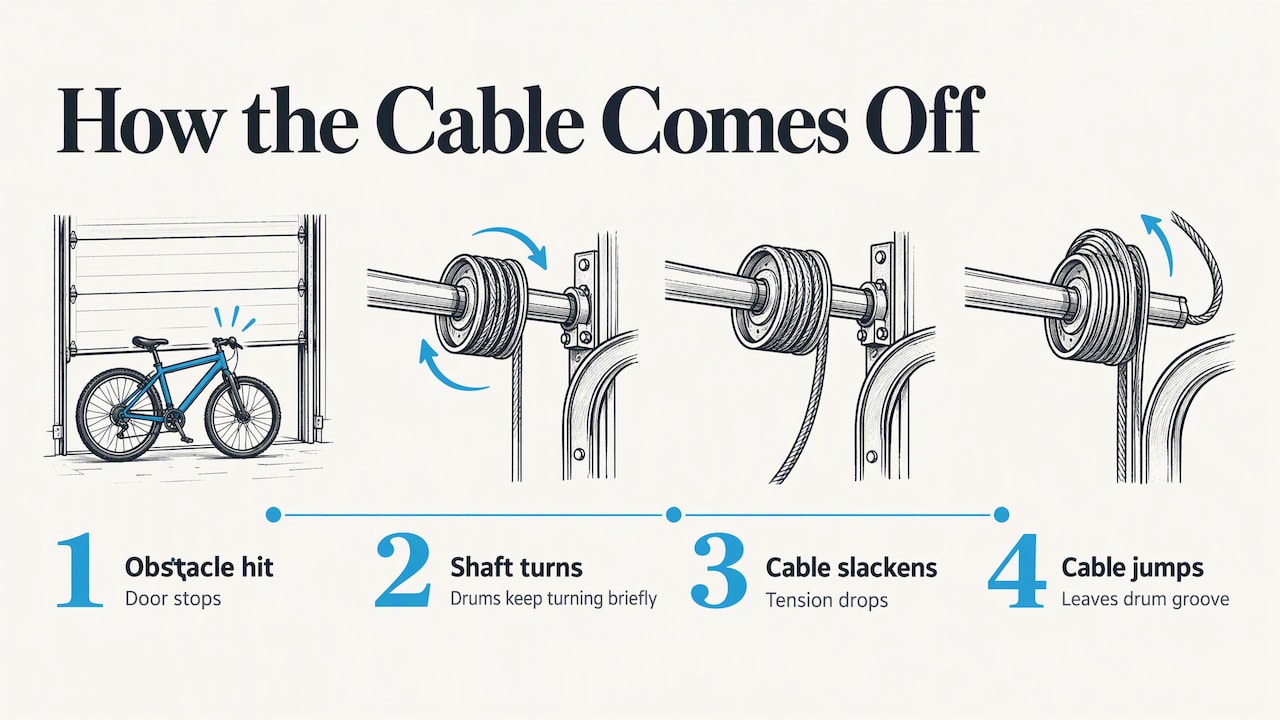
The door hit something on the way down
This is the most common story we hear. A bicycle, a trash can, a bag of salt or a child’s toy sits in the path. The door lands on it and stops, but the spring shaft and drums keep turning for a moment. The cable goes slack, and the next time the door moves, the cable has jumped off the drum groove. Modern openers have an auto-reverse feature, but a door can still bounce on an obstacle and slacken a cable before it reverses. Sensors that are misaligned or dirty make this more likely, which is why we also look at opener and sensor condition on a cable call.
A roller or hinge is binding
If one side of the door sticks in the track, that side stops dropping while the other side keeps going. The cable on the stuck side loses its load. Dried-out rollers, worn hinges, a bent track section or a roller that has popped out all do this. Here in western Massachusetts and Connecticut, winter makes it worse: old grease stiffens, and moisture and road salt corrode hardware in the garage.
The tracks are out of line
Vertical tracks need to be plumb and level with each other. When a house settles, or a car clips a track, the door runs tighter on one side. The cable on the tight side can go slack at the top of travel.
The springs are worn, broken or unevenly set
A broken torsion spring leaves the door without its counterbalance. The door becomes heavy and the cables can go loose on the drums. A spring that has been wound badly, or that has lost tension over the years, can have the same effect on a smaller scale. If your door has felt heavy lately, or you heard a loud bang from the garage, read our guide to the warning signs that a garage door spring is about to break.
Cable length or drum timing is unequal
If one cable is a bit longer than the other, or a drum has slipped on the shaft, one side carries more load than the other. This commonly follows a previous repair that did not set both sides equally. Clopay warns that improper DIY repairs to cable tension can leave the door unbalanced or noisy and make future cable failures more likely.
The cable itself is frayed or corroded
A cable that has rubbed against the drum edge or rusted at the bottom bracket can snap rather than slip. That is a different failure, but the symptoms are similar: the door goes up crooked, stops halfway or will not close.
Is it safe to use a garage door with a cable off?
No. A garage door is one of the heaviest moving things in your house, and the cables carry its weight. With one cable off, the whole load is on the other side. The door can tilt, jam in the track, come out of the track or fall.
DASMA, the Door and Access Systems Manufacturers Association, warns homeowners not to remove, adjust or repair doors, springs or other door-system components, because heavy doors and springs under extreme tension can cause serious injury or death. Its safety tips add that cables should be replaced only by a trained technician.
Watch for these specific hazards while you wait for the repair:
- A door that is partly open and crooked. It can drop without warning. Keep everyone out from under it.
- A door that is closed with a cable off. It looks safe, but forcing it open by hand or with the opener can bend the track or pull the door out of line.
- A loose cable under spring tension. Cables and drums can snap or spin if touched.
- A garage that is exposed. If the door cannot be closed, secure the interior door to the house and move valuables until the repair is done.
If you see a door that has already come out of its track, or the bottom corner is hanging away from the frame, treat it as an emergency and call right away.
Can you put a garage door cable back on yourself?
You will find videos that show it. We advise against it, and so do the people who make the doors. The reasons are practical:
- To get the cable back on the drum, someone has to lift the door and hold it, or release spring tension. The door and the springs are the danger.
- Putting the cable on is only the visible half of the job. The cable also has to be the right length, equal on both sides, with the drum set to the right position on the shaft. If you get that wrong, the door will run crooked, and the cable will probably jump off again.
- If the real cause is a worn roller, a bent track or a weakened spring, the cable will come off again no matter how carefully you reinstall it.
What you can do safely is to look, take photos, clear the area, and write down what happened right before it failed (a noise, an obstruction, a heavy door in recent days). That information helps the technician.
What a technician checks and repairs
A proper cable call is more than threading the cable back on. This is how we approach it.
- Secure the door. Before touching anything, the technician clamps the door or the track so it cannot move.
- Find out why the cable went slack. That means checking for an obstruction mark on the bottom of the door, bent or crooked tracks, binding rollers and hinges, the spring condition, and whether the opener or sensors played a part.
- Inspect the cable, drum and bracket. Frayed strands, flattened sections and damaged drum grooves mean the part needs replacing, not resetting.
- Replace or reset the cable. If one cable is worn, the other is usually the same age and wear. Replacing both keeps the door balanced, which is the usual practice.
- Set spring tension and drum timing. Both sides must carry equal load. If the spring is weak or broken, that is repaired in the same visit. Our broken spring repair service covers spring replacement and adjustment.
- Straighten or replace damaged hardware. That might include rollers, hinges, a track section or a damaged panel.
- Test the door. Run it by hand first, then with the opener, and test the auto-reverse.
For a closer look at the repair itself, see our page on broken cable repair.
How much does it cost to fix a garage door cable?
Prices vary by door type, parts and time of day. For a national benchmark, HomeGuide’s 2026 cost guide reports the following ranges in the US:
| Repair type | Typical US cost |
|---|---|
| Standard cable replacement (both cables) | $150 to $250 |
| Cable tensioning or realignment | $100 to $200 |
| Partial cable repair | $150 to $200 |
| Complete cable system overhaul | $200 to $400 |
| Emergency cable repair | $250 to $350+ |
The same guide gives an overall range of $150 to $350 for cable repair. Treat these as general US figures, not our quotes. We do not publish fixed prices for cable repair, because the price depends on what we find: a cable that simply needs resetting costs less than a job that also needs a spring, a track section or a panel. We give you a clear quote after the technician sees the door, before the work starts.
A few things push the total up:
- a broken spring on the same visit
- bent tracks or a damaged bottom panel
- evenings, weekends and holidays
- heavier doors or commercial doors with special cable sizes
A short-term saving that costs more later: replacing only the one cable that came off. If the other one is the same age, the door tends to go out of balance again.
Perspective: why cables come off twice
We are a family-owned garage door company serving Massachusetts and Connecticut, and the cable calls we dread most are the repeat ones. The cable goes back on, the door works for a week or two, and then it comes off again. In our experience that almost always means the first repair treated the cable and missed the cause.
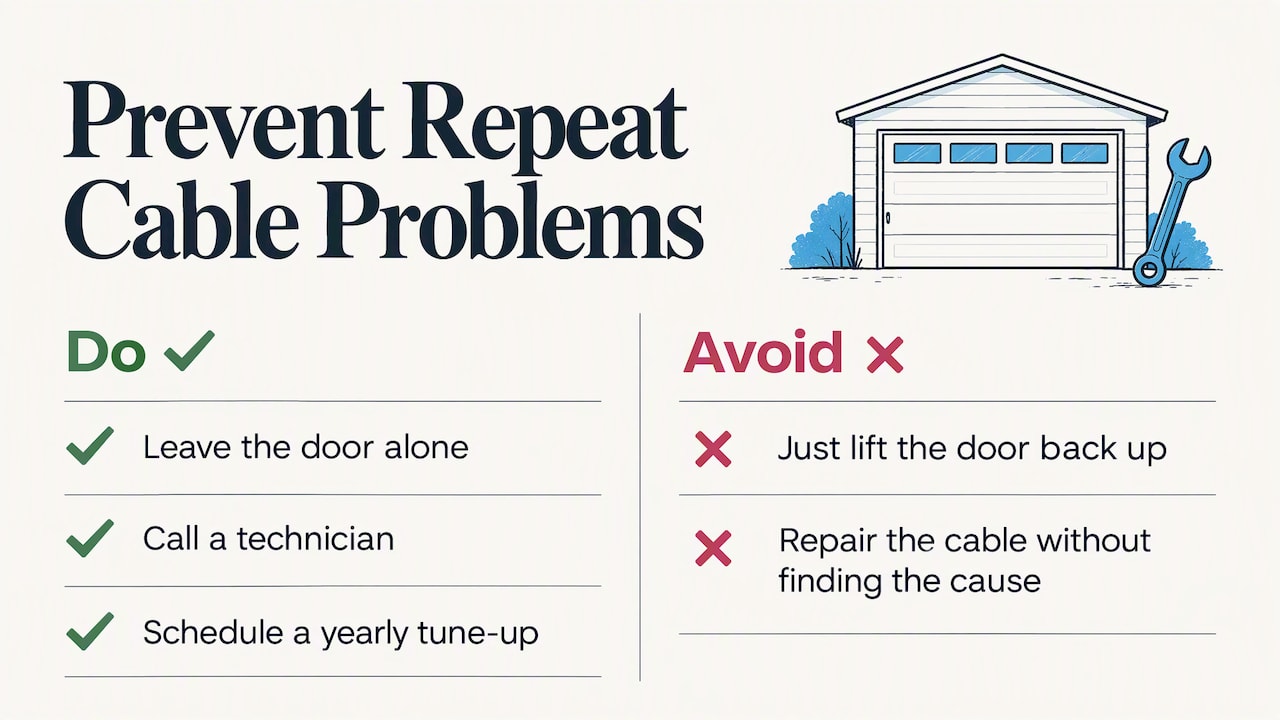
A cable is the symptom. The cause is usually something that made the door run uneven: a roller that is worn flat, a track that sits a quarter inch out, a spring that is tired, or a drum that was set a half turn off. So when we get a cable call, we spend as much time on the tracks, rollers and spring as on the cable. We would rather tell you the door needs a new set of rollers than send you home with a cable that will slip again.
We also believe in telling you plainly what is safe. Garage doors injure people each year because someone decided to “just lift it back up.” Our advice is simple: leave the door alone, call us, and let us handle the springs and cables. And once the door is fixed, a yearly tune-up costs far less than an emergency call at night.
— the author
Preventing the cable from coming off again
Once the door is repaired, a few habits keep it that way. Clopay’s guidance on slack cables points to keeping the cables equally taut, checking for binding rollers and tracks that are not level and plumb, and stopping the door from closing on objects. Here is how that translates into a routine:
- Keep the door’s path clear. Put bikes, bins and boxes away from the opening, and teach everyone in the house not to run the door while something is in the way.
- Test the sensors. Place a roll of paper towels in the beam path and close the door. It should reverse. If it does not, call for service.
- Lubricate moving parts. Clopay recommends a silicone-based lubricant on the pulleys so they move smoothly and the cable wears less. Do not spray the cable drums or springs yourself beyond what the manufacturer suggests, and keep your hands away from the spring area.
- Look and listen once a month. Watch the door run. Does one side lag? Is the cable frayed near the bottom bracket? Is there a new squeal or scrape? Notice and photograph, but do not adjust.
- Do not ignore a heavy door. If the door suddenly feels heavy or slams down, the spring may be weak or broken.
- Schedule a yearly tune-up. A technician can check balance, cable wear, rollers and tracks before something fails. After a hard New England winter, a spring or fall check is a good rhythm.
Fast help for cable problems in Massachusetts and Connecticut
When a cable comes off, you want a person who answers the phone, tells you what is happening and shows up soon. Speedy Garage Door Services handles cable, spring, roller, track and opener repairs for homes and businesses in Massachusetts and Connecticut, with same-day service and 24/7 emergency repairs. Our technicians fix the cable and look for the reason it failed, so the repair lasts.

See our garage door cable and repair services or call us from the page. We work in Chicopee, Longmeadow, Agawam, Granby, MA, Granby, CT, East Windsor, CT and the towns around them.
FAQ
Can I open my garage door with the cable off?
Don’t. With a cable off, the door is unbalanced and can tilt, jam or fall. Using the opener can bend the track or pull the door out of line. Leave it where it is, unplug the opener and call a technician.
Why does my garage door cable keep coming off the drum?
Repeat failures almost always mean the cause was never fixed. Common reasons are a binding roller, a crooked track, unequal cable length or drum timing, or weak spring tension. Putting the cable back without correcting those lets it go slack again. A technician needs to find and fix the underlying issue.
How long does a garage door cable repair take?
Most cable repairs take a technician a visit of roughly an hour or two, depending on the door and whether springs, rollers or tracks also need work. We confirm the scope on site and give you the quote before starting. If the door has come out of the track, expect more time.
Do I need to replace both cables if only one came off?
Usually yes. Both cables have the same age and wear, and replacing both keeps the door balanced. Replacing one can leave the other close to failure and the door unevenly loaded. Your technician will inspect the second cable and tell you what they see.
Is a garage door cable repair an emergency?
It is urgent, because the door cannot be used safely. It becomes an emergency if the door is stuck open and your home is exposed, if the door is stuck closed with a car inside, or if the door has come out of its track. In those cases, call a 24/7 service.
Sources
- Clopay: Troubleshooting Slack Cables
- Clopay: Garage Door Cable Replacement, safety and professional help
- DASMA: Safety Tips
- DASMA: Trained Door Systems Technician, checking a garage door
- HomeGuide: How Much Does Garage Door Cable Repair Cost? (2026)