

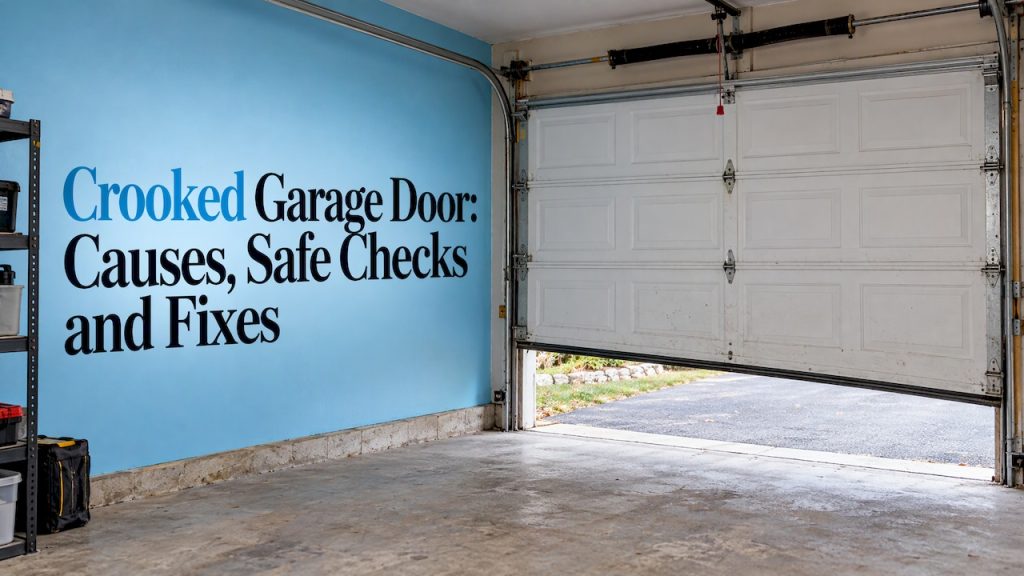
A garage door that hangs crooked, rises on one side or closes with a gap at one corner almost always has a problem on one side of the system: a slipped or frayed cable, a spring losing tension, a bent track or worn hardware. You can safely look and run a simple balance test. The fix itself, especially anything involving springs and cables, belongs to a trained technician.
This guide explains what causes an uneven door, how to tell a balance problem from a cosmetic one, which checks are safe, what repairs usually involve and what they typically cost.
TL;DR
- A crooked door means one side is lifting or holding differently from the other. Springs, cables, drums, tracks and rollers are the usual suspects.
- Do a visual check and a balance test monthly. Stay out from under the door if it looks off.
- Never loosen or adjust springs, cables, brackets or pulleys yourself. They are under extreme tension.
- Spring repair in the US typically runs $100 to $300, according to Houzz. Your door and region can change that.
- If the door slams down, shoots up, binds or sags to one side, stop using it and call a professional.
Table of Contents
- What a crooked garage door is telling you
- Signs your door is out of balance
- Common causes of an uneven garage door
- How to check balance safely
- What not to do
- Can a bent garage door be straightened?
- What does it cost to fix a crooked garage door?
- Our perspective on crooked doors
- Get your door straight again
- FAQ
- Sources
What a crooked garage door is telling you
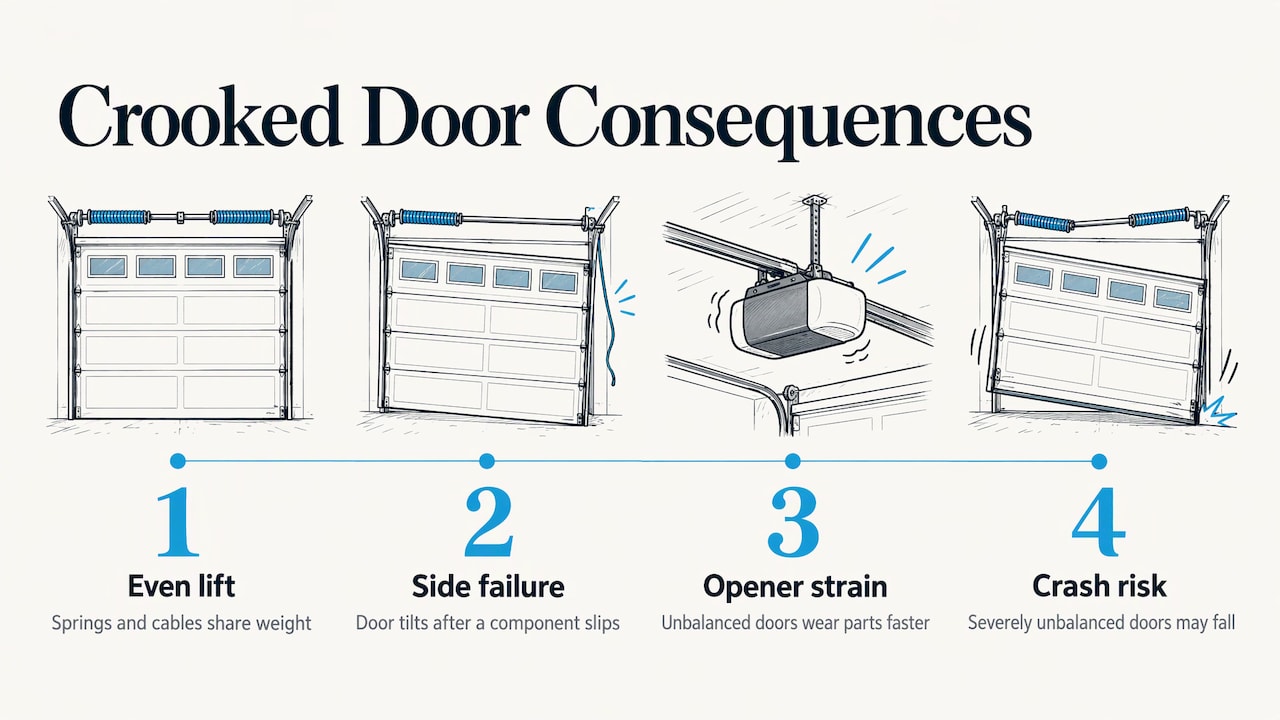
A garage door is built to be symmetrical. Springs carry the weight of the door, and cables on each side lift it evenly. When the door tilts, a component on one side has failed, slipped or loosened.
That is why a crooked door is more than a looks issue. Genie explains that a balanced door has its torsion springs doing the lifting, with weight spread evenly. When it is not balanced, the opener works harder than it should and parts can wear or fail faster. The U.S. Consumer Product Safety Commission warns that a severely unbalanced door could crash to the floor, possibly striking someone beneath it.
So treat a crooked door as a repair that is coming, not a quirk to live with.
Signs your door is out of balance
Crooked is the most visible symptom, but readers describe it in several ways: an uneven door, a door that closes unevenly, one that feels heavy or one that seems to fall. Genie lists these signs of an unbalanced door:
- The door looks crooked while opening.
- It makes loud noises or creaks.
- It crashes down after being opened.
- It feels very heavy when you lift it by hand.
You may also notice a gap at one bottom corner when the door is closed, one side of the door reaching the top before the other, the opener straining or reversing for no clear reason, or the door stopping short of the floor on one side.
If you want to know what else can stop a door from closing, our guide on what to check when a garage door won’t close covers sensors, tracks and more.
Common causes of an uneven garage door
Most crooked doors trace back to one of the causes below, listed roughly from most to least common in our experience.
A cable that slipped or frayed
A cable runs from the bottom bracket on each side up to a drum on the torsion bar. If a cable slips off its drum, or the drum slips on the bar, that side of the door hangs lower than the other. The door then goes up crooked and often gets worse each cycle. A frayed cable can also snap. The IDA tells homeowners to look closely for cable wear or fraying during monthly inspections.
If you see a loose or dangling cable, read what to do when a garage door cable is off. Our broken cable repair page explains how we handle it.
A worn or broken spring
Springs do the heavy lifting. If one spring in a two-spring setup breaks or weakens, the door loses lift on that side. Even when both springs are intact, uneven tension between them can tilt the door. Single-bay doors with extension springs can also close crooked when one spring stretches more than the other.
A door that feels heavy by hand is often a spring issue. Our list of warning signs a spring is about to break can help you catch it early.
Bent or misaligned tracks
A door can hang crooked if a track is bent, loose or no longer parallel to the other side. A bump from a car, a shifted bracket or loosened bolts can do it. The door may rub, bind or jump as it travels.
Worn rollers and loose hardware
Worn or broken rollers let the door wobble in the track. Loose hinges or brackets let sections shift out of line. These problems are usually smaller than spring or cable failures, but they can add up to a visibly uneven door.
Damaged sections or panels
A door that has been hit, or a section that has cracked or buckled, can lose its shape. A bent section stops the door from sitting flush and can strain the rest of the system. A technician will decide whether to replace a section or panel, or the whole door. DASMA’s inspection guidance says that when a problem is found, a judgment should be made on whether to repair or replace, with attention to sections, struts, hinges, rollers and fasteners.
An opening that has shifted
Sometimes the door is fine and the frame around it has moved. Settling, moisture or a rusting steel lintel above the opening can leave it out of square. If the opening itself looks bent, read about garage lintel rust and its causes so you can recognize it. A door technician can then judge whether the problem is in the door or the structure.
How to check balance safely
The IDA recommends monthly visual inspections and monthly balance tests. The balance test follows the same steps from manufacturers:
- Close the door and stand inside the garage with nobody under or near the door.
- Pull the emergency release cord to disconnect the opener.
- Lift the door by hand. It should move easily. Chamberlain says a balanced door should move easily with one hand.
- Raise it about three feet and let go slowly. Genie describes a 36-inch lift. A balanced door stays roughly in place or drifts only a little. It should not fall all the way closed.
- Lower the door back down and reconnect the opener only when everything is safe.
How to read the result:
| What the door does | What it suggests | What to do |
|---|---|---|
| Stays about where you left it | Balanced | Keep monthly checks |
| Drifts slowly up or down | Acceptable, per Chamberlain | Keep monthly checks |
| Slams shut or shoots upward | Out of balance | Stop using it, call a technician |
| Feels very heavy, or one side lifts first | Spring, cable or drum issue | Call a technician |
Chamberlain’s guidance is clear that a door that slams shut or shoots up with force is out of balance and needs a professional door technician.
A quick visual check
With the door closed, stand inside and look. Compare left and right: cable position, spring condition, bracket height, track alignment and gaps along the bottom seal. Look for frayed strands, loose bolts, flattened rollers and a drum that sits differently from its twin. Take photos. They help a technician diagnose before arriving.
What not to do
Some things look like easy fixes and are not. Chamberlain warns never to try to loosen, move or adjust springs, cables, pulleys or brackets, because they are under extreme tension. DASMA calls counterbalance tension the most complex and dangerous part of a door, and says repairs and adjustments should be done only by a trained door systems technician with the right tools.
In practice:
- Do not stand or walk under a door that is partly open and crooked.
- Do not keep running the opener on a visibly tilted door. Chamberlain notes an unbalanced door may not reverse when required.
- Do not force the door by hand if it binds or jams.
- Do not loosen drum set screws, spring winding bolts or bottom brackets.
Things you can do safely: clear debris from the area, keep the door closed if it is stable, take photos, note when the problem began and whether it got worse, and call for service.
Can a bent garage door be straightened?
Sometimes. A track with a minor bend can sometimes be repaired if the metal is still sound, while sharply creased, cracked or twisted tracks generally need replacing. A section with a small dent may be straightened, but a buckled panel often needs a replacement section.
The repair-or-replace call comes down to the condition of the sections, hinges, rollers and fasteners. A technician checks these together with the springs and cables, because straightening one part does nothing if the real fault is a slipped drum. If the door is old and several parts are worn, a new door can make more sense than a string of repairs. Our new door installation page covers that route.
What does it cost to fix a crooked garage door?
The price depends on the cause. A cable reset or roller swap is a smaller job than replacing springs, a section or the whole door. For reference, Houzz reports that US homeowners usually spend between $100 and $300 on garage door spring repair, with a typical cost of $230. The low end is $75 and the high end $400.
We do not publish set prices, because the job depends on the door type, spring system, parts and the time of day. A technician who sees the door can give you a clear number before work starts. Photos and a description of the symptoms help us come prepared.
Our perspective on crooked doors
A crooked door is almost never one problem. In our work we usually find that a slipped cable, a tired spring or a bent track has been quietly pushing the other parts past their limits. That is why we check the whole system, not just the corner that looks wrong.
We are a family-owned company, and we explain what we find in plain terms: what failed, what it needs and what can wait. Springs and cables are the parts people most want to fix themselves, and the parts we most ask you to leave alone. The tension in them is serious, and a repair that is a little off can leave a door that still falls.
The best protection is regular maintenance. A tune-up that looks at balance, cables, rollers and hardware catches a small tilt before it becomes a broken spring at 6 a.m. on a work day. When something does fail, we offer same-day service and 24/7 emergency repairs so a stuck or unsafe door does not stay that way.
the author
Get your door straight again
If your door is crooked, uneven or heavy to lift, we can find the cause and fix it. We repair springs, cables, rollers, tracks, sections and panels, adjust spring tension, and service openers, sensors and remotes for homes and businesses in Massachusetts and Connecticut.

Start with our garage door repair services, or go straight to broken spring repair and spring adjustment. If the door is stuck or unsafe right now, our 24/7 emergency garage door repair line is there for you. Businesses can see our commercial garage door services.
To stop it coming back, ask about garage door maintenance. We serve towns across western Massachusetts and Connecticut, including Chicopee, Springfield, Agawam and Longmeadow.
FAQ
What should I do if my garage door is crooked?
Stop using the opener, keep people and vehicles out from under the door, and look from inside the garage for a slipped cable, a loose bracket or a bent track. Do not try to adjust springs or cables. Take photos and call a trained technician, since an unbalanced door can fall.
Why does my garage door close unevenly?
The most common reasons are a cable that has slipped off its drum, springs with unequal tension, a bent or loose track, or worn rollers. A shifted door frame can also cause it. A technician can tell which one by checking both sides of the system.
How do I know if my garage door is unbalanced?
Disconnect the opener with the release cord, lift the door about three feet by hand and let go slowly. A balanced door stays near that spot or drifts a little. If it slams down or shoots up, it is out of balance and needs a professional.
Can I adjust the garage door balance myself?
We advise against it. Springs, cables and brackets are under extreme tension, and manufacturers and industry groups say only a trained door technician should adjust them. You can do the visual check and balance test, then call for the adjustment.
How often should I check my garage door balance?
The IDA recommends doing a balance test and visual inspection every month. Check more often if the door has started to feel heavy, noisy or uneven.
Sources
- How to Check If Your Garage Door Is Balanced (Genie)
- Safety & Maintenance (IDA)
- How to test the balance of a garage door (Chamberlain Group)
- CPSC Publication 523
- DASMA TDS175: Checking a Garage Door
- DASMA Updated Checklist for Inspections
- Garage Door Spring Repair Cost (Houzz)
- Garage Lintel Rust: Signs, Causes and Repair Options