

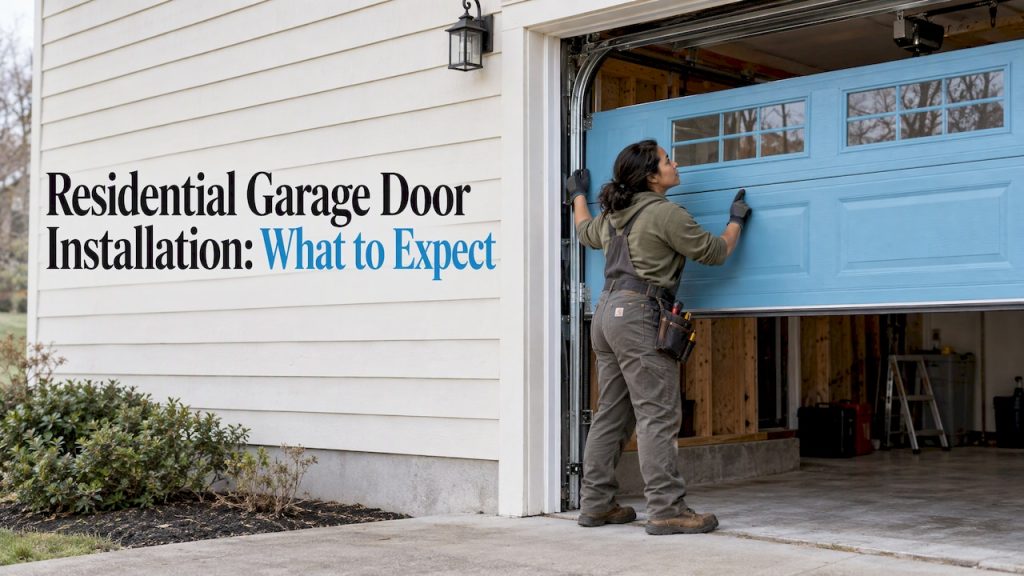
A residential garage door installation is a one-day job in most homes, and it goes well when four things are settled before the crew arrives: the opening is measured correctly, the door type fits your climate and budget, the springs and opener are matched to the door’s weight, and the finished door passes a safety check. We install new garage doors for homeowners in Massachusetts and Connecticut, and our new garage door installation service covers the door, the hardware and the opener work as one job.
This guide walks through the process in order, shows what moves the price, and explains where installations go wrong so you can plan yours with confidence.
TL;DR
- Typical cost: a new garage door runs about $1,400 on average, with most homeowners paying $1,151 to $1,869 for materials and installation. Size, material and extras move that range.
- The job starts with measuring the opening, headroom and side room. Wrong measurements are the most common reason a door does not fit.
- Springs, cables, tracks and the opener are part of the installation, not add-ons. They have to be balanced to the door’s weight.
- A finished installation ends with a balance test, a safety-sensor test and a walk-through of how to operate the door.
- We offer same-day service and 24/7 emergency repairs in Massachusetts and Connecticut, so a failed door does not have to wait.
Table of Contents
- What a residential garage door installation includes
- Step 1: Measure the opening
- Step 2: Choose the door type, material and insulation
- Step 3: Match the springs and hardware to the door
- Step 4: Install the opener, sensors and controls
- Step 5: Test balance and safety before you sign off
- What residential garage door installation costs
- Replace the door or repair it?
- How to choose an installer
- Our perspective
- Book your installation
- FAQ
- Sources
What a residential garage door installation includes
A garage door is the largest moving part of your house. It is a set of panels hinged together, riding in steel tracks, lifted by torsion or extension springs, and usually driven by a motorized opener. A proper installation covers all of those pieces, not just the panels you see from the street.
In practice a full installation includes:
- Removal of the old door. The old panels, tracks and springs come out. Springs hold stored energy, which is why this is work for trained technicians and not a weekend project.
- Framing check. The jambs (the vertical boards at each side of the opening) and the header above must be solid, plumb and level. Rot or damage here is fixed before the new door goes in.
- Track and panel assembly. Panels are stacked and hinged, rollers are set, and the tracks are aligned and braced to the wall.
- Spring and cable setup. The springs are wound to match the door’s weight so it lifts smoothly and stays where you leave it.
- Opener installation or reconnection. The opener, rail, wall control, remotes and safety sensors are mounted and programmed.
- Testing and handover. Balance, travel limits, auto-reverse and sensors are tested, and you are shown how the door works.
If you are replacing only one damaged panel, a section or panel replacement can be the smarter move than a whole new door. Our garage door services page lists the repair options, and our team can tell you on site which route makes sense.
Step 1: Measure the opening
Every installation starts with three measurements, and each one can sink the job if it is off.
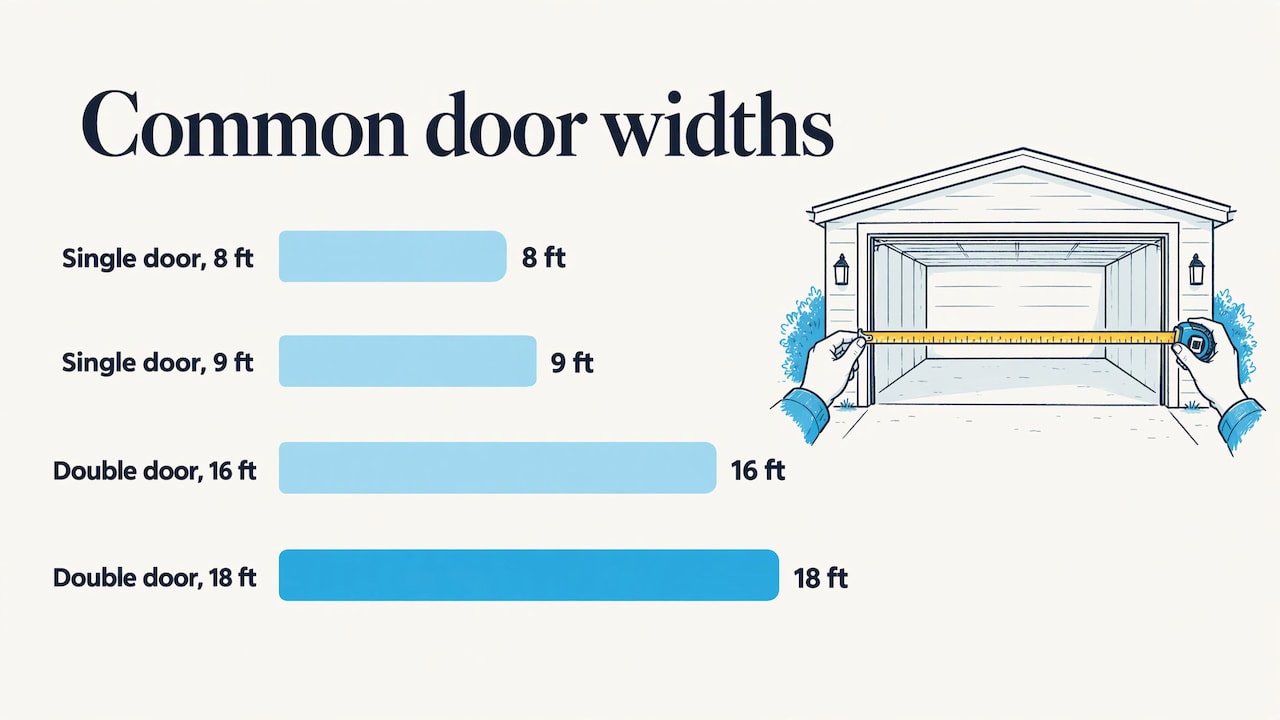
- Width and height of the opening. Measure the finished opening between the jambs and from floor to header. Standard residential doors come in common sizes, such as 8, 9, 16 and 18 feet wide for single and double doors, but older homes often have openings that are not square.
- Headroom. This is the space between the top of the opening and the ceiling or the lowest obstruction, such as a beam or pipe. It decides what track layout the door can use.
- Side room and backroom. You need clearance at each side for the track brackets, and enough depth in the garage for the door to travel back along the ceiling.
Where it goes wrong: homeowners order a door online from a nominal size, then discover the opening is half an inch narrower on one side, or that a ceiling-mounted storage rack blocks the track path. An on-site measurement by the installer catches both before anything is ordered.
We measure at the property and confirm the layout with you before the door is installed, so the door that arrives is one that fits your opening.
Step 2: Choose the door type, material and insulation
This is where most of the price and most of the long-term satisfaction is decided. The main choices are:
| Choice | What it means for you |
|---|---|
| Steel | A common, durable choice that handles New England weather well and comes in many styles. |
| Insulated steel | Steel panels with an insulation layer, useful when the garage is attached to living space or you use it as a workshop. |
| Wood or wood composite | A traditional look, often chosen for carriage-house styles. Needs more upkeep than steel. |
| Aluminum and glass | A modern look with natural light. Usually a style choice more than a budget choice. |
Two more decisions are worth making deliberately:
- Insulation. If your garage shares a wall or ceiling with a bedroom or a living area, an insulated door helps keep the temperature steadier through Massachusetts and Connecticut winters.
- Windows and style. Panel pattern, color and window inserts change how the door looks from the street. Neighborhood or historic-district rules in some towns restrict styles, so check with your town or homeowners association before ordering.
Our residential page shows the range of home projects we handle, and for a one-of-a-kind look, our guide to custom garage door installation, cost, process and code checks goes deeper on design and compliance.
Step 3: Match the springs and hardware to the door
The springs do the lifting. A typical garage door weighs far more than a person could lift comfortably, and the springs carry nearly all of that weight so the opener only has to guide the door along its path.
There are two spring systems:
- Torsion springs mount on a bar above the door. They are the more common choice on modern installations and lift the door smoothly.
- Extension springs run along the sides of the horizontal tracks. They are found on many older doors.
Where it goes wrong: springs are sized by the weight of the door. If you upgrade to a heavier insulated door and keep the old springs, the door will feel heavy, strain the opener and may not stay open. A new door and its springs are specified together. If your home has an older extension spring setup, a system conversion to torsion springs can be done as part of the work, and our broken spring repair page explains spring adjustment and conversion.
Cables, rollers, hinges and tracks are the other wear parts. Installing them new with the door means the whole system starts at the same age, instead of a new door riding on worn tracks.
Step 4: Install the opener, sensors and controls
Most homeowners replace or add an opener when they install a new door. A newly installed door, balanced properly, is easier on the motor, which helps the opener last.
A complete opener installation has several parts:
- the motor unit and rail or drive mounted to the ceiling structure,
- the wall control and any keypad outside,
- remotes and a receiver, programmed to your household,
- safety sensors (the “photo eyes”) mounted near the floor on both sides of the door.
Those sensors are not optional. If something crosses the beam while the door is closing, the door reverses. They must be aligned correctly or the door will refuse to close, which is one of the most common calls we hear about after a do-it-yourself job.
We repair and install openers, keypads, remotes, sensors, receivers and gears, all described on our opener repair and installation page. If you already have an opener that works, we can reconnect it to the new door and test it, and if it is time to replace it, we can do that in the same visit.
Step 5: Test balance and safety before you sign off
An installation is finished when the door is tested, not when the last bolt is tightened. Before the crew leaves, these checks should be done with you watching:
- Balance test. With the opener disconnected, the door should stay roughly in place when lifted halfway. If it drops or shoots up, the spring tension is off.
- Travel limits. The door should open fully and close firmly against the floor without straining.
- Auto-reverse. The door should reverse when it meets an obstruction while closing.
- Sensor test. Break the beam while the door is closing. It should stop and reverse.
- Remote and keypad test. Every remote and the keypad should work from the driveway.
- Weather seal. The bottom seal should sit flat on the floor with no daylight at the edges.
Ask the technician to show you how to disconnect the opener for manual use during a power outage, and how to spot early signs of wear. Never try to adjust springs or cables yourself: they are under high tension and can cause serious injury. Call a trained technician for any spring or cable work.
What residential garage door installation costs
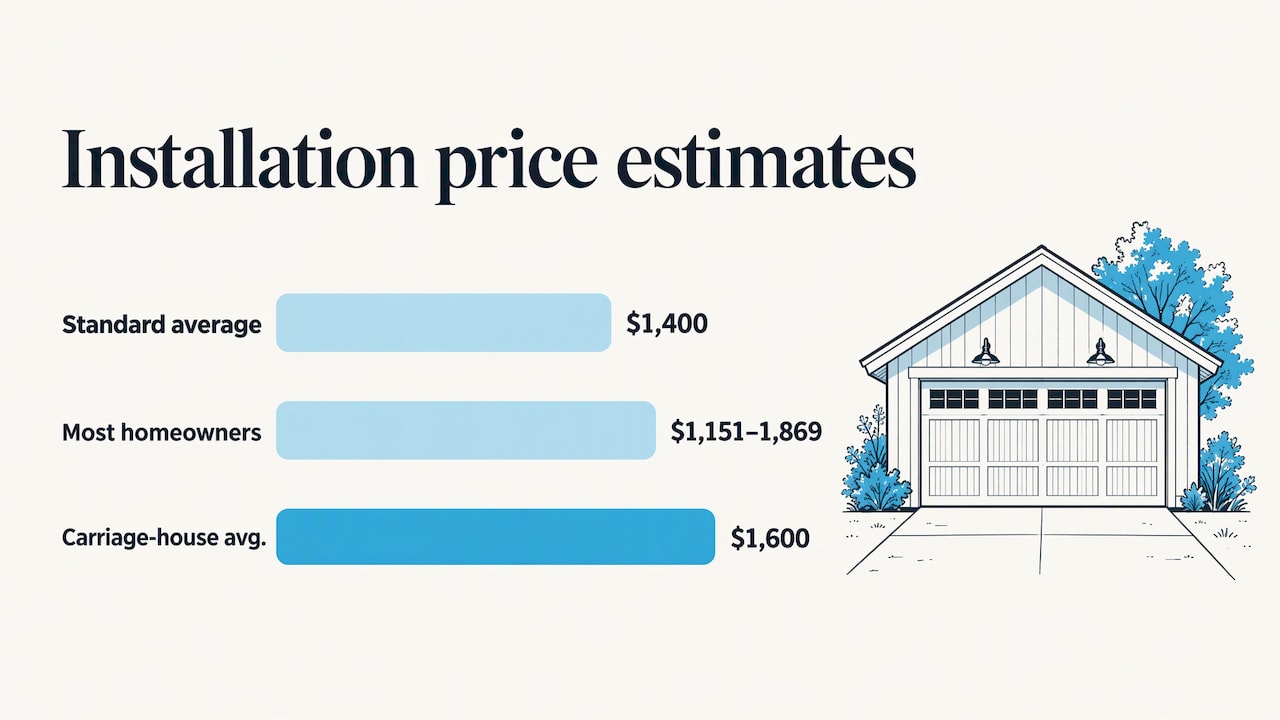
Price depends on the job, so every project is quoted after the opening is measured and your choices are known. Published national figures give you a frame for your budget. According to This Old House’s 2026 cost guide, a new garage door averages about $1,400 for a standard installation, with most homeowners paying between $1,151 and $1,869. That range covers materials and installation, and the same guide places standard panel doors near the lower end and carriage-house styles higher, around $1,600 on average.
What moves your own number:
| Factor | Effect on the total |
|---|---|
| Single vs. double width | A double door uses more material and heavier springs. |
| Material | Insulated steel, wood and glass cost more than basic steel. |
| Insulation level | Thicker insulation adds to the door price. |
| Windows and custom styling | Decorative options raise the price. |
| Opener | A new opener adds to the project, especially with smart features. |
| Condition of the opening | Rotted jambs or a damaged header add framing work. |
| Removal of the old door | Included in most installations, but confirm it in the quote. |
We do not publish fixed prices for installation, because the right quote depends on your opening and the door you choose. You get the figure after we see the job, and the quote should name the door model, the springs, the opener if any, the labor and the removal of the old door, so you can compare it line by line.
Replace the door or repair it?
Not every problem needs a new door. A broken spring, a snapped cable, a bent track or a worn roller can usually be repaired the same day. A single dented panel can often be replaced alone, if the model is still available.
A full replacement tends to make sense when:
- several panels are damaged or the door is sagging and delaminating,
- the door is old enough that parts are hard to find,
- you want better insulation, a quieter door or a different look,
- repairs are arriving every year, and the total is climbing toward the cost of a new door.
If you are unsure, a technician can look at the door and tell you which path is more sensible. Regular tune-ups also extend a door’s life: lubrication, hardware tightening and balance checks catch small problems early. Our door maintenance page explains what a tune-up covers.
How to choose an installer
A garage door installation is only as good as the person doing it. When you compare quotes, look for these points:
- A technician who measures on site. A quote by phone for a door you have not shown anyone is a guess.
- A written quote with specifics. Door model, material, insulation, springs, opener, labor, removal and disposal, all listed.
- Springs matched to the door. The installer should explain what springs your door gets and why.
- Safety testing at handover. Balance, auto-reverse and sensors, shown to you.
- Local availability after the install. Garage doors fail at inconvenient times. An installer who also handles repairs and emergencies is a safer partner than one who only sells doors.
- Clear communication. You should know when the crew is arriving, how long the work takes and what happens if the technician finds a problem.
A national retailer or a general handyman can sell or hang a door, but a garage door is a specialized system of springs, cables, tracks and electronics. A dedicated garage door company handles all of it and stays available for the repairs that come later.
Our perspective
We are a family-owned garage door company, and the installations we are proudest of are the ones the homeowner never has to think about again.
Our view is simple: a new door is a system, not a product. The panels, springs, cables, tracks, opener and sensors have to work together, and when one is chosen without the others in mind, the homeowner ends up calling for repairs within a year. That is why we treat installation, repair and maintenance as one relationship with one local company.
We focus on safety and durability because a garage door is heavy, moves daily and sits above your car and your family. We communicate clearly about what the job involves, we handle residential and commercial properties across Massachusetts and Connecticut, and we offer same-day service and 24/7 emergency repairs, so you are not stranded if something fails.
If you are planning a new door, the best thing you can do is have a technician look at the opening, talk through your options, and give you a written plan. That conversation costs you nothing to begin, and it prevents most of the mistakes that make installations go wrong.
the author
Book your installation
If you are planning a new door in Massachusetts or Connecticut, our technicians can measure your opening, walk you through door types and springs, and install the whole system. See our garage door installation in Massachusetts page for the details, or read about local service in Chicopee, Agawam, Longmeadow and Amherst.
To start, visit Speedy Garage Door Services and request a visit. If your current door has failed and cannot wait, our 24/7 garage door repair is there for emergencies.
FAQ
How long does a residential garage door installation take?
Most residential installations are completed in a single visit. A straightforward replacement of one door with matching hardware is a matter of hours, while jobs that add framing repairs, a new opener or a custom door can take longer. Your technician can give you a realistic window after measuring the opening.
How much does it cost to install a garage door?
National figures put the average at about $1,400 for a standard installation, with most homeowners paying $1,151 to $1,869. Your price depends on the size, material, insulation, opener and the condition of the opening, so a written quote after an on-site measurement is the reliable number.
Can I keep my existing opener when I get a new door?
Often yes, if the opener is in good working order and the new door is balanced properly. It is worth having a technician test it, because an older opener may lack current safety features or struggle with a heavier insulated door. We can reconnect, repair or replace the opener as part of the same job.
Do I need new springs with a new door?
Springs are sized to the weight of the door, so a new door should have springs matched to it. Reusing old springs on a different door is a common cause of doors that feel heavy or drift open. Spring work is best left to a trained technician because the springs are under high tension.
What should I do when my garage door breaks and I cannot wait?
Stop using the door, keep people and vehicles clear of it, and do not try to lift, force or adjust it. Call us any time: we offer 24/7 emergency service in Massachusetts and Connecticut, and the technician can tell you whether the door can be repaired or replaced.