

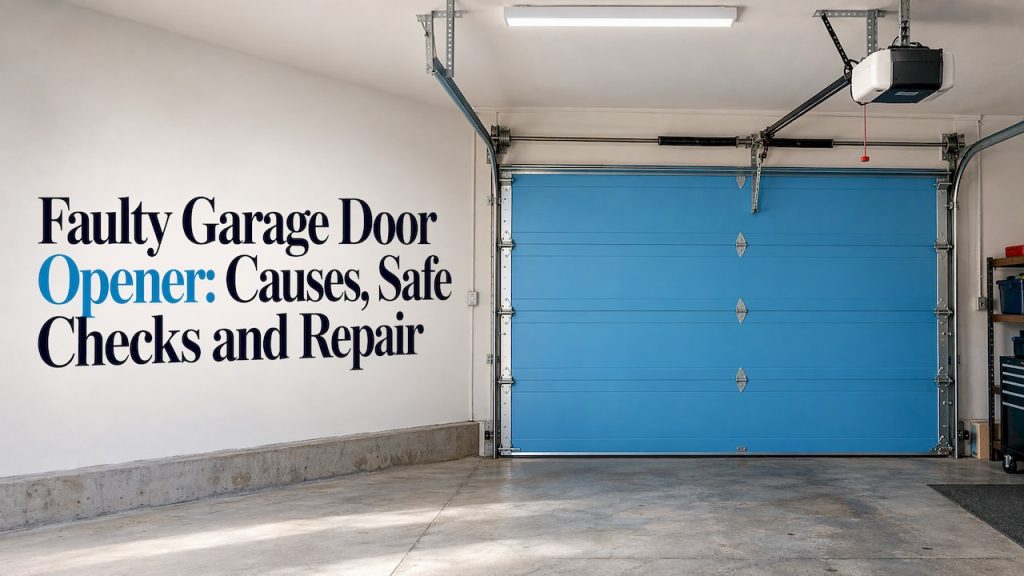
A faulty garage door opener is usually one of three things: no power reaching the unit, a signal problem between the remote or wall control and the motor, or a door that has become too heavy or stiff for the opener to lift. The first two you can check in ten minutes with no tools. The third, and anything involving springs, cables or internal gears, belongs with a trained technician. If you are in Massachusetts or Connecticut and the door is stuck shut, we handle opener repair and installation with same-day service and 24/7 emergency calls.
TL;DR
- Start with power: plug a lamp into the opener’s outlet, check the breaker, and make sure the wall control’s lock or vacation mode is off.
- Replace the remote battery and reprogram the remote before assuming the motor has failed.
- Photo-eye sensors that are dirty, bumped or misaligned are a common reason a door will not close, and the opener’s lights often blink when this happens.
- Disconnect the door from the opener and lift it by hand: if it is heavy or drops, the problem is the door’s springs or hardware, not the opener.
- Never touch springs, cables or brackets yourself. Those parts are under extreme tension and need a trained technician.
Table of Contents
- Start by sorting the symptom
- Check 1: Power, the outlet and the breaker
- Check 2: The lock or vacation setting
- Check 3: Remote battery and programming
- Check 4: Safety sensors, the most common reason a door will not close
- Check 5: What the clicking and blinking lights mean
- Check 6: Is it the opener or the door?
- Where to stop
- What a technician does that a quick check cannot
- Repair or replace?
- Keep it from failing again
- Our view on opener failures
- When the door will not open and you need it fixed
- FAQ
- Sources
Start by sorting the symptom
Before you touch anything, decide what the opener is actually doing. The symptom points to the cause faster than any list of possible problems.
| What you see or hear | Most likely area | First thing to check |
|---|---|---|
| No lights, no sound, nothing from wall control or remotes | Power | Outlet, breaker, wiring |
| Wall button works, remote does not | Remote or receiver | Battery, programming |
| Motor hums or clicks but the door does not move | Door balance, drive parts, or internal gear | Disconnect and lift by hand |
| Door starts to close, then reverses | Safety sensors or force and travel settings | Photo eyes, alignment |
| Door travels part way and stops | Binding, balance or travel limits | Track, rollers, door weight |
| Blinking light on the opener | Diagnostic code | Model chart |
The manufacturers’ own troubleshooting pages list a similar spread. Genie’s guide names power loss, a lock mode, wiring, remote battery or programming trouble, safety beam problems, a binding or unbalanced door, incorrect travel or force settings and damaged drive parts as possible causes. Most are cheap to rule in or out. A few are not safe to touch.
Check 1: Power, the outlet and the breaker
It sounds too simple, but a dead opener is often a dead outlet. Garage outlets are commonly on a circuit shared with other things, and a tripped breaker or a tripped GFCI outlet cuts power without any sign in the garage.
- Look for any light, LED or sound on the opener when you press the wall control. If there is nothing at all, you are in a no-power situation. Chamberlain’s support page describes that exact pattern: no lights, no movement and no response from the wall control or the remotes.
- Plug a lamp into the same outlet. Genie recommends this test because it separates an outlet problem from an opener fault. If the lamp stays dark, check the fuse or circuit breaker.
- Press the reset button on any GFCI outlet in the garage and check the breaker panel for a switch sitting between on and off.
- If the lamp works but the opener is still dead, the opener’s own wiring or logic board may be the issue. Stop there. Do not open the motor housing.
To answer a common question: yes, some openers have an internal fuse or protective circuit, but it sits inside the unit. That is a technician’s job, not a homeowner’s.
Check 2: The lock or vacation setting
Many wall controls have a lock button. When it is on, the remotes are ignored but the wall button still works, which looks exactly like a remote failure. Genie lists an enabled Sure-Lock or vacation lock as one of the first things to rule out on a non-operating opener. Check your wall control for a lock indicator, switch it off and try the remote again. Someone in the household may have pressed it by accident.
Also look at the manual release. If the red emergency cord was pulled, the door is disconnected from the opener and the motor can run without moving anything.
Check 3: Remote battery and programming
If the wall button opens the door but the remote does not, the problem is almost never the motor.
- Replace the battery in the remote, even if it seems fine.
- Stand close to the opener and try again, then move away to see where it fails.
- Reprogram the remote to the opener. Genie notes that battery or programming trouble can stop a remote, and reprogramming is the fix when a new battery does not help.
- Try a second remote or the keypad. If only one remote fails, that remote is the culprit. If all of them fail, the receiver in the opener may be the weak link.
We repair and install remotes, keypads and receivers. If you would rather not work through programming steps for your model, see our guides on choosing, programming and fixing a garage remote or our remote repair service.
Check 4: Safety sensors, the most common reason a door will not close
Every modern opener has a pair of photo eyes, one on each side of the door, about a hand’s width above the floor. They send an invisible beam across the opening. If something breaks the beam, or the eyes drift out of line, the opener refuses to close the door or reverses it.
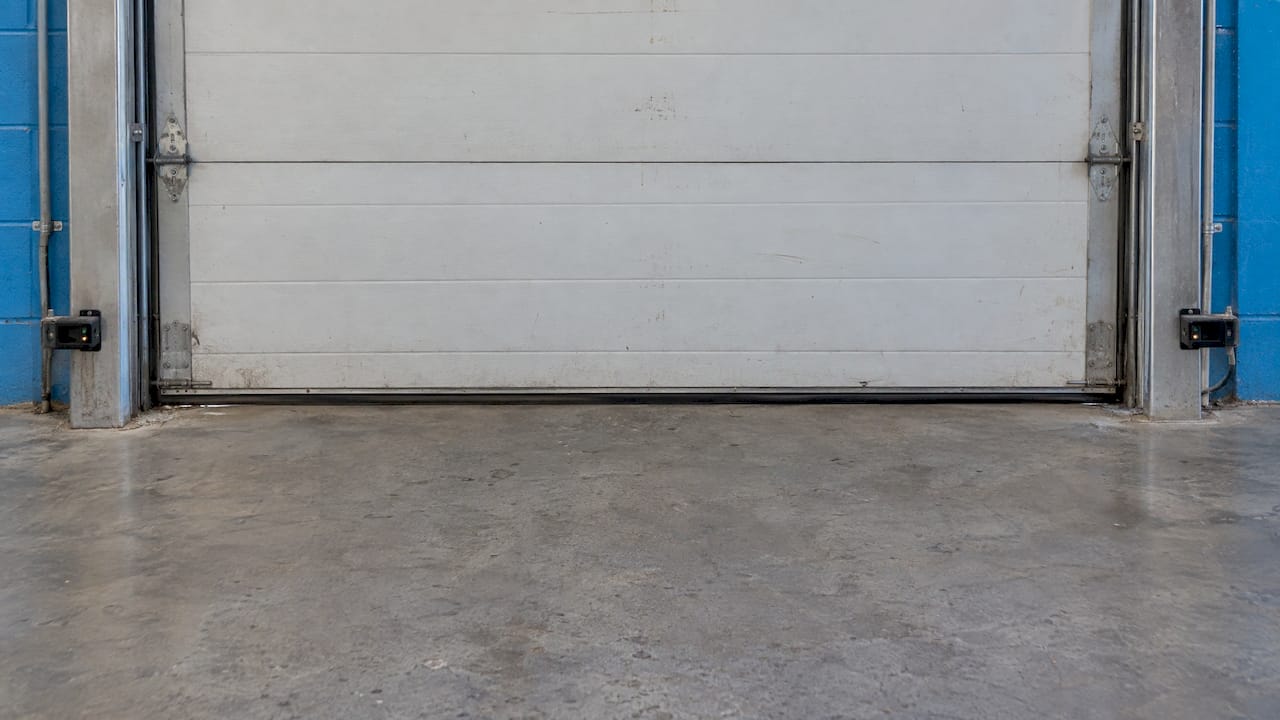
Symptoms: the door goes down a few inches and returns up, the opener lights flash, or the door will not close at all from the remote but closes if you hold the wall button down.
What to do:
- Wipe both lenses with a soft dry cloth. Dust, cobwebs and sun glare cause false readings.
- Make sure nothing is stored in the beam’s path.
- Check that both eyes point straight at each other and that the brackets are tight. A bumped bracket from a bicycle or trash can is a classic cause.
- Look at each eye’s indicator light. A steady light usually means a clean connection. A dim or flashing light on the receiving eye points to misalignment or a wiring problem.
For the test itself, Chamberlain’s instructions put the photo eyes about 4½ inches above the floor. You can interrupt the beam with an object and check that the receiver LED turns off, then realign the sensor if needed. The same page warns that failing to test or adjust the safety-reversing sensors can result in severe injury or death. If the LED never turns off during the test, or the door closes while the beam is blocked, stop using the door’s automatic close and have a technician look at it. Our guide to a garage door that won’t close goes through this in more detail, and we replace sensors as part of opener service.
Check 5: What the clicking and blinking lights mean
A click with no movement and a blinking light both mean the opener is telling you something. The pattern matters, and it differs by brand and model.
- A click with no movement. The relay is switching, but the motor is not turning the drive, or the door is too heavy to lift. Go to the disconnect test below.
- A blinking status light. On Genie Excelerator openers, a blinking light can indicate a safety beam malfunction, incorrect force settings, overheating or over-cycling, or a board interruption. The same guide says a single blink can relate to an improperly balanced door, a worn counterbalance spring or binding door hardware.
- Repeating flash patterns on other brands. Chamberlain explains that its diagnostic LED uses repeating patterns to show what the opener detects, and the meaning should be read from the chart for your exact model.
Find the model number on the motor housing, then match the pattern to the manual’s chart. Chamberlain’s chart for some older models, for example, ties a door that will not close and flashing lights to sensor wiring or alignment faults, including a short, reversed wiring or a broken wire. The same chart assigns some no-movement symptoms to internal problems such as motor gears, and one code to a logic-board error. Those are repairs for a technician, not a homeowner.
Check 6: Is it the opener or the door?
This is the check that saves the most money and the most danger. A lot of “faulty opener” calls are actually door problems. The opener is built to move a door that is already balanced and easy to lift. Chamberlain’s guidance says that when the door resists, the opener may stop or reverse to prevent damage or injury. A door that is out of balance, hitting resistance, or running with wrong force or travel settings will not travel fully.
Here is the safe way to tell the difference:
- Close the door fully if you can. Never do this test with the door open, because a broken spring could let it fall.
- Pull the red emergency release cord so the door is disconnected from the opener.
- Lift the door by hand about halfway. A balanced door feels fairly light and stays where you leave it.
- If it is heavy, sticks, or drops when you let go, the door side has a problem, usually the springs or hardware. Chamberlain says a disconnected door that moves smoothly and stays in place points to the opener, while a heavy, sticking or dropping door points to a balance problem.
- If the door moves smoothly but the opener’s trolley still stops early when run on its own, the issue sits inside the opener.
If the door is heavy or crooked, do not force it. Read our guides on the warning signs a spring is about to break and on a crooked garage door. Spring, cable and bracket work is something we do, with broken spring repair and cable repair available.
Where to stop
The checks above are the ones an owner can do from the floor. Stop and call a technician when:
- The door is heavy, sticks, drops, or hangs crooked when disconnected. A LiftMaster owner’s manual says a door that binds, sticks or is out of balance should be checked by a trained door-systems technician.
- You can see a gap in a spring, a frayed cable, or a bent track. The same manual warns that spring assemblies, cables and other door hardware are under extreme tension and that repairs must be done by a trained technician.
- The sensor LED never turns off during the beam test, or the door closes while the beam is blocked.
- The opener hums, grinds or clicks but nothing moves, which can mean worn gears or a failed board.
- The lamp test shows the outlet is fine and the opener is still dead.
Never loosen the bolts on the bracket at the bottom of the door or the winding cone on a spring. Those carry the full load of the door.
What a technician does that a quick check cannot
A professional visit is less about swapping one part and more about finding the real cause. A worn gear may be the visible failure, but a door that is slightly out of balance is what wore it out. If a technician replaces only the opener and leaves a heavy door, the new motor can fail early.
On an opener call we work through the parts we service: sensors, receiver, keypads and remotes, gears, and the opener itself, along with the door-side parts that load the motor, including springs, cables, rollers and tracks. Our page on garage door opener repair, causes, costs and next steps explains how we approach that decision.
Repair or replace?
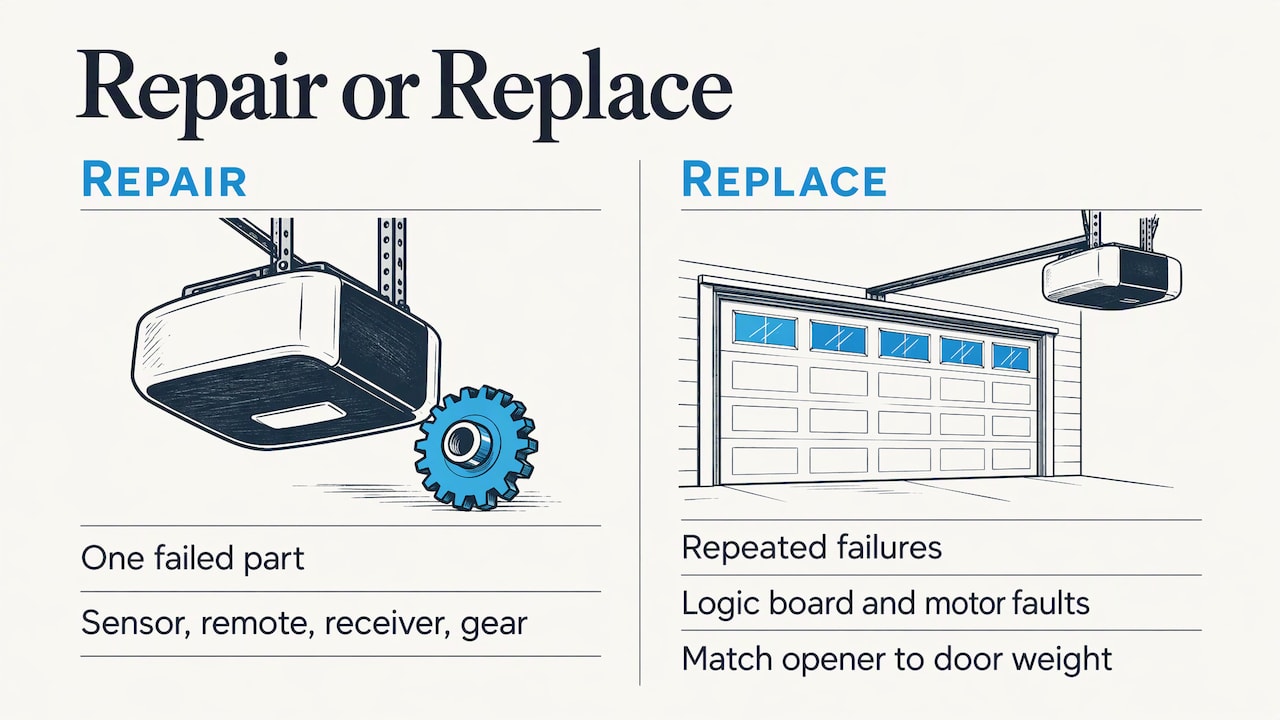
A repair makes sense when the failure is a single part: a sensor, a remote, a receiver, a gear. Replacement is worth discussing when the opener keeps failing in different ways, when a logic board and the motor both show faults, or when the door itself is being replaced and a new opener should match its weight. We install openers as well as repair them, so the decision can be made on the day instead of across two visits. We do not publish prices, because the cost depends on the model, the part and what the door needs. A technician quotes after seeing the unit.
Keep it from failing again
Most opener failures build over months. Simple monthly habits catch them early. The LiftMaster manual recommends:
- Operating the door manually once a month, and checking that it opens and closes fully.
- Repeating the safety-reverse test monthly.
- Oiling door rollers, bearings and hinges once a year, not greasing the tracks, and leaving the opener itself alone, since it does not need additional lubrication.
That guidance comes from the LiftMaster owner’s manual. Beyond that, an annual inspection of springs, cables and rollers catches wear before it reaches the motor. Our door maintenance service covers that for homes, and scheduled maintenance for commercial doors.
Our view on opener failures
Most of the opener calls we get start with someone saying the motor died. Often the motor is fine. The opener is built to move a door that is balanced and moving freely, so when springs weaken or rollers bind, the opener is the first part to show it.
That is why we look at the whole system. We are a family-owned company serving Massachusetts and Connecticut, and we want a repair to last, with clear communication about what failed and why. Safety comes first: sensors, springs and cables are checked as part of the job, not as an afterthought.
When a door will not open at night or before work, speed matters. That is why we offer same-day service and 24/7 emergency repairs.
the author
When the door will not open and you need it fixed
If you have run the checks and the door is still stuck, or you have found a door-side problem you should not touch, we can help. We repair and install openers, remotes, keypads, sensors, receivers and gears, and we handle springs, cables, rollers and tracks. Homeowners and businesses across Massachusetts and Connecticut can reach us for same-day visits and 24/7 emergency service.
See our opener repair and installation page, our 24/7 garage door repair service, or our Chicopee, MA location if you are in the Pioneer Valley.
FAQ
Why did my garage door opener suddenly stop working?
Sudden failures are usually power, a lock mode, a dead remote battery, or sensors that have been knocked out of line. If the opener has no lights at all, test the outlet with a lamp and check the breaker. If the opener hums but the door does not move, a broken spring or a worn gear is more likely.
What does it mean when my garage door opener just clicks?
A click usually means the opener is trying to run but cannot move the door, or that something internal is not engaging. Disconnect the door with the red cord and lift it by hand. A heavy or sticking door points to the springs or hardware. A smooth door points to the opener’s gears or logic board, which a technician should handle.
What does a blinking light on my opener mean?
It is a diagnostic signal, and the pattern depends on the brand and model. On some Genie models, a blinking light can indicate a safety beam problem, incorrect force settings, overheating, or a board interruption. Find the model number on the motor housing and compare the pattern with the chart in your manual.
Do garage door openers have fuses?
Some have internal protection, but it is inside the motor housing and not meant for owners to service. The practical check is outside the unit: test the outlet with a lamp and check the fuse or circuit breaker that feeds it. If the outlet has power and the opener is still dead, call a technician.
Can I fix a garage door opener myself?
You can safely handle the outlet, lock mode, remote battery, reprogramming and sensor cleaning. Anything involving springs, cables, brackets or the inside of the motor should be left to a trained technician, because those parts carry the weight of the door.
Sources
- Genie Garage Door Opener Troubleshooting
- Genie Excelerator Series self-diagnostic troubleshooting
- Chamberlain: Garage door won’t fully open or close
- Chamberlain: How to test the Protector System
- Chamberlain: There is no power to the garage door opener
- Chamberlain diagnostic code chart for older models
- LiftMaster 2110, 2220 owner’s manual