

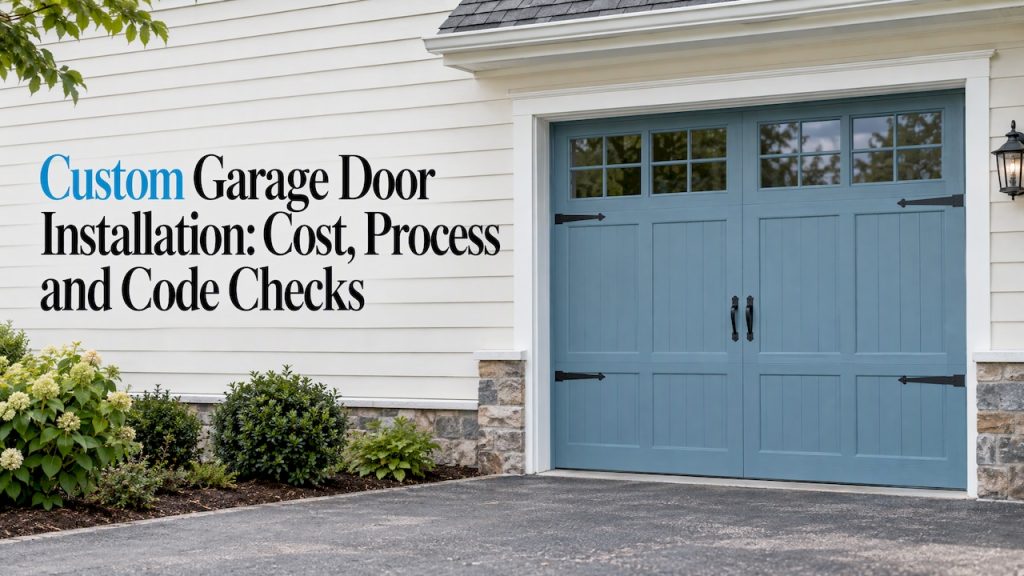
A custom garage door is built or specified to your opening, your home’s style and your performance needs, then fitted by trained installers. One 2026 price guide puts most fully custom doors at $3,000 to $8,000 installed, with premium projects going past $9,000. Installation itself usually takes half a day to two days. The ordering, measuring and approvals before that day are what take the time. Below you will find the choices that move the price, the steps from site visit to final test, the safety and code points to check in Massachusetts and Connecticut, and how to read a quote.
TL;DR
- Custom means a non-stock size, material, design, glass, finish or insulation level, and it is ordered to your opening rather than pulled from a shelf.
- Typical national range: $3,000 to $8,000 installed for a fully custom door. Material, size, windows, hardware and insulation drive the number.
- Installation takes half a day to two days, but ordering a custom door adds lead time before the crew arrives.
- Check local building requirements, wind rating, header framing and the opener’s reversing feature before you sign.
- We install new doors across Massachusetts and Connecticut. Ask us about a new door installation and we will walk the opening with you.
Table of Contents
- What makes a garage door “custom”
- What a custom garage door costs
- What installation involves, step by step
- Safety, code and wind-load checks before you order
- Should you install a custom door yourself?
- Reading a custom door quote
- Perspective
- Installation with Speedy Garage Door Services
- Keeping a custom door in good shape
- FAQ
- Sources
What makes a garage door “custom”
There is no legal definition. In practice, a door is custom when something about it is not a stock catalog item: an unusual opening width or height, a specific wood species, a color match, a window layout, a particular style, or an insulation and wind specification your house needs.
Style is the part most homeowners start with. Designs range from traditional raised-panel to carriage-house, Shaker and smooth midcentury looks, and aluminum-and-glass doors can be clear, opaque or tinted, while wood doors may carry windows along the top. Matching the door to the architecture of the house matters more than any single feature, because the garage door is often the largest single element on the front of the home.
Material choices
Material sets both the look and most of the budget.
| Material | Look and feel | Relative cost |
|---|---|---|
| Steel | Widest range of colors, panel designs and faux-wood finishes | Lowest unit cost |
| Composite | Wood appearance with less upkeep | Between steel and wood |
| Aluminum with glass | Modern, full-view or frosted panels | Between steel and wood |
| Wood | Natural grain, fully tailored designs and stains | Highest of the group |
The International Door Association’s executive director, Mike Fisher, has said that steel spans the widest range of design, color and price, which is why it remains the dominant practical material. If you want the custom look without the top-tier price, a well-specified steel door is usually where we start the conversation.
Windows, insulation and hardware
Windows let in light but add cost and, depending on the glazing, affect insulation. Insulated sections matter if the garage is attached to living space, a workshop or a room above. Hardware, such as decorative handles, hinges and straps on carriage-style doors, changes the look noticeably and is often where a custom door earns its character.
What a custom garage door costs
The national figure to keep in mind is $3,000 to $8,000 installed for a fully custom door, according to one 2026 price guide. That guide lists materials, size, panel complexity, windows, hardware, insulation and labor as the factors that move the price. Treat it as a ballpark, not a quote. Prices in New England depend on the door, the opening and the site, and we do not publish fixed prices because no two openings are the same.
Here is how each factor tends to play out:
- Size. A double-wide door uses more material, heavier springs and more labor than a single.
- Panel design. Flat panels cost less than deep carriage-house or custom-milled designs.
- Glass. Full-view aluminum doors cost more than a row of windows in a steel door.
- Insulation. Thicker insulated sections cost more up front and make a difference in a garage that shares walls with the house.
- Hardware and opener. Heavier doors need appropriately rated springs and an opener that can handle them.
- Labor and removal. Taking out the old door, adjusting the framing or adding trim all add time.
If a number sounds far below the range with no explanation, ask what is excluded. Removal of the old door, new springs, trim and opener work are common line items to find out about early.
What installation involves, step by step
Custom installation follows a sequence. The details vary by door, but the order rarely does.
- Site visit and measuring. A technician measures the opening width and height, headroom above the door, side room for the tracks and the depth of the garage. They also look at the header and jambs, the floor slope and any obstacles such as pipes or ceiling lights.
- Specification and quote. You choose material, design, glass, color, insulation and hardware. The quote should name each of them.
- Ordering. A custom door is built to order, so there is a wait. Lead time depends on the manufacturer and the options you choose. Custom colors, specialty glass and carriage-house designs generally take longer than standard configurations, and we will tell you what to expect when you order.
- Preparation. For heavier custom doors, the opening may need reinforced framing. Garage door framing must support the door’s weight, the track and spring assemblies, counterbalance torque, wind-load forces and operating vibration.
- Removal of the old door. The old door and springs come out. The springs hold a lot of stored energy, which is one reason this step belongs to trained technicians.
- Installation. Sections, tracks, springs, cables, rollers and the opener are fitted and aligned.
- Balance and safety testing. The door should be balanced so it stays put at mid-height. The opener’s reverse function is tested, and photo-eye sensors are checked.
- Walkthrough. You get operating instructions, maintenance advice and a chance to ask anything you need.
The actual install window is short. The same price guide estimates half a day to two days depending on site access and door size, and notes that busy markets can see scheduling delays of a few weeks.
Safety, code and wind-load checks before you order
This is the part that gets skipped most often, and it is where a good installer earns the fee.
Local requirements come first
Structural and safety requirements are set locally. DASMA’s guidance says local authorities determine them and points to ANSI/DASMA 108 as a test procedure manufacturers may use to determine a door’s wind-load performance. DASMA also advises that specific requirements and administrative details come from the building department or the authority responsible for the decision.
In practice, call your town’s building department before you order. Ask whether a permit is needed for your door, whether wind-load ratings apply to your address and whether any historic-district or homeowners association rules cover door style. Those answers can change which door you can order.
Wind and the building envelope
In hurricane-prone areas, a failing garage door can pressurize a house and contribute to structural damage. That guide advises checking local requirements and choosing a door labeled for the required wind rating, since impact protection may also be required. The International Door Association’s wind-resilience view is that a garage door should be evaluated as part of the building envelope: larger openings see more wind pressure, so verified performance and installation quality both count.
One warning for owners of existing doors: do not add reinforcement yourself before a storm. DASMA’s guidance notes that homemade reinforcement can add weight and cause tracks or other components to fail or collapse.
Opener entrapment protection
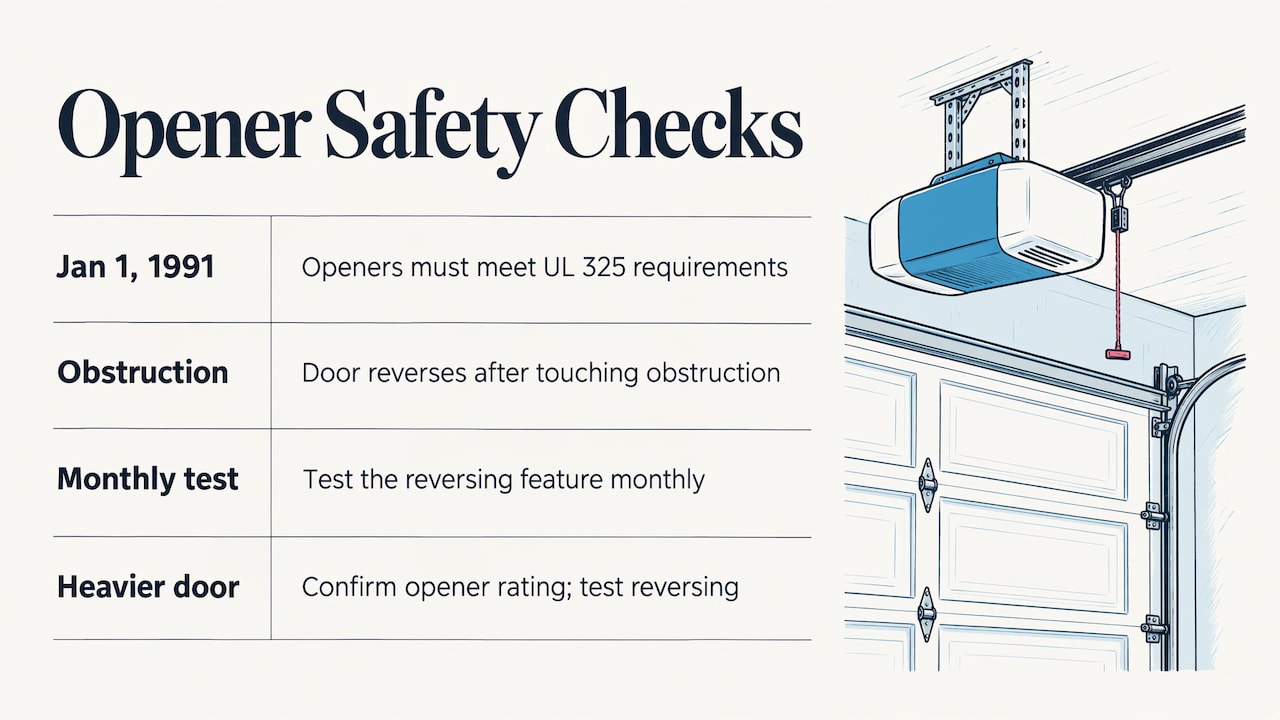
U.S. rules require that residential openers made on or after January 1, 1991 meet the entrapment protection requirements of UL 325. Those openers must also reverse a downward-moving door after it touches an obstruction. The same agency advises homeowners to test the reversing feature monthly. If you want to see how installers document compliance for powered equipment, this UL 325 compliance checklist shows the kind of items that get verified.
If your new custom door is heavier than the old one, ask your installer to confirm the opener is rated for it, and to test reversing before they leave. Our opener repair and installation team handles opener replacement, sensors, keypads and remotes in the same visit.
Should you install a custom door yourself?
Some guides call garage door installation a manageable DIY project, yet they also advise caution with high-tension springs and suggest seeking professional help when difficulties come up. The same guide stresses that installation involves heavy materials, that the door must be balanced and aligned, and that an electric opener’s automatic reverse should be tested.
A custom door adds three complications to that picture. The sections are often heavier than stock ones. Glass and wood panels are expensive to damage. And the door has to be right for the opening the first time, because it was built to order. The International Door Association calls the garage door the largest moving appliance in the home and recommends contacting a trained professional if you have concerns about springs, cables or rollers. For torsion springs in particular, we do not recommend adjusting them without training and the right winding bars.
Reading a custom door quote
Two quotes that both say “custom garage door” can describe very different jobs. Craft-door makers advise comparing wood species and grade, dimensions, operation, windows, hardware, finish, shop drawings, delivery preparation, installation responsibilities and care guidance. A custom scope can also include shop drawings, approvals and protective packing for shipment, so those items should be named, not assumed.
Use this checklist when you compare proposals:
- Door specification: material, thickness, insulation value, panel style, color and finish.
- Dimensions: exact width and height, and who measured them.
- Glass: type, tint and layout.
- Hardware: springs, rated cycle life, cables, rollers, track gauge and handles.
- Opener and accessories: model, horsepower, sensors, keypad, remotes.
- Labor and removal: is the old door hauled away, and is trim or framing work included?
- Permits and code: who pulls the permit if one is needed.
- Timeline: order lead time and installation date, in writing.
- Warranty: what is covered on the door, the hardware and the labor, and for how long.
Ask for all of it in one document. A written scope protects you and the installer.
Perspective
Most of the trouble we see after a new door goes in comes from the parts nobody discussed at the quote stage: springs sized for the wrong weight, an opener that was never replaced, or a header that was not checked. A custom door is only as good as the opening, the hardware and the setup behind it.
We are a family-owned company, and that shapes how we work. We would rather spend twenty minutes at the opening explaining what your door needs than hand you a catalog number. We want you to know why a given spring is being used and what the opener is doing, and we explain it in plain words.
Our approach to a custom job is simple: measure carefully, specify every component in writing, install with the safety tests done before we leave, and be reachable if something sounds off later. Because we also do repairs, springs, cables, rollers and tune-ups, we know which parts fail first and we choose hardware with that in mind.
the author
Installation with Speedy Garage Door Services
We install new residential and commercial garage doors across Massachusetts and Connecticut, with same-day service and 24/7 emergency repairs when something breaks before your new door arrives. Our team can measure your opening, talk through styles and materials, and handle the installation along with the opener, sensors and remotes.
We do not publish fixed prices, because the right quote depends on the door and the opening. To start, request a new door installation or look at our Massachusetts installation page. Not sure whether your current door is worth saving? Our guide on whether to repair or replace walks through the decision. For businesses, we also handle commercial garage door installation.
Keeping a custom door in good shape
A custom door is an investment, and the cheapest way to protect it is regular care. The International Door Association recommends checking the door, springs, cables and rollers for wear and listening for unusual sounds. In New England, where winters are hard on metal and weatherstripping, a yearly tune-up catches problems early. Our door maintenance service covers lubrication, balance checks, hardware tightening and safety tests. When a spring does fail, broken spring repair is a job for a trained technician.
FAQ
How much does custom garage door installation cost?
Nationally, one 2026 guide reports that most fully custom doors cost $3,000 to $8,000 installed, with premium projects above $9,000. Material, size, glass, insulation and hardware decide where yours lands. For an accurate figure for your home in Massachusetts or Connecticut, we measure the opening and quote in writing.
How long does installation take?
The installation itself generally takes between half a day and two days, depending on door size and site access. The longer part is the wait for a built-to-order door, which depends on the manufacturer and your options. We confirm the expected timing when you place the order.
Do I need a permit for a new garage door?
It depends on your town and on what is changing. Structural and safety requirements are set by local authorities, so call your building department before ordering, particularly if the opening, header or wind rating will change. Your installer should be able to tell you what usually applies in your area.
Is steel or wood better for a custom garage door?
Steel offers the widest range of designs and colors and has the lowest unit cost. Wood offers a natural, fully tailored look at a higher price and with more upkeep. If you want a wood look with less maintenance, composite and faux-wood steel finishes are worth a look.
Can I install a custom garage door myself?
We advise against it. Heavy sections, high-tension springs and a door built to order for your opening leave little room for error. Trained installers can balance the door and test the opener’s reverse function before they leave.
Sources
- All About Garage Doors, Fine Homebuilding
- Custom Garage Door Prices: Cost and Price Ranges
- DASMA TDS 155x, wind-load guidance
- DASMA TDS 156, wood header and jamb details
- DASMA TDS 152, garage doors and high wind events
- DASMA, Explaining Codes and Wind Loads
- Residential Garage Door Buyer’s Guide, Richards-Wilcox
- International Door Association, consumer awareness
- CPSC, final rules for automatic garage door openers
- CPSC, garage door safety standard
- This Old House, installing a new garage door
- Craft Doors USA, custom garage door cost