

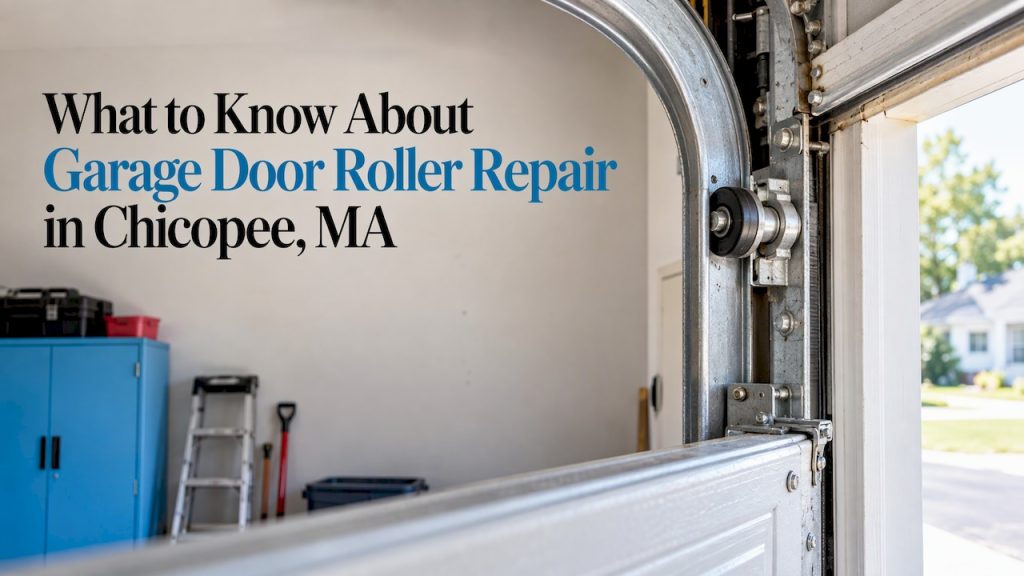
If your garage door shakes, grinds or jumps in its track, worn rollers are one of the most common causes, and a trained technician can usually replace them in a single visit. Rollers sit right beside the springs and cables, so a roller problem is never worth fixing with a wrench and guesswork. This guide explains the warning signs, what causes rollers to fail, what replacement typically costs, and what to expect when you book roller repair in Chicopee.
TL;DR
- Grinding, rattling, a jerky ride or a door that comes off its track are the classic signs that rollers need attention.
- Rollers wear from daily cycles, dirt, missing lubrication and misaligned tracks. Rollers are small parts, but the door’s whole weight rides on them.
- National cost guides put roller replacement at roughly $150 to $250 for parts and labor, with the roller material and door size moving the number.
- You can look and listen yourself, but removing or adjusting door parts is a job for a trained technician because the springs are under extreme tension.
- We offer garage door roller repair in Chicopee and the surrounding Massachusetts towns, with same-day service and 24/7 emergency calls.
Table of Contents
- What garage door rollers do
- Signs your garage door rollers need repair
- What causes rollers to wear out, break or slip off the track
- Can you keep using a door with a damaged roller?
- What you can check yourself, and what to leave alone
- How a technician inspects and replaces rollers
- Choosing roller types: steel, nylon and ball bearings
- How much does garage door roller repair cost?
- What to look for when booking roller service in Chicopee
- Routine care that keeps rollers running longer
- When roller trouble points to something bigger
- Book garage door roller repair in Chicopee
- FAQ
- Sources
What garage door rollers do
Every sectional garage door has a row of small wheels, the rollers, mounted in the hinges along both edges of the door. They run inside the vertical and curved horizontal tracks. When the opener or the springs lift the door, the rollers guide it up and over your head, then back down again.
A typical door has ten or more rollers, and each one carries part of the door’s weight on every trip. Because the door cycles at least twice a day in most households (out in the morning, back in the evening, plus every trip in between), rollers log more miles than almost any other part of the system. Winters in the Pioneer Valley add temperature swings, road salt carried in on tires and moisture, all of which are tough on moving parts.
Rollers come in a few common types. Basic steel rollers are cheap and loud. Nylon rollers are quieter, and rollers with sealed ball bearings tend to run smoothest. We cover how to think about the choice further down.
Signs your garage door rollers need repair
Rollers rarely fail without warning. They tell you first, usually through sound and movement. Watch for these:
- Grinding, rattling or squealing. A worn bearing or a roller with a flat spot makes noise as it rolls through the track. The sound usually gets worse over weeks.
- A jerky or shaky ride. If the door shudders or hesitates as it travels, one or more rollers may be seized, cracked or loose.
- A door that looks crooked. If one side seems to travel higher or lower than the other, a roller may have popped out of the track or a stem may be bent.
- Visible damage. Chipped nylon, a wobbling wheel, a missing bearing or a stem that is bent in its hinge are all clear problems.
- A slow or straining opener. When rollers bind, the opener works harder. Many people blame the opener first and replace it when the real culprit is the hardware it is lifting.
- Dust or metal shavings below the track. Fine debris on the floor can mean metal is wearing against metal.
The industry’s own guidance backs up the habit of looking. The Door & Access Systems Manufacturers Association (DASMA) advises homeowners to watch for signs of wear or damage on hinges, rollers, springs and door panels during routine maintenance, and to contact a trained door systems technician if any damage is evident.
A quick listen test
With the door closed and the opener disconnected from your attention (stand clear of the door and never put your hands near the tracks or hinges), have someone run the door through one full cycle while you stand back and listen. A smooth, even hum is healthy. A rhythmic clack, a scrape at one specific height or a sound from one side only points you to the problem area. Write down where it happens and tell the technician. It saves diagnosis time.
What causes rollers to wear out, break or slip off the track
Rollers fail for a handful of repeatable reasons.
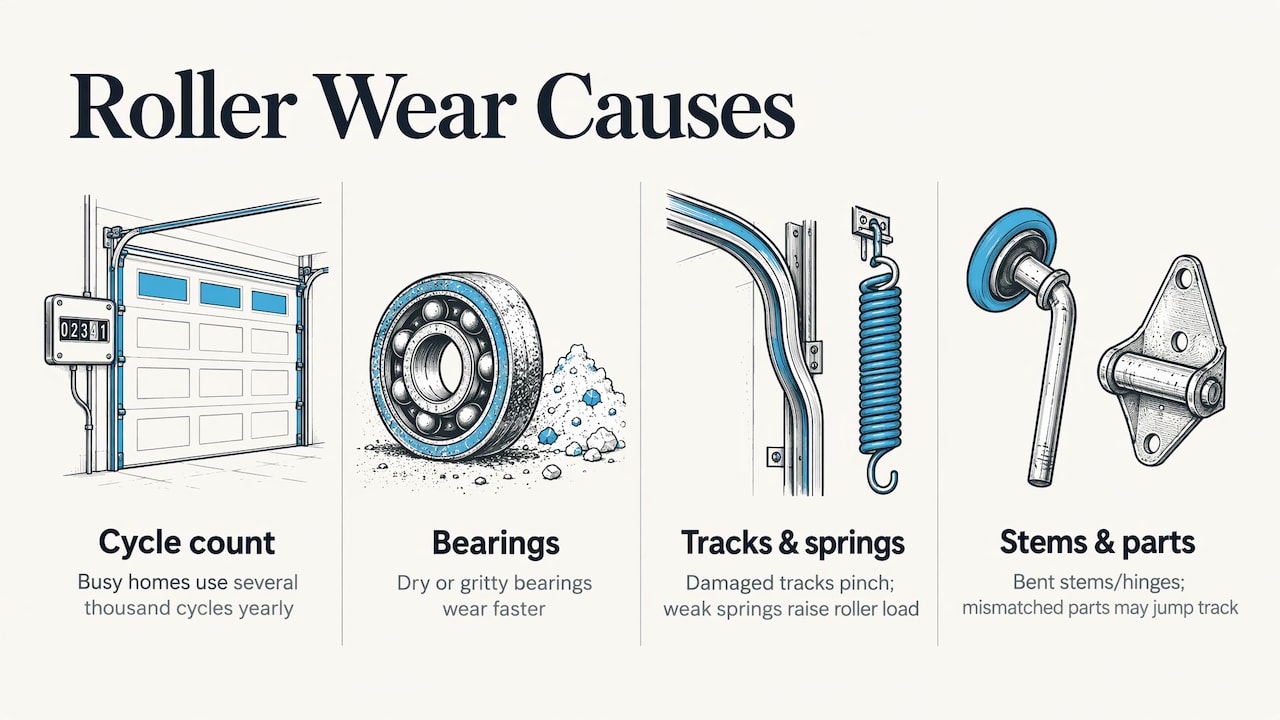
Cycle count. Every roller has a finite life. A busy household that uses the garage as the main entrance can put through several thousand cycles a year, so rollers installed with the door can reach the end of their useful life well before the rest of the door does.
Missing lubrication and dirt. Bearings that are dry or packed with grit wear faster. Road salt and winter grime make this worse in Massachusetts.
Misaligned or damaged tracks. A track that has been bumped by a car, a bike or a ladder, or one whose mounting bolts have loosened, pinches rollers or lets them wander. That is why roller trouble and track repair often show up together.
Imbalance from the springs. When a spring is weak or broken, the door is heavier than it should be on the way up and the load on rollers and hinges rises. A door that is out of balance is hard on every moving part.
Bent stems or hinges. After an impact, a roller stem can bend inside its hinge bracket. The roller then binds instead of rolling freely.
Cheap or mismatched replacement parts. Rollers with no bearings, or stems the wrong length for the hinge, wear quickly and sometimes jump the track.
Can you keep using a door with a damaged roller?
Short answer: you should not rely on it. A damaged roller can seize, break or leave the track, and when one does the door can bind, hang crooked or come down unevenly. A door weighs from around a hundred pounds for a light single door to several hundred for an insulated double, so an uneven fall is a real hazard to people, pets and vehicles.
If you notice a problem:
- Stop using the opener if the door is jerking, tilting or making new noises.
- Keep people and vehicles clear of the door’s path.
- Do not try to force the door up or down by hand if it looks crooked or is stuck.
- Call a technician and describe what you see and hear.
If the door is stuck open or closed and you cannot secure your home or get your car out, that is an emergency call, and we run 24/7 emergency service for exactly that situation.
What you can check yourself, and what to leave alone
A homeowner can safely do a visual walk-around and a listen. That means looking at the rollers you can see from the floor, noticing any visible wear, and watching how the door moves.
What you should not do is remove, loosen or adjust anything on the door. DASMA’s technical data sheet is blunt about it: building occupants should not remove, adjust or repair doors, springs or other door-system components, because springs are under extreme tension and can cause serious injury or death. Rollers are mounted in hinges that are tied into the same tensioned system. Swapping a roller on a door that is not properly secured is where DIY attempts go wrong.
In practice, that means:
| Task | Homeowner | Technician |
|---|---|---|
| Listen for noise and watch for jerky motion | Yes | Yes |
| Visually check for chipped or wobbling rollers from the floor | Yes | Yes |
| Wipe dirt from the inside of tracks with the door closed | Usually fine | Yes |
| Remove or replace rollers and hinges | No | Yes |
| Adjust springs or cables | No | Yes |
| Realign or repair bent tracks | No | Yes |
How a technician inspects and replaces rollers
A proper roller visit is more than swapping wheels. DASMA’s technician guidance describes what a trained professional checks, and the list is a useful picture of a thorough visit:
- Confirming that all rollers sit in the track system without tension.
- Looking over ball-bearing rollers for looseness or missing bearings.
- Checking that roller stems rotate and slide freely in their brackets, which shows that neither the shafts nor the roller carriers are bent.
- Checking that the door stays half open when stopped there, which is a quick balance test, and testing the opener’s reversing feature according to the manufacturer’s instructions.
That last pair matters. Roller work is a good moment to look at the whole system, since a door that stays put halfway is balanced and a door that drifts is telling you about the springs.
In a typical roller repair the technician secures the door, replaces worn rollers (often the whole set, so they wear evenly), checks hinges for cracks or bent stems, examines the tracks for alignment and dents, lubricates the right parts, and then runs the door through several full cycles. If something bigger turns up, such as a bent track, a damaged section or a worn spring, you get the findings before any extra work begins.
Choosing roller types: steel, nylon and ball bearings
When we replace rollers, the material and bearing design affect noise and service life. In general terms:
- Steel rollers are inexpensive and sturdy but tend to be louder because metal runs on a metal track.
- Nylon rollers are quieter, which matters when the garage is under a bedroom or attached to a living space.
- Sealed ball-bearing rollers roll more smoothly and resist dirt, and they suit doors that cycle often.
National pricing data shows the gap in parts cost is small: Angi lists nylon rollers at about $10 to $20 each and steel at $15 to $30, and notes that nylon is quieter although some homeowners find it wears sooner than steel. Because the parts are cheap and the labor is the larger share, it is usually worth choosing a quality roller once rather than coming back for another visit.
Tell your technician what bothers you most: noise, speed or longevity. The right roller for a quiet attached garage differs from the right roller for a workshop door used all day. Doors with unusual track spacing or heavy commercial panels may need long-stem rollers, so give the technician the door’s make if you know it.
How much does garage door roller repair cost?
We do not publish prices for roller repair, because the right quote depends on your door. For a general benchmark, Angi puts garage door roller replacement at $150 to $250, averaging $200 for parts and labor in its 2026 data. Treat that as a national ballpark rather than a Chicopee quote.
What moves the price on a real job:
- Number of rollers. A single door needs a different count than a wide double door or a tall commercial door.
- Roller type. Steel, nylon and sealed ball-bearing rollers cost different amounts, though the part is a small portion of the total.
- Related damage. Bent tracks, cracked hinges or a damaged section add parts and time.
- Timing. An after-hours emergency call is a different job from a booked daytime visit.
- Door size and weight. Heavier doors take more care and more time to secure.
Ask for the scope in plain terms: which rollers, which type, whether hinges and tracks were checked, and what happens if something else turns up. A clear quote that lists these items is worth more than a low number that leaves them out.
What to look for when booking roller service in Chicopee
Chicopee homeowners and business owners have a lot of choices, from small family shops to large commercial door contractors. Whichever way you go, a few criteria separate a smooth job from a repeat visit:
- Same-day availability. A door with failing rollers shouldn’t wait a week. Ask when someone can actually be at your property.
- A technician who inspects the whole door. Rollers, hinges, tracks, springs, cables and the opener’s reversing feature all affect each other.
- Clear communication. You should hear what was found, what is recommended and what it will cost before work starts.
- Residential and commercial experience. If you run a shop, warehouse or loading dock in Chicopee, make sure the company handles commercial doors too.
- Emergency coverage. Doors fail in storms, on weekends and at night. A company with round-the-clock service means you are not stuck with an open garage.
- Local reputation. Look at recent reviews that describe the type of job you have, not just the star rating.
If you are comparing options, the questions above are the ones that matter. You do not need to chase the lowest quote. You need a clear scope and a technician who explains what he or she sees.
Our perspective on roller repair
Rollers are the part of a garage door people ignore until it is loud, and by then they have usually been wearing for a while. We see them as an early warning system: when a roller starts to grind, the door is telling you something about the tracks, the hinges or the balance of the springs.
That is why we do not treat a roller call as a single-part swap. Our technicians look at the whole moving system while they are there, explain what they find in plain language, and fix what needs fixing so you are not calling again next month. As a family-owned company, we would rather you understand your door than just pay for it.
Our approach is built around safety and durability. Springs and cables are dangerous, which is why we handle them ourselves and tell customers not to. We also offer same-day service and 24/7 emergency repair across Chicopee and the surrounding Massachusetts towns, because a door that will not close is not something you can wait on.
the author
Routine care that keeps rollers running longer
Roller life depends heavily on small habits. Between professional visits:
- Listen and look monthly. Run the door through a cycle and note any new sound, shake or lean. Early notes save money.
- Keep the tracks clean. Wipe away dust and debris on the track surface when the door is closed. Avoid heavy grease in the track, since it collects dirt.
- Do not over-lubricate. The parts that need lubricant are the ones a technician identifies. Spraying everything attracts grime.
- Keep the area clear. Bikes, ladders and bins near the door are how tracks get bumped out of line.
- Test the safety features. DASMA’s guidance includes checking the opener’s reversing function, and your opener’s manual explains how to do it for your model.
- Book a tune-up. A yearly maintenance visit catches worn rollers before they fail. Our garage door maintenance guide for Chicopee walks through what a visit covers.
Businesses with doors that cycle all day have more to gain from scheduled maintenance than anyone. Our commercial service includes scheduled maintenance plans so rollers, tracks and hinges are checked before they cause downtime.
When roller trouble points to something bigger
Sometimes the roller is the symptom, not the cause. Consider a broader repair if:
- The door is heavy to lift by hand or drifts when stopped halfway. That points to the springs. See our broken spring repair page.
- A cable has frayed or slipped off its drum. Roller damage often shows up alongside cable problems.
- The opener struggles, hums without moving or reverses randomly. The opener may need attention, covered under opener repair and installation.
- Multiple panels are cracked or dented. Section or panel replacement may be the better fix.
- The door is decades old and has several worn parts. A new door can make more sense than a string of repairs, and our new door installation team can talk through the options.
Book garage door roller repair in Chicopee
If your door is noisy, shaky or off its track, we can send a technician who handles roller repair together with a check of the tracks, hinges and balance. We serve homes and businesses in Chicopee and nearby towns, offer same-day service, and answer emergency calls around the clock. Start on our roller, track and cable repair page or go straight to our Chicopee garage door repair page to book.
Tell us what you hear and see, the size of your door and whether it is residential or commercial, and we will tell you what to expect before anyone arrives.
FAQ
How long does garage door roller replacement take?
For most residential doors it is a single visit. The technician secures the door, replaces the rollers, checks hinges and tracks, and tests the door. If the inspection finds bent tracks or other damage, the visit takes longer and you will hear about it first.
Can I replace garage door rollers myself?
We advise against it. DASMA says building occupants should not remove, adjust or repair doors, springs or other door-system components, because the springs are under extreme tension and can cause serious injury or death. A trained technician has the tools and training to secure the door first.
How often should garage door rollers be replaced?
There is no single schedule, because it depends on roller type, how often the door cycles and how clean and aligned the tracks are. Rather than replacing on a calendar, have them checked at a yearly maintenance visit and replace them when they show wear, noise or looseness.
Do you offer emergency roller repair in Chicopee?
Yes. We provide 24/7 emergency service, and a door that is stuck, crooked or off its track qualifies. Call, describe what you see, and keep people and vehicles away from the door until the technician arrives.
What should I tell the technician when I call?
Describe the noise and when it happens, whether the door looks crooked, how big the door is and whether it is residential or commercial. If a roller has fallen out or a cable looks loose, say so, since it affects how the technician prepares.
Sources
- DASMA: Trained Door Systems Technician, Checking a Garage Door (TDS175)
- DASMA: Automatic Garage Door Opener Safety & Maintenance Guide
- Angi: How Much Does a Garage Door Roller Replacement Cost?